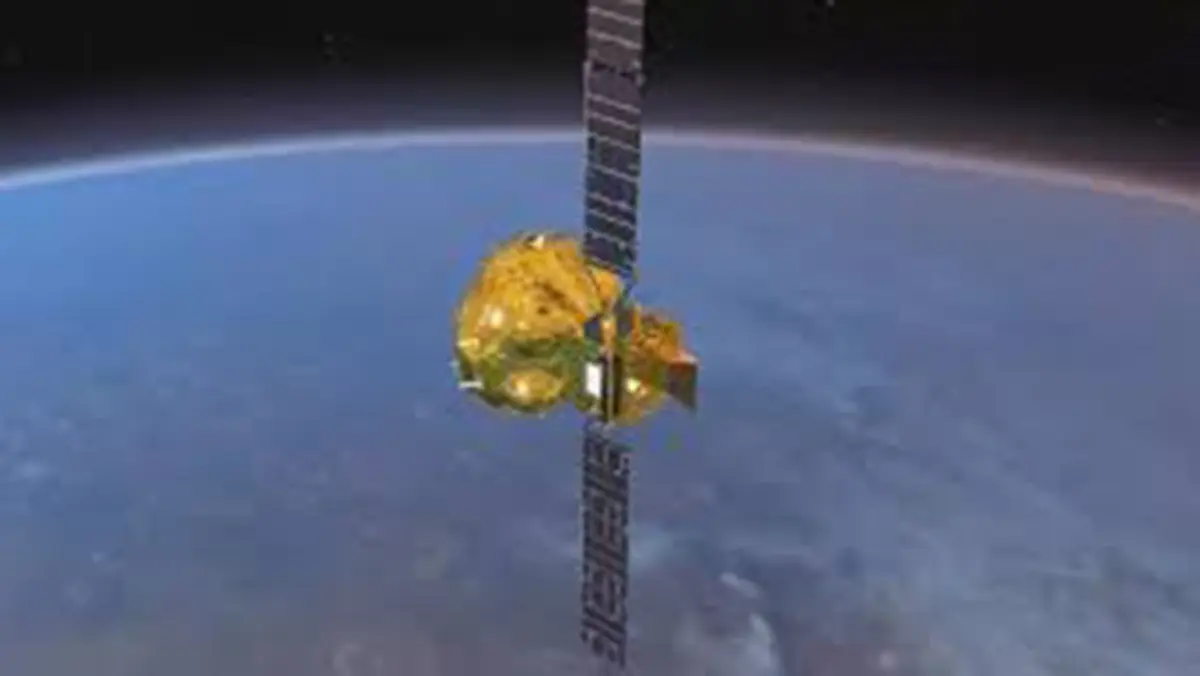
Why in News? On 19 May 2026 the Solar wind Magnetosphere Ionosphere Link Explorer (SMILE) spacecraft launched aboard a Vega‑C rocket from Europe’s Spaceport in French Guiana. This joint mission by the European Space Agency (ESA) and the Chinese Academy of Sciences (CAS) will study how the solar wind interacts with Earth’s magnetosphere, providing the first global images of our planet’s magnetic shield.
Background
Earth is continuously bombarded by a stream of charged particles called the solar wind. Our planet’s magnetic field deflects most of these particles, creating a protective bubble known as the magnetosphere. When solar storms disturb the magnetosphere, they can trigger brilliant auroras and disrupt satellites, power grids and communication systems. Previous missions have observed these processes locally, but no mission has provided a global view of where and how the solar wind collides with the magnetosphere.
Mission Objectives and Features
- Global imaging: SMILE will be the first mission to observe the magnetosphere in soft X‑ray light. It exploits a phenomenon called “solar wind charge exchange” in which charged particles from the solar wind interact with neutral atoms in Earth’s exosphere, emitting X‑rays. By capturing these emissions, the spacecraft will map the shape and dynamics of the magnetopause and polar cusps.
- Auroral monitoring: An ultraviolet imager (UVI) will continuously observe the northern and southern lights for up to 45 hours at a time, linking auroral patterns to solar‑wind activity. These observations will help scientists understand how energy from the solar wind is deposited in the upper atmosphere.
- In situ measurements: A light ion analyser (LIA) and a magnetometer (MAG) will measure the properties of charged particles and the magnetic field around the spacecraft. Combining remote sensing and in situ data will allow researchers to answer three key questions: Where does the solar wind meet the magnetosphere? What triggers magnetic reconnection on Earth’s night side? How can we predict dangerous magnetic storms earlier?
- International collaboration: SMILE is the first space mission jointly designed, built and operated by ESA and China. ESA provides the payload module, one scientific instrument and the launch vehicle, while CAS supplies the platform, three instruments and mission operations. After a month‑long transit to a highly elliptical orbit, scientific operations will begin in September 2026. The nominal mission duration is three years.
Significance
Space weather affects everything from satellite operations to aviation and power grids. By capturing the first global images of Earth’s magnetosphere and linking them with auroral and particle data, SMILE will improve our ability to forecast solar storms and protect technology and astronauts. The mission also demonstrates the benefits of international cooperation in space science.
Conclusion
The SMILE mission marks a new era in studying the Sun–Earth connection. Its innovative X‑ray imaging technique will provide a “big picture” of the magnetosphere, complementing the detailed measurements of past missions. As climate and technology make our societies more dependent on space‑based systems, understanding space weather is more important than ever.
Sources: IE,