
Why in news?
Scientists from the Indian Institute of Astrophysics (IIA) analysed over a century of solar observations from the Kodaikanal Solar Observatory to study how supergranulation – large convection cells on the Sun’s surface – varies during the solar cycle. Their results, published in 2026, reveal strong links between supergranular properties and sunspot activity.
Background
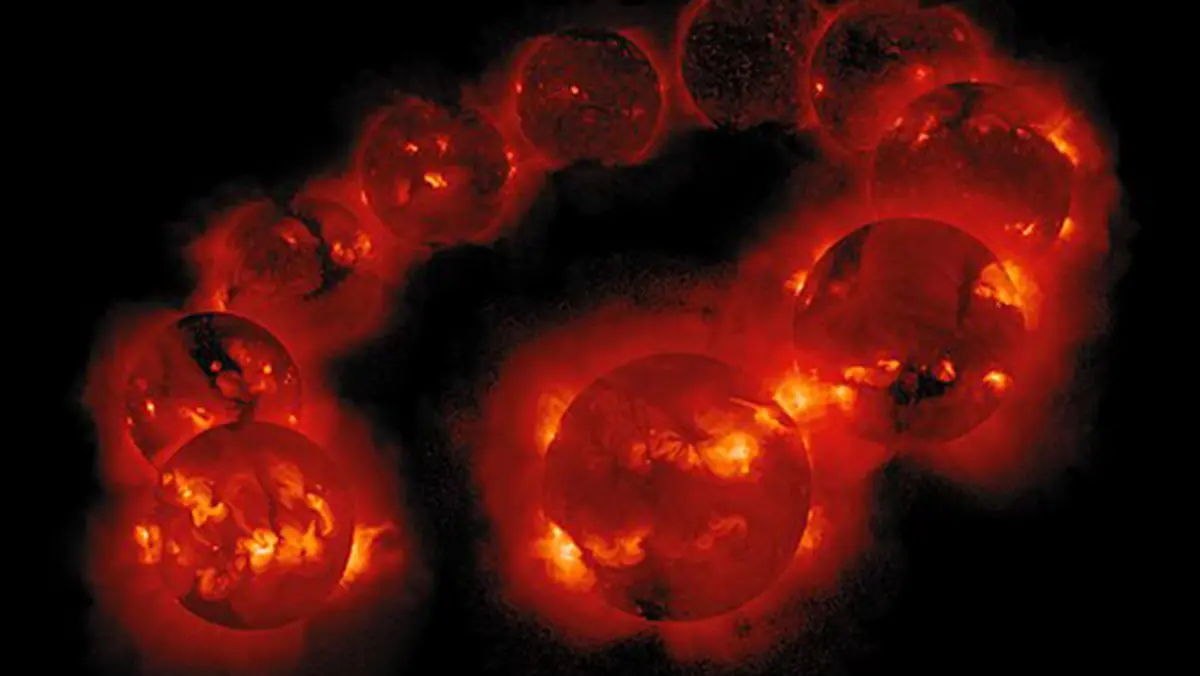
The Sun follows an 11‑year magnetic cycle during which sunspot numbers rise and fall. Periods of high sunspot activity are called solar maxima, while lulls are known as minima. Solar activity influences space weather, radio communications and even climate on Earth. Supergranulation refers to a pattern of giant convection cells on the solar surface. Each cell is roughly 30,000 kilometres across and lasts about a day. The bright interiors represent upwelling hot plasma, while dark intergranular lanes represent downflows of cooler material. Understanding how these cells change during the solar cycle helps scientists refine models of the solar dynamo.
Key findings
- Data set: Researchers examined calcium (Ca II K) spectroheliograms recorded at Kodaikanal since 1907. The data set spans more than 100 years, making it one of the longest continuous solar records.
- Lane width variation: The widths of the dark intergranular lanes average around 6,000 kilometres. They were observed to widen during solar maximum, suggesting that stronger magnetic fields influence convection patterns.
- Brightness lag: The brightness of supergranular interiors peaked about 1.25–1.5 years after the sunspot maximum. This lag varied with latitude, indicating that supergranulation may respond differently depending on solar latitude.
- Correlation with sunspot numbers: At certain latitudes, supergranular properties showed a strong correlation with sunspot counts. This supports the hypothesis that local magnetic flux influences convection.
Significance
- Predicting solar activity: The observed lag between sunspot peaks and supergranulation brightness may improve predictions of solar cycle phases, which is important for space weather forecasting.
- Unique long‑term data: The study underscores the value of preserving and digitising historic observations. Few observatories have continuous records spanning a century.
- Contribution to solar physics: Understanding supergranulation aids in refining models of the solar magnetic dynamo that generates the cycle of sunspots and solar flares.
Conclusion
By combining heritage data with modern analysis, researchers have deepened our understanding of how the Sun’s convection patterns evolve through its magnetic cycle. Continued observations will be critical to anticipate space weather and comprehend our star’s behaviour.