
Why in news?
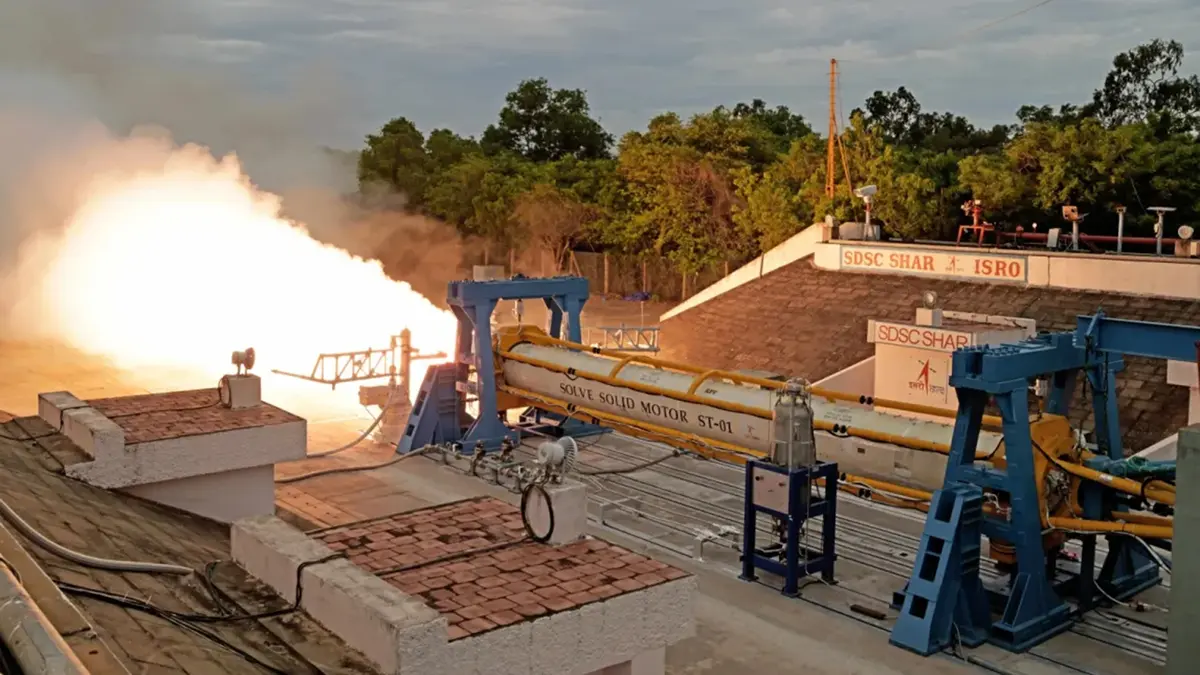
On 3 July 2026 the Indian Space Research Organisation (ISRO) successfully conducted a static ground test of the new Sub‑Orbital Launch Vehicle for Experiments (SOLVE). The test took place at the Satish Dhawan Space Centre in Sriharikota. SOLVE will be used to validate the parachute‑based deceleration system of the crew module for India’s Gaganyaan human spaceflight programme. The development is a critical milestone ahead of crewed flight tests.
Background
Gaganyaan aims to send a three‑member Indian crew to low‑Earth orbit and safely return them. To ensure safe recovery, ISRO must test the parachute systems that will slow down the crew module during re‑entry. SOLVE is a single‑stage solid rocket derived from the Polar Satellite Launch Vehicle’s strap‑on motor but modified to burn slowly and provide stable flight. The vehicle will carry the crew module to an altitude between 10 and 17 kilometres before separation, after which a series of parachutes will deploy.
Important features
- Solid motor: SOLVE uses a solid propellant motor with a slow burn rate. This ensures a longer boost phase and smoother ascent.
- Thrust vector control: A straight nozzle fitted with secondary injection thrust vector control allows precise steering during flight.
- Parachute tests: The crew module will be equipped with ten parachutes that deploy in stages, slowing the module for a splashdown in the sea.
- Flexibility: Because the vehicle is sub‑orbital, engineers can vary flight trajectories and re‑entry conditions to simulate different scenarios for Gaganyaan.
Conclusion
The successful ground test of SOLVE demonstrates progress toward India’s first crewed space mission. By using a dedicated sub‑orbital vehicle, ISRO can refine parachute deployment systems without risking astronauts. The data gathered from upcoming flight tests will help ensure the safety of Gaganyaan crews.