
Why in news?
Sooty bark disease has emerged as a growing threat to maples in British Columbia, Canada. The province confirmed the disease after cases appeared near Vancouver during 2022. Hot and dry conditions can activate hidden infections and weaken affected trees. Canada’s native bigleaf maple is among the important hosts now under observation.
Background
Sooty bark disease is caused by the microscopic fungus Cryptostroma corticale.
The fungus infects maple trees and may remain hidden inside apparently healthy tissue.
Severe heat, drought and water stress can trigger rapid fungal growth and visible damage.
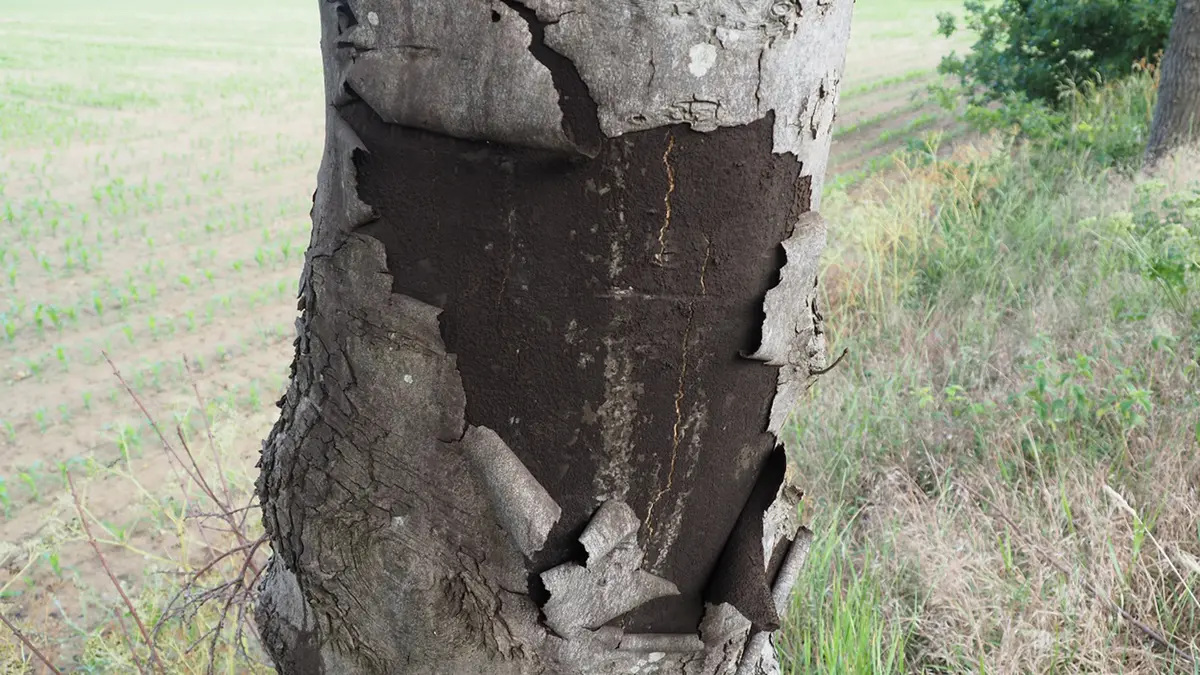
Dark masses of spores develop beneath loosening bark, producing the characteristic sooty appearance.
Hosts and geographical history
Important hosts include sycamore maple, Norway maple and North America’s native bigleaf maple.
The fungus occurs naturally around the Great Lakes region of North America.
It became an introduced tree disease in several European countries.
Records from the Pacific Northwest began during the late 1960s.
British Columbia confirmed its first recognised case near Vancouver during 2022.
Researchers had recorded more than thirty provincial observations by March 2024.
How does the disease develop?
- Fungal spores enter through wounds, damaged branches or other vulnerable tissues.
- The organism may persist quietly as an endophyte without immediate external symptoms.
- Heat and drought reduce the tree’s defences while favouring fungal activity.
- Bark cracks and lifts as large numbers of dark spores accumulate underneath.
- Repeated damage can cause crown dieback, structural weakness and eventual tree death.
Poor soils, intense sunlight and compacted ground can worsen water stress around urban maples.
Human-health concern
Heavy, prolonged exposure to airborne spores can rarely cause hypersensitivity pneumonitis.
This inflammatory lung condition has historically affected sawmill workers and people processing contaminated wood.
Casual outdoor exposure presents a much lower risk than repeated occupational contact.
Workers handling infected trees should follow professional respiratory and containment guidance.
Management options
No treatment can reliably cure a tree after advanced infection develops.
However, “no cure” does not mean that authorities have no management choices.
- Mixed tree planting prevents one susceptible species from dominating an entire stand.
- Reducing soil compaction improves root access to water and oxygen.
- Mulching and appropriate watering can reduce drought stress during severe heat.
- Professionals should remove dangerous infected trees during cool or humid conditions.
- Wood and bark require controlled handling because movement can spread fungal material.
The Canadian Forest Service is developing field tests that could accelerate reliable diagnosis.
Why climate matters
Climate change does not create the fungus, but extreme heat can favour disease expression.
Longer droughts leave urban and natural maples less able to contain latent infections.
Tree-health monitoring therefore provides useful evidence about interacting climate and disease pressures.
Conclusion
Early detection, safer tree handling and reduced drought stress offer the most practical response.