
Why in news?
The Vietnamese cargo vessel Khoi Nguyen 18 sank near Fiery Cross Reef. It carried 62 Vietnamese nationals during bad weather on 25 July. Rescuers from several countries joined the urgent search operation. The accident again focused attention on the disputed South China Sea.
Background
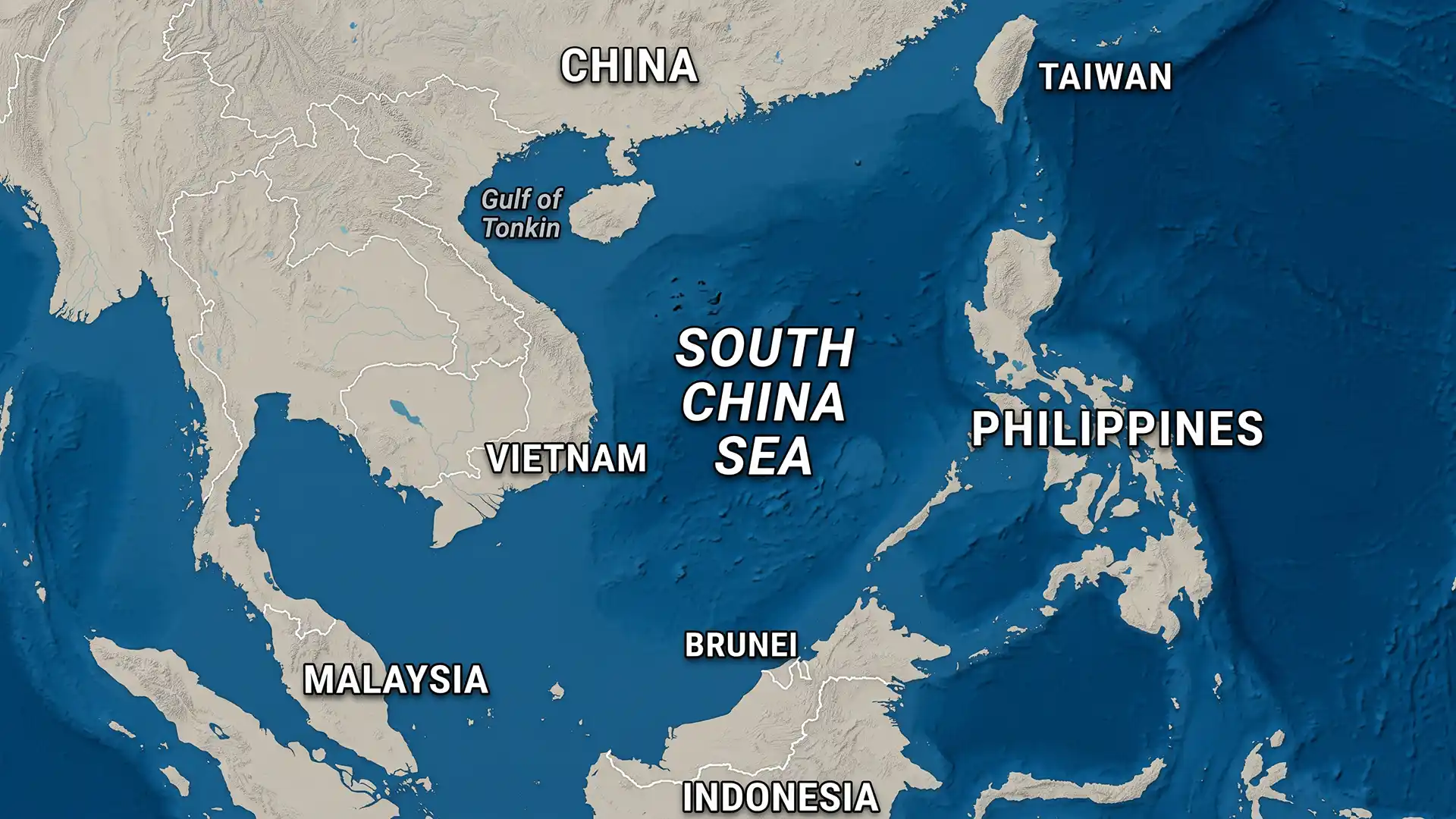
The South China Sea is a large marginal sea in the western Pacific Ocean.
It lies between mainland Southeast Asia, the Philippines, Borneo and southern China.
Vietnam calls these waters the East Sea, while the Philippines uses West Philippine Sea.
What happened to the vessel?
- The vessel met severe weather near Fiery Cross Reef on 25 July.
- A Chinese rescue ship noticed a distress signal, and multinational resources later supported the search.
- Reports confirmed 46 rescues by late 26 July.
- The search continued for the remaining people at that reporting stage.
Early reports carried different rescue totals because the operation was still changing.
Location and sea connections
| Direction | Land or water connection |
|---|---|
| North | Southern China and the Taiwan Strait lie towards this side. |
| East | The Philippines and Luzon Strait connect with the Pacific. |
| South | Borneo and nearby Indonesian waters form the southern boundary. |
| West | Vietnam and the Indochinese Peninsula border these waters. |
| Southwest | The Strait of Malacca links wider routes towards the Indian Ocean. |
This position places the sea between East Asian factories and major global markets.
Important island groups and features
- Paracel Islands: China controls them, while Vietnam also claims them.
- Spratly Islands: Several countries occupy different reefs, islands and outposts.
- Scarborough Shoal: China and the Philippines dispute this fishing area.
- Pratas Islands: Taiwan administers this island group in the northeast.
- Fiery Cross Reef: China has developed a large artificial island there.
Most natural features are tiny, even though surrounding maritime claims cover vast waters.
Why is the sea strategically important?
- Major shipping routes carry goods, while these waters support fishing communities across neighbouring countries.
- Seabed resources and military submarine routes give the area both economic and defence importance.
- Undersea communication cables also cross the wider maritime region.
Who claims what?
China, Taiwan and Vietnam claim several island groups; the Philippines, Malaysia and Brunei claim nearer coastal areas.
Indonesia claims no Spratly island, but rejects overlaps near the Natuna Islands.
China often represents its broad claim through a dashed line on maps.
Law of the sea
The United Nations Convention on the Law of the Sea (UNCLOS) provides the main legal framework.
| Maritime zone | General limit | Main meaning |
|---|---|---|
| Territorial sea | Up to 12 nautical miles | The coastal state exercises sovereignty, subject to lawful passage. |
| Contiguous zone | Up to 24 nautical miles | The state may enforce selected customs and security laws. |
| Exclusive Economic Zone | Up to 200 nautical miles | The state has resource rights, but not complete sovereignty. |
| Continental shelf | At least 200 nautical miles where geography permits | The state holds rights over seabed resources. |
An Exclusive Economic Zone (EEZ) gives resource rights within 200 nautical miles.
Other states still retain navigation and overflight freedoms inside that zone.
Chronology of the dispute
| Year | Development |
|---|---|
| 1974 | China took full control of the Paracels after fighting South Vietnam. |
| 1988 | Chinese and Vietnamese forces clashed near Johnson South Reef. |
| 2002 | China and Southeast Asian states signed a non-binding conduct declaration. |
| 2013 | The Philippines began arbitration proceedings under the maritime convention. |
| 2016 | An arbitral tribunal issued its major award on maritime entitlements. |
What did the 2016 award decide?
The tribunal found no legal basis for sweeping historic rights beyond convention limits.
It also found that no Spratly feature could generate a full exclusive zone.
The tribunal did not decide island ownership or maritime boundaries, and China rejected the entire proceeding.
Why does the rescue matter?
Search operations need fast coordination, while maritime practice expects nearby ships to assist people in danger.
The episode shows that practical cooperation remains possible during unresolved disputes.
India’s interest
India relies on safe Indo-Pacific routes and supports peaceful dispute settlement under international law.
Indian companies have also explored energy blocks offered by Vietnam.
Conclusion
The shipwreck shows both the sea’s dangers and the value of regional cooperation.