

Why in news?
NASA announced that its SPHEREx spacecraft recently observed the interstellar comet 3I/ATLAS, which passed through the inner Solar System in late 2025. The infrared telescope detected molecules such as methanol, hydrogen cyanide and methane in the comet’s coma and found that the comet brightened significantly only after it rounded the Sun. The discovery underscores SPHEREx’s ability to monitor transient events while it maps the entire sky.
Background
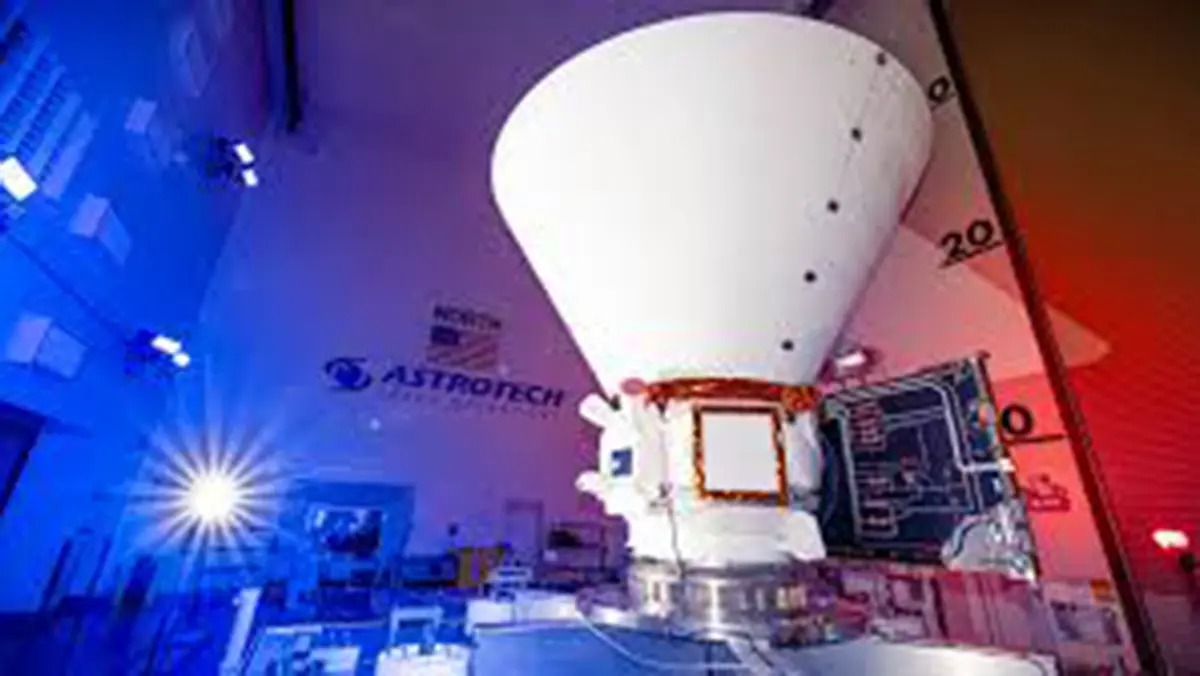
SPHEREx (Spectro‑Photometer for the History of the Universe, Epoch of Reionization and Ices Explorer) is a NASA mission launched on 11 March 2025. Orbiting in a polar sun‑synchronous path, the spacecraft uses three telescopes to survey the sky in 102 infrared colours every six months. Its primary goals are to study the cosmic inflation that occurred fractions of a second after the Big Bang, map the large‑scale distribution of galaxies and examine icy molecules in interstellar clouds. Beyond cosmology, SPHEREx’s rapid all‑sky scans allow it to detect comets, asteroids and other transient objects.
The comet 3I/ATLAS is only the third known interstellar object observed passing through our Solar System, following 1I/‘Oumuamua and 2I/Borisov. Discovered by the Asteroid Terrestrial‑impact Last Alert System (ATLAS) in 2023, it traveled on a hyperbolic orbit that brought it around the Sun in November 2025. Because such visitors formed around other stars, studying their composition provides clues to planetary formation beyond our own neighbourhood.
Key findings from SPHEREx
- Detection of complex molecules: SPHEREx’s infrared spectra revealed signatures of methanol (wood alcohol), hydrogen cyanide and methane in the comet’s atmosphere, indicating that these volatiles were preserved during its interstellar voyage.
- Delayed brightening: The comet remained relatively faint during its approach to the Sun. Only after rounding perihelion did it brighten, suggesting that ices buried deep inside the nucleus began to sublimate after absorbing heat.
- Comprehensive coverage: Because SPHEREx scans the entire sky every six months, it was able to observe 3I/ATLAS multiple times, tracking changes in brightness and composition over several days.
- Mission versatility: These observations demonstrate that a mission designed for cosmology can also contribute to planetary science by capturing rare events without dedicated target scheduling.
Significance
- Insights into building blocks of life: Identifying organic molecules on interstellar visitors helps researchers understand how common the ingredients for life might be in other planetary systems.
- Understanding cometary behaviour: The delayed release of gases hints at thermal and structural properties of comet nuclei, informing models of comet evolution.
- Proof of concept for all‑sky missions: SPHEREx shows that survey telescopes can respond to transient phenomena without interrupting primary science goals.
Conclusion
SPHEREx’s observations of 3I/ATLAS offer a glimpse of material from beyond the Solar System and illustrate the mission’s broad scientific reach. As the telescope continues mapping the heavens, more such serendipitous discoveries are likely to enrich our understanding of cosmic history and planetary chemistry.
Sources: NASA (JPL)