

Why in news?
Researchers have discovered fossils of a new species of meat‑eating dinosaur, Spinosaurus mirabilis, in the central Sahara Desert of Niger. The find, published in the journal Science, reveals a distinctive predator that lived about 95 million years ago.
Background
The genus Spinosaurus was first described in 1915 from fossils of S. aegyptiacus unearthed in Egypt. These dinosaurs were known for their elongated skulls, conical teeth and sail‑like structures formed by tall vertebral spines. The new species was excavated by an international team led by Professor Paul Sereno from the University of Chicago. The fossils were recovered from the Jengueb region, a remote inland habitat dissected by rivers and once lush with vegetation. The discovery marks only the second species of Spinosaurus identified to date.
Key findings
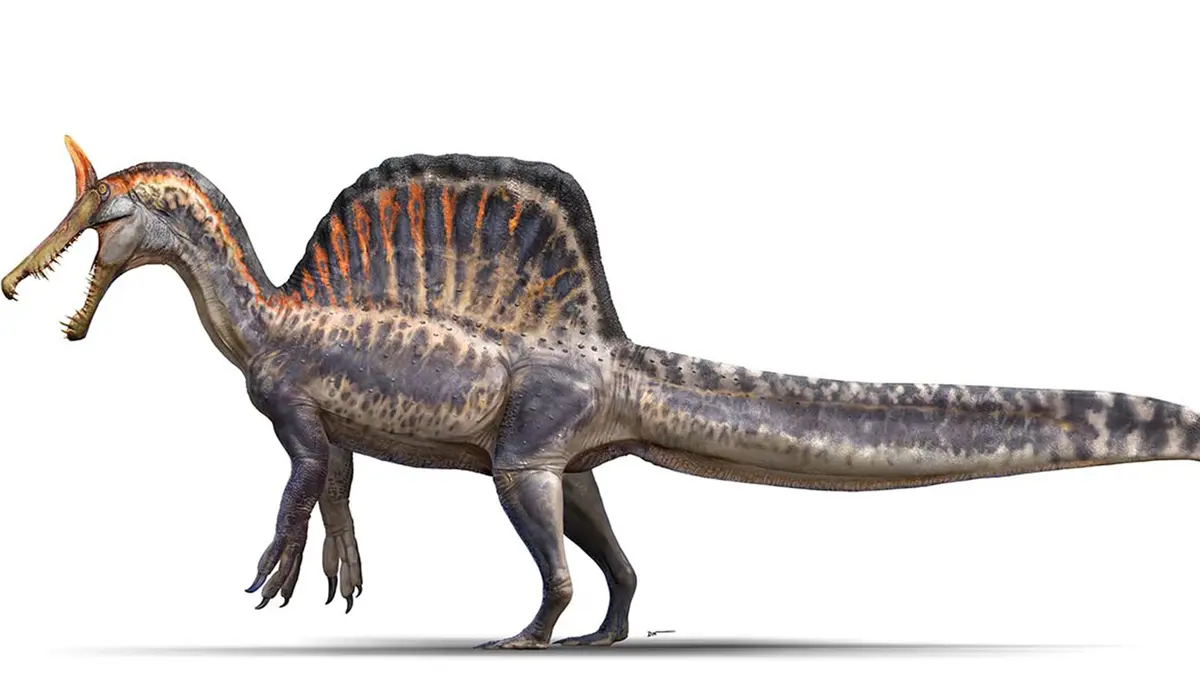
- Astonishing crest: S. mirabilis possessed a massive, scimitar‑shaped cranial crest roughly 50 cm long. Analysis of the crest’s surface texture and vascular canals suggests it was sheathed in keratin and likely brightly coloured for display.
- Fish‑eating adaptations: The dinosaur’s interlocking conical teeth formed a “fish trap,” allowing it to catch slippery prey. Its elongated snout, long hind limbs and partially aquatic lifestyle indicate it hunted both on land and in shallow waters.
- Comparison with S. aegyptiacus: While both species shared sail‑like back spines, mirabilis had a larger crest, longer legs and a more elongated snout.
Significance
- Expanding knowledge: The discovery adds to our understanding of spinosaurid diversity and their ecological roles in Cretaceous ecosystems.
- Palaeo‑environmental insights: Fossils from the Sahara provide evidence that this region once hosted forested waterways supporting large fish and semi‑aquatic predators.
- Public interest: Such discoveries inspire curiosity about Earth’s deep past and highlight the importance of protecting fossil sites from looting and climate erosion.
Source: Mint