
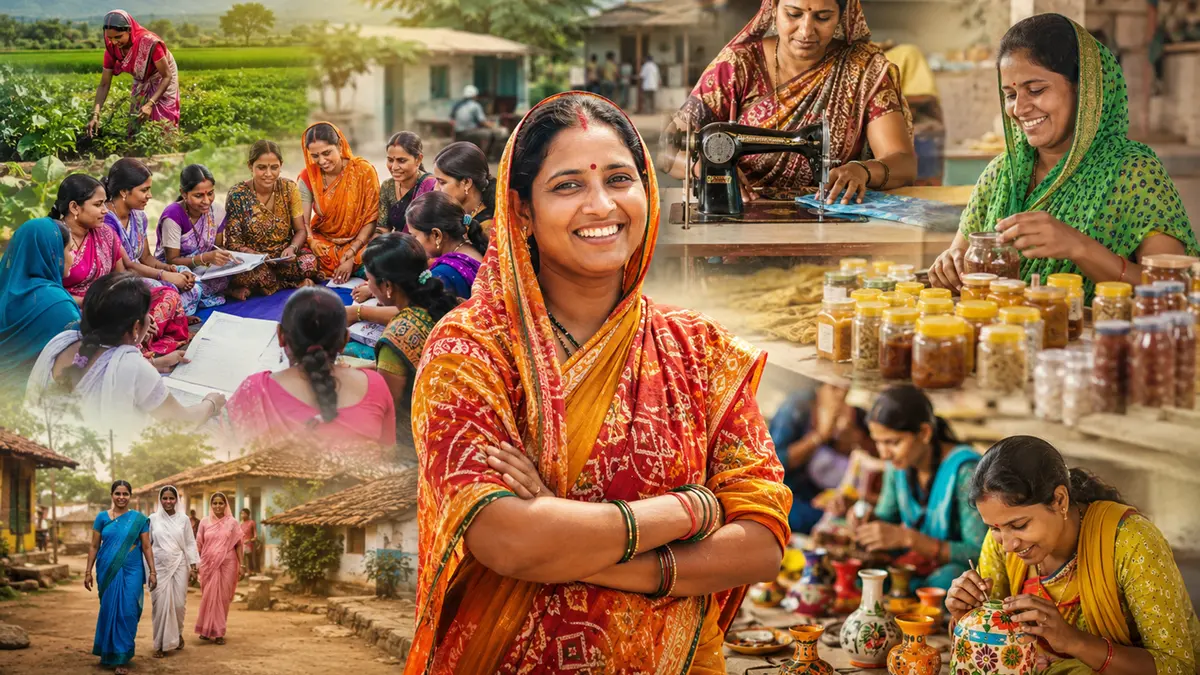
Why in news?
A government review highlighted the programme’s progress during July 2026. It had supported over 4.32 lakh rural enterprises by June 2026. Around 86 per cent of entrepreneurs came from disadvantaged social groups. The programme combines community finance, business training and local mentoring.
Background
The Start-Up Village Entrepreneurship Programme (SVEP) began during 2016 as a sub-scheme under the Union Government’s rural livelihoods mission.
The parent Deendayal Antyodaya Yojana–National Rural Livelihoods Mission (DAY-NRLM) operates through the Ministry of Rural Development.
DAY-NRLM first organises poor rural households into community groups, mainly women’s groups.
These Self-Help Groups (SHGs) encourage regular savings, internal lending and stronger access to formal banking services.
SVEP uses this established community network to develop locally suitable and financially viable small non-farm businesses.
What kind of “start-up” does SVEP support?
SVEP does not mainly target high-growth technology companies seeking large amounts of private venture-capital funding.
It supports practical village enterprises that serve nearby customers, larger markets or local production chains.
- A member may start food processing, tailoring or repair services.
- A family may expand a shop, transport service or small workshop.
- A producer may improve packaging and market access for local goods.
- An entrepreneur may establish a service missing within nearby villages.
Why was the programme needed?
Rural entrepreneurs often lack acceptable collateral, formal business records, practical training and reliable information about nearby markets.
Formal lenders may consider a new and untested village business risky without records or a tested business plan.
Even after receiving initial finance, first-time entrepreneurs need regular problem-solving support during difficult early business stages.
SVEP therefore combines finance with planning, mentoring and local institutional oversight.
How does support reach an entrepreneur?
- Community organisations identify interested SHG members or their family members.
- Local mentors assess the proposed product, customers, costs and competition.
- A simple business plan tests whether the enterprise can remain viable.
- The entrepreneur receives relevant financial and business-management training.
- Community organisations examine and approve eligible enterprise loans.
- Local mentors assist with purchasing, bookkeeping, pricing and market links.
- Digital systems track finance, activity and enterprise performance.
Institutions behind the programme
| Institution | Role |
|---|---|
| State Rural Livelihood Mission | It manages implementation within the concerned state. |
| Block Resource Centre–Enterprise Promotion | It coordinates enterprise services across a participating block. |
| Community Resource Person–Enterprise Promotion | This trained local mentor supports planning, finance and operations. |
| Self-Help Group federations | They identify entrepreneurs, approve support and monitor repayments. |
| Community Enterprise Fund | It provides community-managed loan capital for viable enterprises. |
| Banks and linked schemes | They provide additional credit for eligible entrepreneurs. |
SVEP can also converge with suitable credit schemes such as Pradhan Mantri Mudra Yojana.
Convergence means combining suitable and non-duplicative support from more than one public programme.
Rules for community mentors
- At least 90 per cent of mentors come from SHG households.
- Women must form at least 60 per cent of this cadre.
- Each mentor may support up to 50 enterprises.
- Selection includes testing, training and certification.
- Local residence and basic mathematical skills receive preference.
Financial design
The programme provides up to ₹6.50 crore for services and enterprise support within an implementing block.
The stated average programme investment is ₹27,083 for each supported enterprise across participating blocks.
The Union Government had released a cumulative central share of ₹942.09 crore by February 2026.
The release was 738 per cent above the cumulative January 2018 figure.
Scale and inclusion by June 2026
| Indicator | Reported position |
|---|---|
| Rural enterprises supported | More than 4.32 lakh enterprises had received support. |
| Social inclusion | Around 86 per cent came from specified disadvantaged groups. |
| Women beneficiaries | Programme design requires women to form at least 60 per cent. |
| DAY-NRLM mobilisation | Over 10.29 crore households had joined SHGs by mid-June. |
| Leading states by supported enterprises | Assam, Bihar, Jharkhand, West Bengal and Madhya Pradesh led. |
These groups include Scheduled Castes, Scheduled Tribes, Other Backward Classes and recognised minority communities.
What did the mid-term study find?
The Quality Council of India conducted the ministry’s mid-term evaluation, with major field assessments during 2019.
- About 99 per cent of assessed supported enterprises were profitable.
- Enterprise income formed 57 per cent of total household income.
- Average monthly enterprise revenue was around ₹39,000.
- Manufacturing enterprises averaged ₹47,800 in monthly revenue.
- About 96 per cent of entrepreneurs reported increased savings.
- Women owned or managed 75 per cent of assessed enterprises.
Why community ownership matters
Local organisations understand household conditions, while community mentors can visit nearby enterprises frequently at relatively low cost.
Regular community monitoring may improve repayment discipline, record keeping and early detection of operational problems.
However, transparent selection remains essential to prevent favouritism or weak appraisal.
Conclusion
SVEP builds rural businesses through patient mentoring, suitable credit and accountable community institutions.