
Why in news?
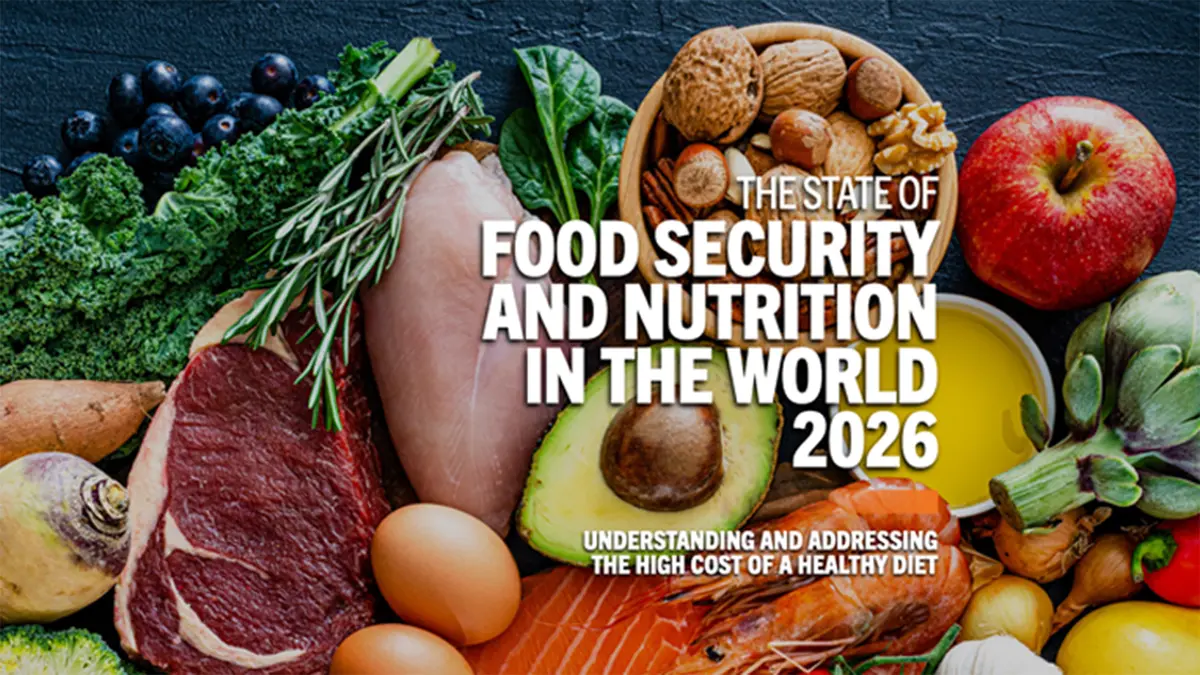
Five United Nations bodies released the 2026 food-security report on 21 July. Global hunger declined for a third consecutive year during 2025. However, about 645 million people still faced hunger. Africa now contains the world’s largest absolute number of hungry people.
Background
The report is the United Nations system’s main annual assessment of hunger and malnutrition across countries and regions.
Its short name is State of Food Security and Nutrition in the World (SOFI), which appears annually.
Five organisations jointly prepare SOFI because food security involves agriculture, health, children and development.
| Organisation | Main role relevant to the report |
|---|---|
| Food and Agriculture Organization of the United Nations (FAO) | It leads international work on agriculture, food and hunger measurement. |
| International Fund for Agricultural Development (IFAD) | It finances rural development and smallholder livelihood programmes. |
| United Nations Children’s Fund (UNICEF) | It focuses on children’s nutrition, health and development. |
| World Food Programme (WFP) | It provides emergency food assistance and strengthens food systems. |
| World Health Organization (WHO) | It tracks nutrition-related health and supports global health standards. |
The 2026 theme is “Understanding and addressing the high cost of a healthy diet.”
The report also measures global progress towards Sustainable Development Goal 2, commonly called Zero Hunger.
Four terms that must not be confused
| Term | Simple meaning |
|---|---|
| Hunger or undernourishment | Usual food intake does not provide enough dietary energy. |
| Food insecurity | Reliable access to enough safe and nutritious food is uncertain. |
| Malnutrition | Nutrition is inadequate, excessive or unbalanced in some important way. |
| Healthy-diet unaffordability | Income remaining after essential expenses cannot purchase a healthy diet. |
Major global findings for 2025
| Indicator | Latest estimate | Earlier comparison |
|---|---|---|
| People facing hunger | About 645 million, or 7.8 per cent. | The share was 8.1 per cent during 2024. |
| Moderate or severe food insecurity | About 2.1 billion, or 25.8 per cent. | The share was 27.1 per cent during 2024. |
| Healthy diet unaffordable | About 2.69 billion, or 32.7 per cent. | The figure was 2.97 billion during 2021. |
| Average healthy-diet cost | 4.28 purchasing-power-parity dollars per person daily. | The cost was 3.44 such dollars during 2021. |
A purchasing-power-parity dollar adjusts for national purchasing power, unlike simple market exchange-rate conversion.
Regional picture
- Africa had about 309 million hungry people during 2025 under the latest modelled estimates.
- Asia had about 292 million hungry people during 2025 under the same measurement approach.
- Africa therefore had the largest absolute hungry population.
- Africa’s hunger share declined slightly from 20.3 to 20.0 per cent.
- About 56.6 per cent of Africans faced moderate or severe food insecurity.
- About 66.6 per cent of Africans could not afford a healthy diet.
Asia and Latin America showed steadier improvements, while Africa’s progress remained fragile.
Why can a healthy diet cost so much?
A healthy diet needs adequate, balanced, diverse and moderate food choices.
Fruit, vegetables and animal-source foods usually cost more than starchy staples in many local markets.
Farming represents only one part of the final consumer price within a much longer value chain.
Post-farmgate activities contribute around 70 to 75 per cent of consumer prices.
Processing, logistics and wholesale may together contribute up to 40 per cent.
- Poor roads raise the expense of transporting perishable food.
- Weak cold chains increase spoilage before food reaches markets.
- Energy and fertiliser shocks increase production and distribution costs.
- Market concentration can weaken competition along the food chain.
- Conflict and extreme weather can disrupt both supply and household income.
Global nutrition remains a mixed picture
About 150 million children below five remained stunted, meaning low height for age after prolonged deprivation or illness.
Only 30.8 per cent of children aged 6–23 months received minimum dietary diversity.
Adult obesity increased from 12.1 per cent during 2012 to 16.2 per cent during 2024.
Anaemia among women aged 15–49 also continued worsening globally.
India’s long-term movement
| Indicator | Earlier estimate | Latest estimate |
|---|---|---|
| Undernourishment | 21.1 per cent, or 243.9 million, during 2004–06. | 9.8 per cent, or 142.5 million, during 2023–25. |
| Healthy diet unaffordable | The comparable figure varies by selected base year. | 520.1 million people, or 35.5 per cent, during 2025. |
| Child stunting | 41.7 per cent during 2012. | 32.9 per cent during 2024. |
| Child wasting | Comparable annual estimates require careful reading. | 18.7 per cent during 2024. |
| Child overweight | 2.1 per cent during 2012. | 3.7 per cent during 2024. |
| Anaemia among women aged 15–49 | 50.1 per cent during 2012. | 53.7 per cent during 2024. |
India’s average healthy diet cost reached 4.11 purchasing-power-parity dollars per person daily during 2025.
This amount was roughly 48 per cent higher than during 2017.
How should these estimates be interpreted?
Undernourishment is a modelled population estimate, not a count from household visits.
It combines food availability, consumption distribution and minimum energy requirements.
Countries often receive three-year averages because modelled annual estimates can fluctuate considerably without showing lasting structural change.
Survey indicators, modelled hunger and measured child growth therefore answer different but related policy questions.
Outlook for 2030
The report projects 510–520 million hungry people during 2030 under conflict-related scenarios.
The earlier pre-conflict scenario produced a lower estimate of about 503 million.
These scenarios do not predict one certain future; they show possible outcomes under selected assumptions.
What policy direction does the report suggest?
- Governments should improve roads, storage, irrigation and cold-chain systems.
- Research should increase nutritious-food productivity under changing climates.
- Trade procedures should reduce avoidable delays and distribution expenses.
- Social protection should protect vulnerable households during price shocks.
- Nutrition programmes should address children, women and adolescent girls directly.
- Policies should reduce food loss without harming small producers’ livelihoods.
Conclusion
Hunger is declining slowly, but affordable nutrition requires stronger incomes and more efficient food systems.