
Why in news?
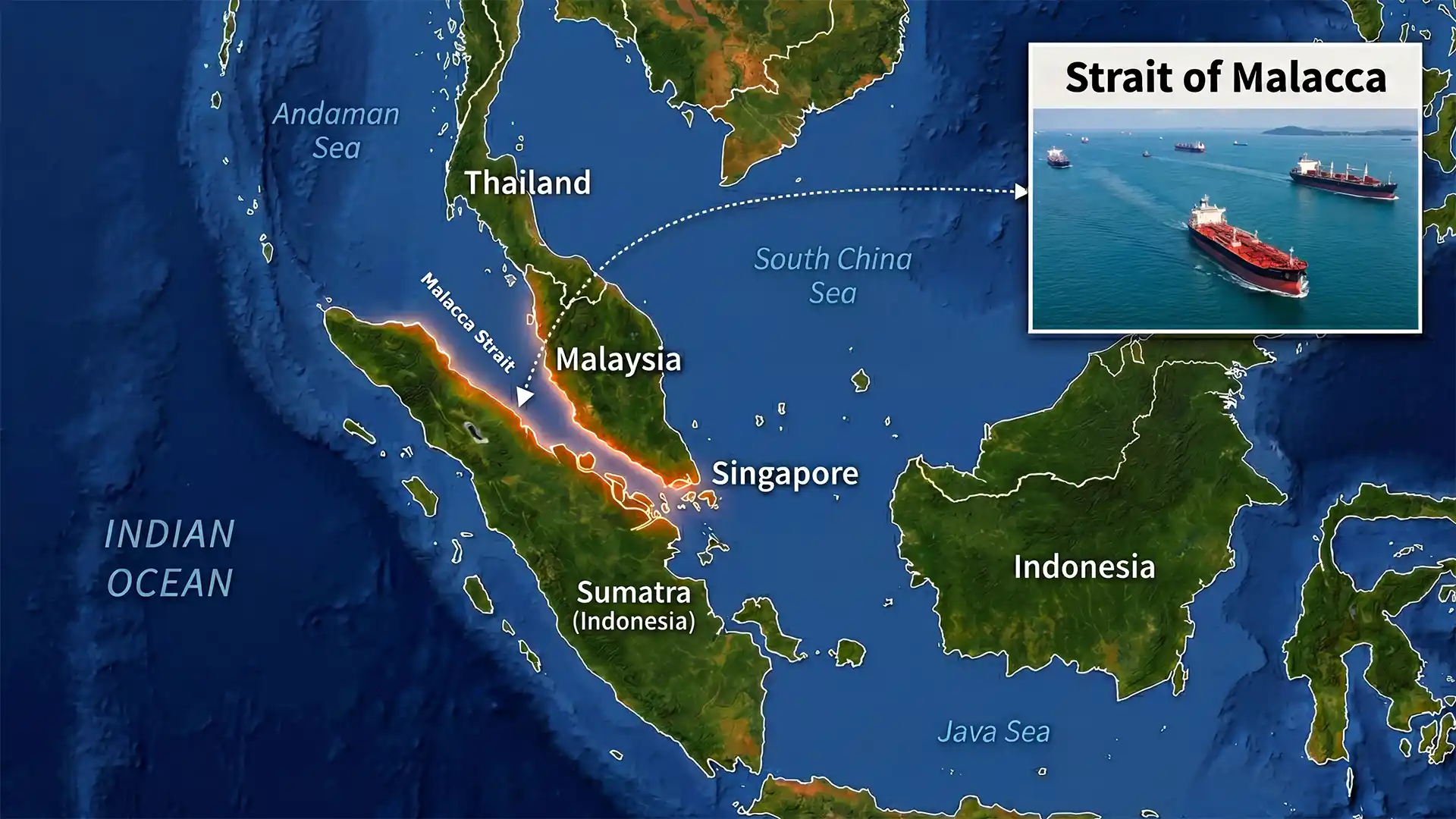
After disruptions in the Persian Gulf, policymakers and analysts have turned their attention to the Strait of Malacca, a narrow waterway that carries nearly a quarter of the world’s maritime trade. Recent commentary highlights its strategic vulnerability and the need for regional cooperation.
Background
The Malacca Strait stretches about 900 km between the Malay Peninsula and the Indonesian island of Sumatra. It links the Indian Ocean with the South China Sea and is bordered by Indonesia, Malaysia, Singapore and Thailand. For centuries it has been a vital route for spice traders, merchants and, more recently, global energy shipments.
Why is the strait important?
- Trade artery: Around one‑fifth of global maritime trade passes through the strait. In the first half of 2025 about 23.2 million barrels of oil per day – roughly 29% of all seaborne oil – moved through Malacca, surpassing the volumes through the Strait of Hormuz.
- Bottleneck: At its narrowest point, the Phillips Channel near Singapore, the passage is only about 2.7 km wide. Shallow depths (25–27 m) and heavy traffic mean collisions, grounding and oil spills are constant risks.
- Energy security: About 75% of China’s seaborne crude oil imports traverse the strait. Japan and South Korea also depend on this route for Middle Eastern energy supplies.
- Piracy and crime: The strait has been a hotspot for piracy. More than a hundred criminal incidents were reported in 2024, although joint patrols by littoral states have reduced attacks.
Current debates
- Indonesian finance officials recently speculated about imposing tolls on ships transiting the strait but later clarified that such charges are not feasible. Neighbouring countries have reaffirmed that the Malacca Strait must remain open and toll‑free.
- Singapore, Malaysia, Indonesia and Thailand conduct coordinated patrols to ensure safety and free passage.
- Analysts warn that tensions in the South China Sea or Taiwan Strait could spill over to Malacca, disrupting trade and raising transport costs.
Impact on India
- India uses the Malacca Strait for oil imports from West Asia and exports to East Asia and Europe. Disruptions would raise freight costs and affect energy prices.
- India supports freedom of navigation and participates in cooperative patrols and maritime security initiatives with ASEAN countries.
- Alternatives like the Lombok–Makassar route around Indonesia exist but add days to journeys and increase costs.
Source: DD News

