

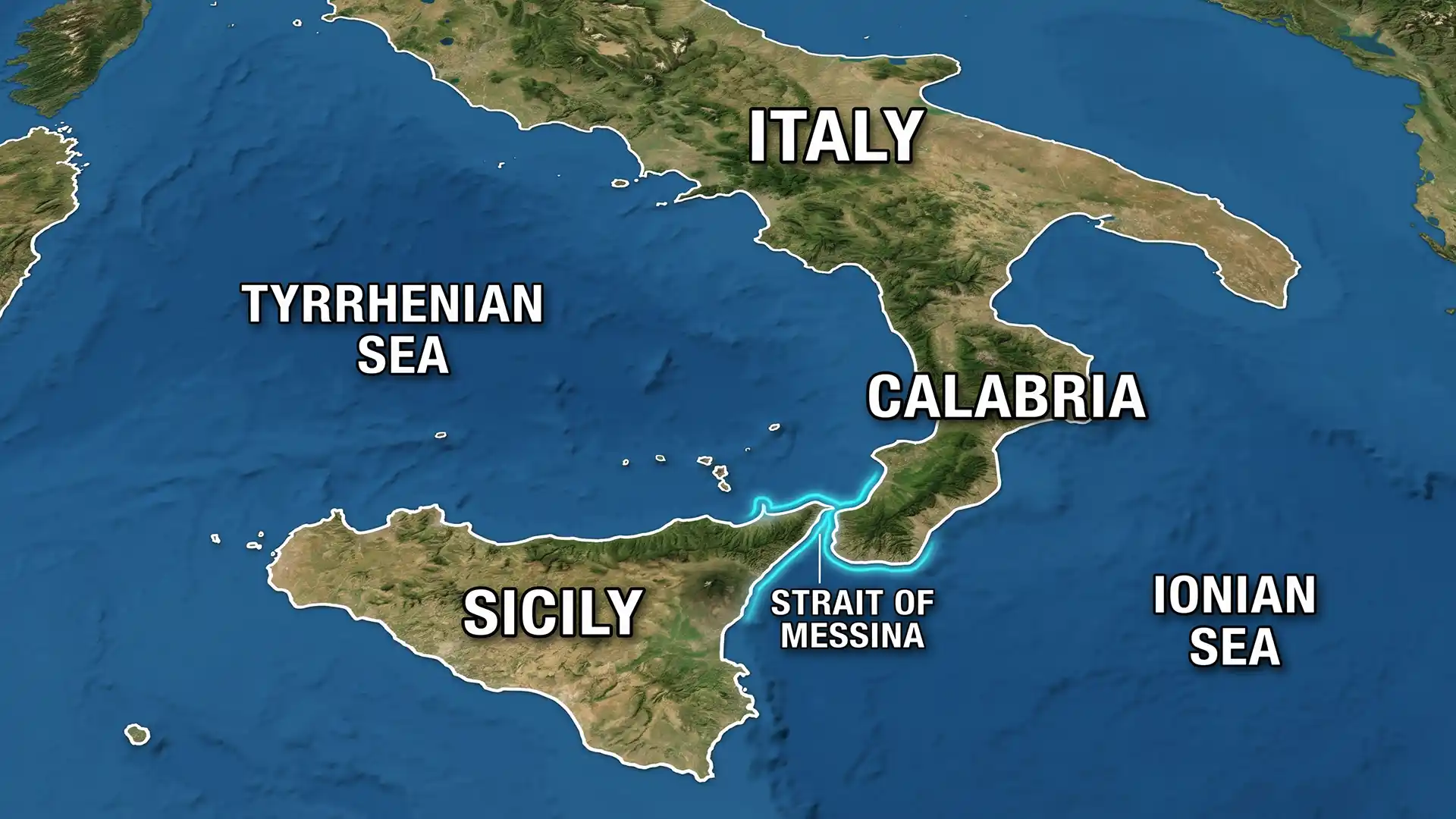
Why in news?
Japan’s Prime Minister recently voiced support for a plan to build a bridge across Italy’s Strait of Messina. The project aims to connect mainland Italy and Sicily and has been repeatedly delayed. Media reports in June 2026 noted that Japanese companies are involved in the consortium and see the bridge as a symbol of bilateral cooperation. Environmental, financial and seismic concerns have kept the project in limbo for decades.
Background
The Strait of Messina is a narrow channel of the Mediterranean Sea between the Italian mainland and the island of Sicily. At its narrowest point it is about 3.1 km wide. Strong currents and whirlpools, personified in Greek mythology as Scylla and Charybdis, made the waters hazardous to ancient sailors. Plans to link Sicily to the mainland date back to the Roman era. Modern proposals gained momentum in the twentieth century, but financial crises, environmental protests and the region’s seismicity stalled progress. In 2012 austerity measures led Italy to shelve an earlier version of the project.
The current proposal
- Bridge design: The proposed bridge would have a central single suspended span of about 3.3 km (3,300 m) and be one of the longest single‑span suspension bridges in the world. It would carry road and rail traffic.
- Consortium: The Eurolink consortium, involving Italian firm Webuild, Japan’s IHI and Spain’s Sacyr, leads the project. Japan’s involvement underlines growing infrastructure cooperation between the two countries.
- Challenges: Critics cite the region’s earthquake risk, potential harm to marine ecosystems and the high estimated cost of about €13.5 billion. Recent corruption investigations have added to the hurdles.
Significance
- Transport benefits: A bridge would reduce ferry reliance and shorten travel times between Sicily and mainland Italy. It could boost trade and tourism across the strait.
- Economic development: Supporters see the project as a catalyst for southern Italy’s development, creating jobs and enhancing regional connectivity.
- Environmental concerns: Opponents worry about ecological damage and argue that funds should instead improve existing infrastructure. Robust seismic design and environmental safeguards would be essential.
Conclusion
The Messina bridge proposal reflects the tension between infrastructure development and environmental caution. With Japanese participation rekindling interest, the project still faces challenges related to cost, seismic risk and ecology. Whether it proceeds will depend on balancing economic benefits against potential hazards.