

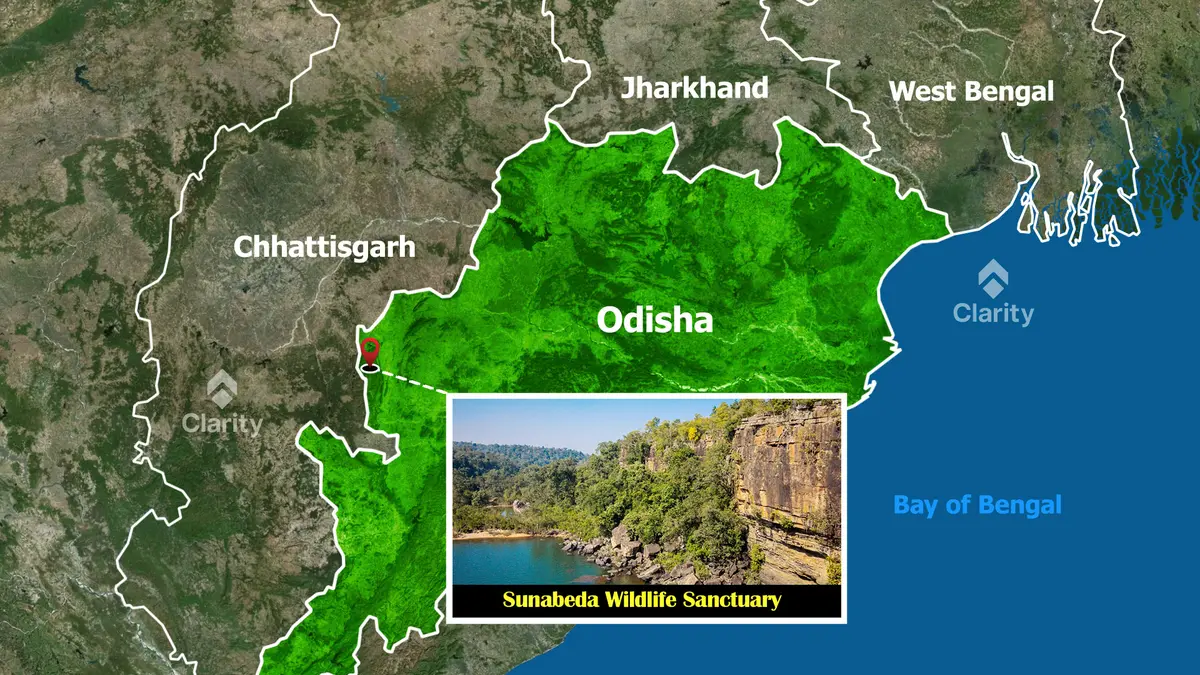
Why in news?
The Sunabeda Wildlife Sanctuary in Nuapada district, Odisha, recently declared ‘Maoist‑free’, is emerging as a promising habitat for leopards. Surveys in 2025‑26 recorded over 70 individuals, highlighting successful habitat management and improved security in an area once hindered by insurgency.
Background
Sunabeda Wildlife Sanctuary covers about 600 square kilometres along Odisha’s border with Chhattisgarh. Notified in 1983, it adjoins the Sitanadi and Udanti sanctuaries in Chhattisgarh, forming a larger forest block. For years the region suffered from Maoist insurgency, which hampered conservation and limited access for forest officials. A decline in tiger numbers was noted; however, restoration efforts and the decline of militant activity have revived wildlife populations.
Physical features
- Terrain: The sanctuary sits on a plateau interspersed with deep canyons and houses 11 waterfalls. Its varied topography creates diverse habitats.
- Water bodies: The Jonk River, a tributary of the Mahanadi, originates within the sanctuary and is dammed to provide irrigation. Wetlands and streams support aquatic life and serve as watering holes.
- Vegetation: Dry deciduous forests dominate, featuring tree species such as teak, bijasal, sissoo, asan, mahua and sandalwood.
Flora and fauna
- Herbivores: The sanctuary is an ideal habitat for barasingha (swamp deer), spotted deer, sambar, gaur and wild boar.
- Carnivores: Leopards, hyenas, sloth bears and occasionally tigers roam the area. Camera traps set in 2025–26 captured leopards in 90% of locations, indicating a robust population.
- Birdlife: The area hosts species such as hill myna and other forest birds.
Importance of recent surveys
- With reduced Maoist influence, forest staff were able to install camera traps widely and collect reliable data on wildlife populations.
- The increase in leopards suggests that prey density and habitat quality are improving.
- Recognition of Sunabeda as a potential leopard haven may attract eco‑tourism and strengthen calls for its notification as a tiger reserve.
Source: The Times of India