
Why in news?
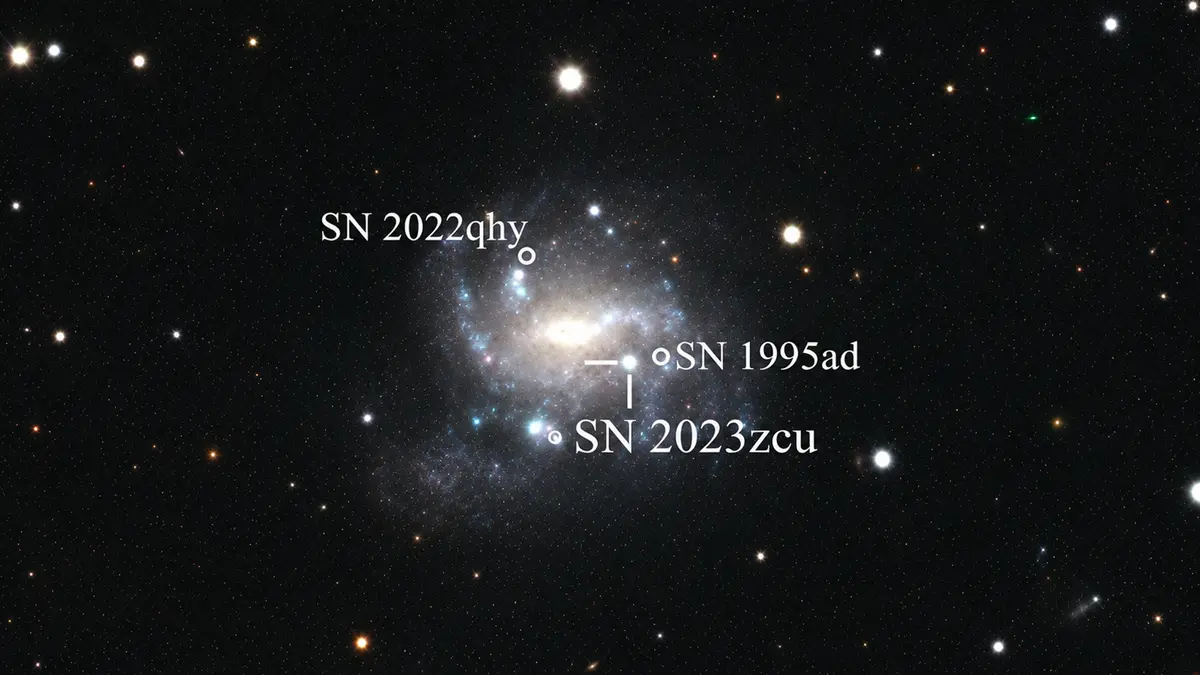
Astronomers around the world continue to study supernovae, the colossal explosions of dying stars. These events help us understand how elements are created and how the universe expands. Questions about supernova types and their frequency often appear in science competitions.
Background
A supernova occurs when a star suddenly increases in brightness and then explodes. Two main types are recognised. Core‑collapse supernovae happen when massive stars (more than eight times the Sun’s mass) exhaust their nuclear fuel. Without outward pressure from fusion, gravity causes the core to collapse in seconds. This collapse triggers shock waves that blow off the outer layers. The explosion produces neutron stars or black holes and sends heavy elements into space. Type Ia or thermal runaway supernovae happen in binary systems. A white dwarf star accretes matter from a companion or merges with another star. When it reaches a critical mass, runaway nuclear reactions cause a bright explosion.
Key points
- Creation of elements: Supernovae forge elements heavier than iron, including gold and uranium. These elements are scattered into space and later become part of new stars, planets and life.
- Cosmic rulers: Type Ia supernovae have nearly uniform brightness. Astronomers use them as “standard candles” to measure distances and study the universe’s expansion.
- Frequency: Supernovae are rare in any one galaxy, occurring a few times per century. However, somewhere in the universe a supernova goes off every few seconds.
- Remnants: After the explosion, a dense core remains. If the remnant’s mass is below about 3 solar masses it becomes a neutron star; otherwise it collapses into a black hole. The expanding gas forms colourful nebulae.
Conclusion
Supernovae are spectacular and essential to cosmic evolution. They enrich the interstellar medium with heavy elements and serve as tools to probe the universe’s size and history. Understanding different supernova types helps scientists refine models of stellar life cycles and the fate of massive stars.