
Why in news?
Taiwan’s long-range radar tracked a Chinese ballistic-missile launch from the South China Sea. China did not publicly identify the missile. Taiwanese officials reportedly considered the Julang-2 submarine-launched ballistic missile, written JL-2, the likely weapon. The event highlighted Taiwan’s powerful early-warning network.
Background
Ballistic missiles rise rapidly and follow a curved path towards their targets. Defenders therefore need reliable detection soon after launch.
During the Cold War, submarines made missile warning more difficult. They could launch weapons much closer to an opponent’s coast.
The United States developed a large phased-array radar system during the 1970s. Its first operational sites began service in 1980.
The system is called the PAVE Phased Array Warning System, or PAVE PAWS. Here, PAVE is a programme code word, and PAWS means Phased Array Warning System.
What is the AN/FPS-115?
The AN/FPS-115 is the original radar model used by PAVE PAWS. Its name is a United States military equipment designation.
It was designed to detect and characterise submarine-launched ballistic missiles. Later, it also tracked satellites and other objects in orbit.
Taiwan purchased a modified system from the United States, and it became operational at Leshan Radar Station in 2013.
- The station lies on a northern Taiwanese mountain, about 2,600 metres high.
- The elevated site gives the radar a wider view beyond the horizon.
- The project reportedly cost about 1.4 billion United States dollars.
- Published estimates place its detection reach near 5,000 kilometres.
Actual detection distance changes with altitude, target size and radar settings, so one fixed range cannot cover every target.
How does a phased-array radar work?
A traditional radar often rotates a large antenna mechanically, and its beam follows the direction faced by the antenna.
A phased array contains many smaller antenna elements, and a computer changes the timing of signals from those elements.
These tiny timing changes steer the combined beam electronically, and the large radar face itself does not need to turn.
- The radar sends a pulse of radio energy towards the sky.
- An object reflects a small part of that energy.
- The radar receives the returning echo and measures its timing.
- Repeated measurements reveal the object’s speed and likely path.
Electronic steering can redirect the beam within milliseconds, and this helps the system follow many fast objects simultaneously.
Important physical features
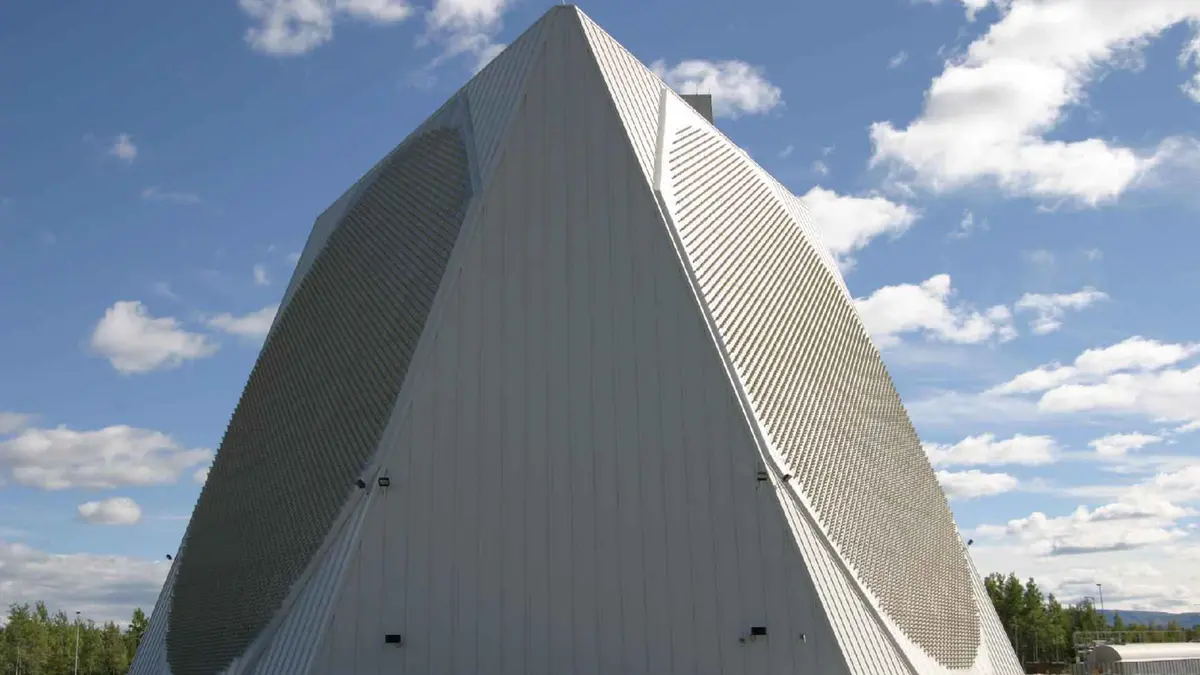
- The structure has two large circular radar faces, and each face covers roughly 120 degrees of horizontal direction.
- Together, the two faces provide about 240 degrees of coverage.
- Each face has about 1,792 powered transmitting and receiving elements.
- The system operates in the ultrahigh-frequency radio band.
The radar first searches a broad region, and it then concentrates more measurements on any detected object.
Why was the recent tracking important?
The launch reportedly occurred without advance public notice. Detection showed that Taiwan could independently observe activity far beyond its coast.
Tracking data can reveal launch time, direction, speed and estimated trajectory. It can also improve regional awareness for partner countries.
However, the reported missile type remains unconfirmed, and a likely identification should never be presented as an established fact.
Early warning is not interception: This radar detects, tracks and reports a missile. It does not destroy the missile, and a separate weapon system must attempt interception.
Limitations
- Mountains and Earth’s curvature can hide very low-flying objects, and a fixed radar cannot watch every direction equally.
- Electronic interference may reduce performance in a contested environment.
- The large fixed station is visible and could become a wartime target.
- Detection alone cannot guarantee a successful defensive response.
Conclusion
Taiwan’s PAVE PAWS radar provides long-range missile warning and space tracking, and its electronically steered beam gives rapid, wide-area coverage. The recent episode demonstrated detection capability, but not the missile’s confirmed identity.