
Why in news?
India and Tanzania held Foreign Office Consultations on 22 July 2026. The talks took place at Dar es Salaam. Both sides reviewed trade, defence, development and digital cooperation. They also discussed regional and international issues.
Background
The United Republic of Tanzania is an East African country beside the Indian Ocean and just south of the equator.
The present state unites mainland Tanganyika with Zanzibar, while Dodoma serves as the official national capital.
Dar es Salaam remains the largest city and principal commercial centre.
How Tanzania was formed
| Date | Development |
|---|---|
| 9 December 1961 | Tanganyika became independent from British rule. |
| 9 December 1962 | Tanganyika became a republic. |
| 10 December 1963 | Zanzibar became independent. |
| January 1964 | A revolution replaced Zanzibar’s sultanate. |
| 26 April 1964 | Tanganyika and Zanzibar formed a united republic. |
| 1 November 1964 | The country adopted the name United Republic of Tanzania. |
The name “Tanzania” combines elements from Tanganyika and Zanzibar.
A national government handles agreed Union matters, while Zanzibar governs many non-Union matters itself.
Zanzibar’s principal islands are Pemba and Unguja, which is commonly called Zanzibar Island.
Location and boundaries
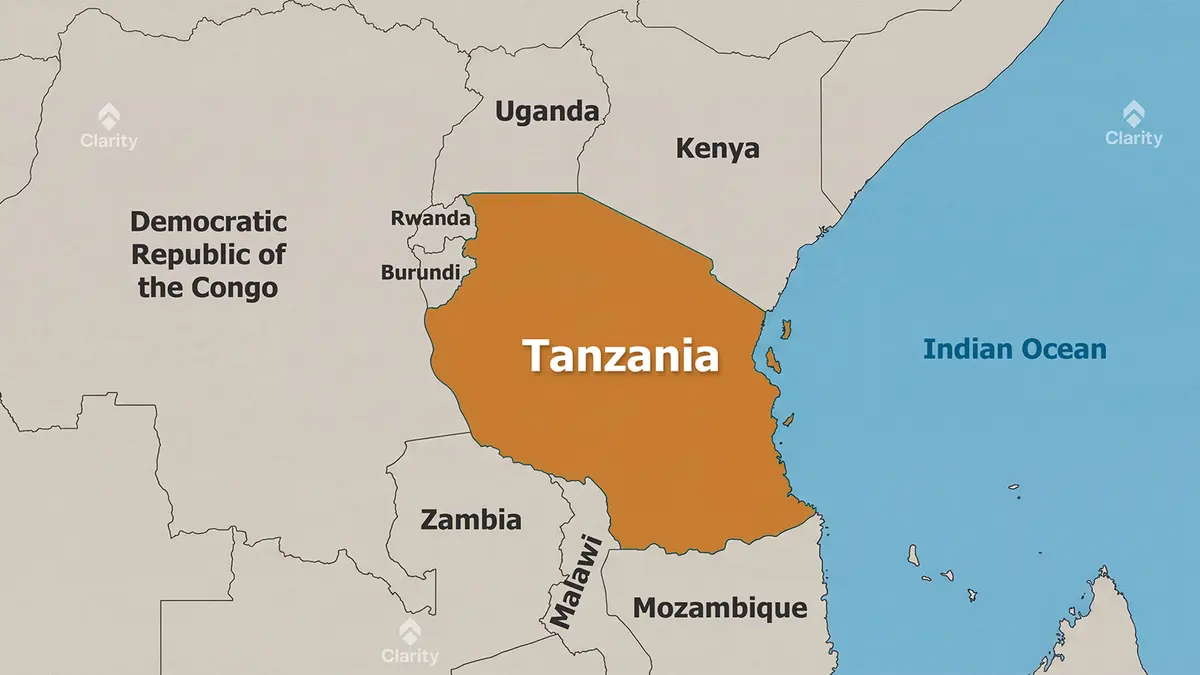
Tanzania has land or lake boundaries with eight countries.
- Kenya and Uganda lie northward, while Rwanda and Burundi lie westward.
- The Democratic Republic of Congo shares a western lake boundary.
- Zambia, Malawi and Mozambique lie southward, while the Indian Ocean lies eastward.
The Congo boundary crosses Lake Tanganyika, while Zanzibar lies offshore in the western Indian Ocean.
Basic facts
| Feature | Details |
|---|---|
| Region | East Africa |
| Capital | Dodoma |
| Largest city | Dar es Salaam |
| Currency | Tanzanian shilling |
| National and working language | Kiswahili |
| Widely used additional language | English |
| Regional organisation | East African Community |
Major physical regions
- A narrow coastal plain borders the ocean, while a large plateau covers much of the interior.
- Branches of the East African Rift cross western and northern Tanzania.
- Volcanic highlands rise near Kenya, while large lakes occupy several border regions.
Mount Kilimanjaro
Mount Kilimanjaro stands in northern Tanzania near the Kenyan border.
Its 5,895-metre Uhuru Peak makes Kilimanjaro Africa’s highest mountain.
UNESCO calls it the world’s largest free-standing volcanic mass, containing Kibo, Mawenzi and Shira.
Kibo contains the summit and is dormant rather than extinct.
The three great lakes
| Lake | Position | Special fact |
|---|---|---|
| Lake Victoria | North-west | Africa’s largest lake by surface area |
| Lake Tanganyika | West | World’s second-deepest freshwater lake |
| Lake Nyasa or Malawi | South-west | A major Rift Valley lake shared with neighbours |
Lake Victoria is the world’s largest tropical lake and second-largest freshwater lake by surface area.
Only Lake Superior has a larger freshwater surface.
Lake Tanganyika ranks second globally for depth and freshwater volume, behind Lake Baikal in both measures.
Important ecosystems
The Serengeti supports one of Earth’s largest migrations, as wildebeest, zebras and gazelles move seasonally.
Ngorongoro contains a vast, largely intact volcanic caldera, and both landscapes hold World Heritage status.
Other ecosystems include miombo woodland, coastal forests and coral reefs.
Economic geography
- Agriculture supports many households through crops such as coffee, cashew nuts, cotton and cloves.
- Gold supports mining, while wildlife and coastal destinations attract international tourists.
- Dar es Salaam’s port also serves several landlocked regional economies.
India–Tanzania relations: a short timeline
| Period | Development |
|---|---|
| Pre-modern period | Indian Ocean trade connected western India with East Africa. |
| After 1961 | Independent India and Tanganyika established close diplomatic ties. |
| July 2016 | India’s Prime Minister visited Tanzania and expanded cooperation. |
| October 2023 | The two countries elevated relations to a Strategic Partnership. |
| October 2023 | Indian Institute of Technology Madras opened its Zanzibar campus. |
| 22 July 2026 | Foreign Office Consultations reviewed the expanding partnership. |
The Zanzibar campus is both India’s first overseas IIT campus and IIT Madras’s first international campus.
Main areas of present cooperation
- Trade and Indian private investment strengthen commercial relations.
- Drinking-water projects and digital public infrastructure support development.
- Defence training, maritime security and healthcare cooperation address practical needs.
- Agriculture, education, scholarships and cultural contacts deepen long-term ties.
Though they share no boundary, both are Indian Ocean neighbours cooperating on shipping, piracy and maritime awareness.
Conclusion
Tanzania’s union structure and Indian Ocean position explain its strategic importance for India.