
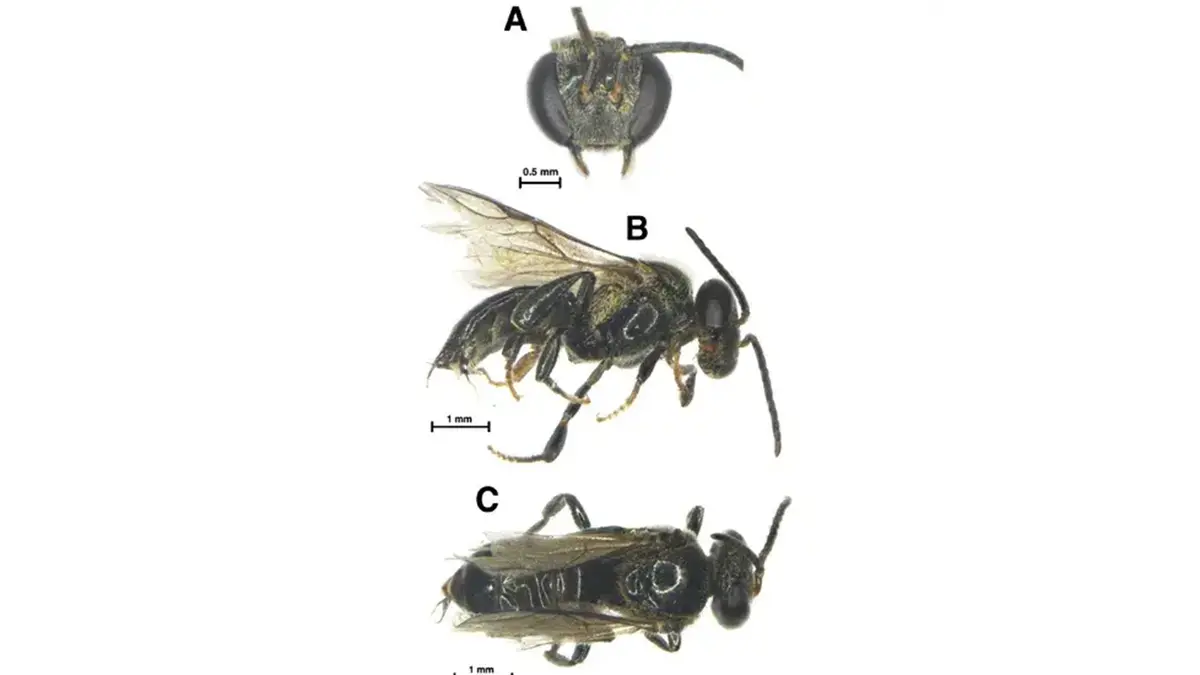
Why in news?
Researchers have described a new stingless bee from Wokha district in Nagaland. They named it Tetragonula yikhumensis after Yikhum village, where specimens were first collected. At 5.59 millimetres, it is India’s largest known stingless bee. The discovery raises India’s recorded stingless-bee count from 25 to 26 species.
Background
Bees belong to the insect order Hymenoptera, together with ants and wasps.
Stingless bees form the tribe Meliponini within Apidae, which also contains honeybees and bumblebees.
These bees have greatly reduced stingers, but they are not completely defenceless. Some species bite, apply sticky resin or swarm around an intruder.
Stingless bees live in permanent colonies containing queens, workers and males. Their workers collect several materials while pollinating wild plants and cultivated crops.
How was the species discovered?
Researchers surveyed twelve Wokha locations between November 2022 and June 2025, studying workers, males and complete underground nests.
The description appeared in Sociobiology during July 2026, giving the species a formally recognised scientific identity.
The name honours Yikhum village, while the ending “ensis” usually indicates association with a place.
Important features
| Feature | Verified detail |
|---|---|
| Scientific name | The species is named Tetragonula yikhumensis. |
| Discovery area | It was recorded in Wokha district of Nagaland. |
| Body length | Its reported worker body length is about 5.59 millimetres. |
| National distinction | It is the largest stingless bee yet recorded from India. |
| Nesting habit | Its colonies occur underground, sometimes beyond two metres. |
| Indian species count | India now has 26 recorded stingless-bee species. |
| Genus count | India now has 18 recorded species within Tetragonula. |
What makes its nest unusual?
The colony builds separate chambers for brood, pollen and stored honey, with narrow tunnels reaching the ground surface.
A hard protective material called batumen surrounds important nest sections. Bees produce it by mixing plant resin, wax and other materials.
The species is India’s second documented underground-nesting Tetragonula, unlike many related tree- or wall-nesting bees.
Local knowledge and scientific value
The Lotha community calls these ground bees “litsuk”, and local knowledge revealed their hidden nesting behaviour.
Researchers combined anatomy of both sexes with nest architecture before describing this species.
Why does the discovery matter?
- It adds one more species to India’s known pollinator diversity.
- It reveals an unusual underground habitat that can be easily disturbed.
- It shows why community knowledge can support formal biodiversity research.
- It provides new material for studying stingless-bee evolution and behaviour.
Conclusion
Tetragonula yikhumensis shows that familiar landscapes contain undescribed life, while protecting its nests also safeguards local pollination.