

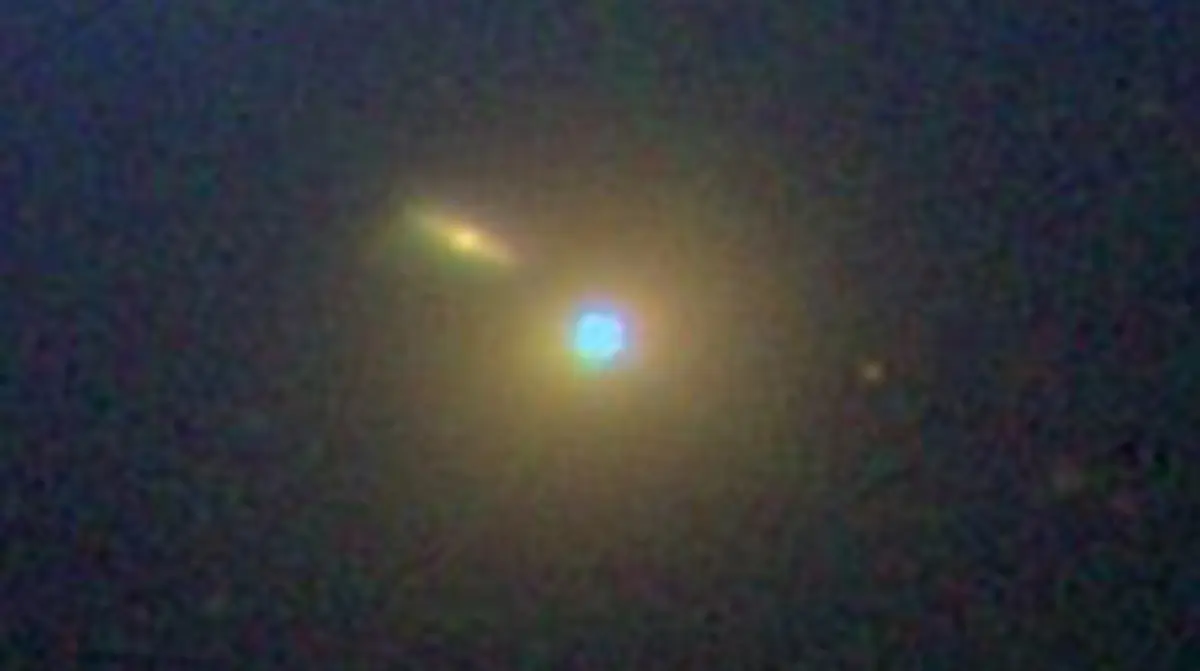
Why in news?
An Indian research study has found evidence that radiation from an accretion disc may contribute to the X-rays of two blazars. Highlighted by the Department of Science and Technology on 25 September, the work combines simultaneous observations from two space instruments. A blazar is an active galaxy whose powerful jet points nearly towards Earth, making the jet appear exceptionally bright. That brightness can hide other parts of the system around its central black hole. By examining relatively quieter states, the researchers found spectra better explained by an additional component. They interpret this as possible disc emission, including a reported first indication for Markarian 501, but further observations are needed to confirm that interpretation.
What makes a galaxy “active”?
Many galaxies contain a supermassive black hole at their centre. A black hole does not become luminous simply by existing. Bright activity occurs when surrounding matter releases energy as it moves through the environment around it. Material can gather in an accretion disc, a rotating structure through which matter moves inward. The radiation being studied comes from this environment, not from light escaping the black hole's interior.
Some active galactic nuclei also produce narrow jets of fast-moving particles. When one jet is directed close to our line of sight, the object is classified as a blazar. Motion near the speed of light amplifies how bright the jet appears to an observer in that direction. Orientation therefore helps explain the extraordinary appearance. It does not mean that Earth is uniquely close to the object or that every active galaxy is a blazar.
Why the disc can be difficult to see
Fast charged particles moving through magnetic fields emit synchrotron radiation. This process contributes strongly to the jet's output. If the jet dominates the measured light, weaker components become difficult to distinguish. A reduction in jet brightness can create a better opportunity to examine those components, even though the entire object then appears fainter. In this setting, a quieter state can provide information that a dramatic flare obscures.
The researchers studied four well-known high-energy sources: Markarian 421, Markarian 501, PG 1553+113 and PKS 2155-304. They belong to the BL Lacertae class of blazars, known for weak or absent prominent emission lines in their spectra. These catalogue names identify particular astronomical objects. They are not four newly discovered galaxies or four newly formed black holes.
Two instruments provide a wider view
The work was carried out by Riya Bhowmick and Alok C. Gupta at the Aryabhatta Research Institute of Observational Sciences in Nainital. It uses the Neutron star Interior Composition Explorer, known as NICER, and the Nuclear Spectroscopic Telescope Array, or NuSTAR. Both are associated with the United States' National Aeronautics and Space Administration (NASA). They observe different but complementary parts of the X-ray range.
NICER is mounted on the International Space Station and supplies lower-energy, or “soft”, X-ray measurements. NuSTAR observes higher-energy, or “hard”, X-rays. These labels refer to photon energy, not the physical texture of radiation. Using both instruments helps researchers examine the shape of the signal across a broader range than either dataset provides on its own.
Simultaneous observation is important because blazars vary. Combining a low-energy measurement from one state with a high-energy measurement from another could create a misleading spectrum. A spectrum shows how the detected radiation is distributed across energy. Matching observations in time makes it more meaningful to ask whether one physical explanation fits the entire distribution.
What the analysis found
The team analysed 13 paired spectra. A curved model commonly used to describe the jet-related emission fitted seven adequately. Four spectra of Markarian 421 and two of Markarian 501 needed an additional component for a satisfactory fit. These cases occurred when the sources were in moderate-to-low or low states. The authors interpreted the extra contribution as evidence consistent with radiation from the accretion disc.
This is an inference from the energy distribution, not a direct photograph of the disc. The distinction matters because fitting a model involves assumptions about how different processes produce radiation. The study's value is that it identifies a pattern requiring explanation and tests a plausible component. Confirming the physical origin requires further observations and comparison with alternative explanations.
The researchers also noted an unexplained feature in some Markarian 421 spectra. They explicitly allowed that it might arise from the instrument or background rather than the galaxy. A feature appearing in data is therefore not automatically a new chemical signature or celestial phenomenon. Separating the astronomical signal from the measurement system is part of the scientific result, not an optional qualification.
What “high-energy” means here
These objects are also known as tera-electronvolt blazars because they emit extremely energetic gamma-ray photons. A tera-electronvolt equals a trillion electronvolts, a unit of energy. The description refers to photon energies, not the temperature of the whole galaxy or the total power of its jet. The present study examines X-rays to investigate the same broader systems; it is not a claim that X-rays and gamma rays are interchangeable measurements.
Understanding the balance between disc and jet emission can help explain how matter feeds a black hole and powers its surroundings. That connection is difficult to study when one component overwhelms the others. Repeated observations during different brightness states offer a way to test whether the proposed disc signal recurs. Agreement across observations would make the interpretation stronger than one unusual spectrum alone.
Conclusion
The study uses a change in brightness to investigate a normally hidden part of a blazar. Its central finding is evidence consistent with an accretion-disc contribution during quieter jet states, not a settled claim about every blazar. The next test is whether further observations reproduce the signal and distinguish it from alternative or instrumental effects. That is how an intriguing spectral pattern can become a more secure account of the system's physics.