
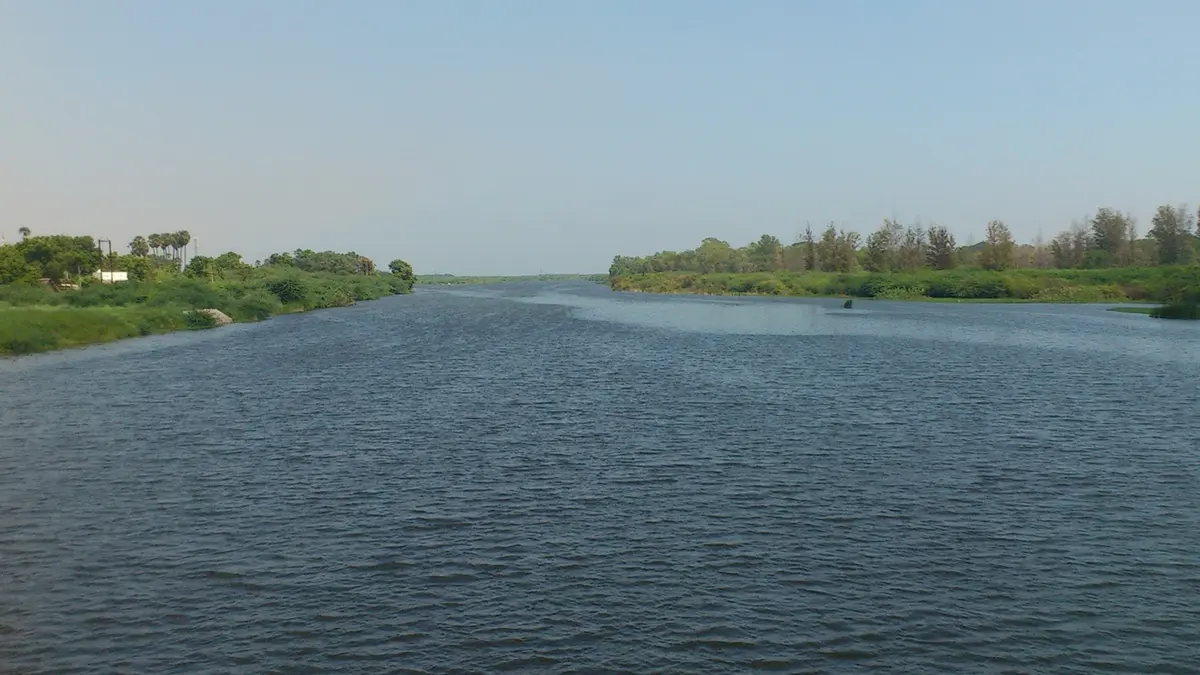
Why in news?
The Madras High Court examined pollution from ritual waste in the Thamirabarani River. Devotees were discarding clothes and other items after funeral rites. A May clean-up removed roughly 86 to 90 tonnes of clothing. The court invited public proposals before considering final directions on 16 July 2026.
Background
The Thamirabarani, also spelt Tamirabarani or Thamarabharani, is a major perennial river flowing entirely within Tamil Nadu.
The river rises in the Pothigai Hills, which form part of the wider Western Ghats and Agasthyamalai landscape.
Its headwaters begin above Papanasam in Tirunelveli district, and the river then flows eastward across fertile plains.
It passes through Tirunelveli and Thoothukudi districts, and after about 128 kilometres, it enters the Gulf of Mannar near Punnaikayal.
Important tributaries include the Karaiyar, Servalar, Manimuthar, Gadananathi, Pachaiyar and Chittar, and several streams descend quickly from the Western Ghats.
Why does it usually carry water throughout the year?
The upper basin receives rain from the southwest monsoon, and lower and eastern areas also receive the northeast monsoon.
Two-season rainfall supports dependable flow, while reservoirs and regulated releases also influence the river today.
Accuracy point: It is safer to call Thamirabarani a major perennial Tamil Nadu river. Claims describing it as the state’s only perennial river are disputed.
What is its historical importance?
Early Tamil literature calls the river Porunai, while Sangam poems connect its valley with farming and Pandya settlements.
Tamraparni is another ancient form of the name, and spellings changed as Tamil, Sanskrit and foreign writers recorded the river.
The lower valley supported ancient Korkai, where pearl fishing and maritime exchange connected the coast with distant markets.
Communities later built channels and anicuts, which are low barriers that divert river water into irrigation canals.
Modern dams, including Papanasam and Manimuthar, expanded storage and changed downstream timing. Papanasam also supports hydroelectric power generation.
Why is the river important today?
- It supplies drinking water to towns and villages.
- Its channels irrigate paddy, banana and other crops.
- Reservoirs support electricity generation and drought management.
- The river carries religious and cultural importance.
- Its waters connect hill forests, farms, wetlands and the sea.
- Native fish and turtles depend upon suitable water quality.
How did the latest case begin?
Sivanupandian versus District Collector and others came before the Madurai Bench of the Madras High Court.
Justices G.R. Swaminathan and B. Pugalendhi heard the matter. Their order was dated 9 July 2026.
The original petition challenged proceedings concerning a riverside mandapam, which is a pillared hall used for gatherings or rituals.
During the hearing, the bench learned that widespread ritual dumping extended far beyond the disputed structure in the original petition.
Which ritual was causing concern?
Some families perform last rites and memorial ceremonies beside the river, and these funeral observances are also called obsequies.
After bathing, some devotees leave garments, towels, slippers and containers, though no universal religious rule requires this practice.
An activist told the court that at least one tonne of garments entered the river daily. The dumping occurred at many riverbank locations.
What did the clean-up recover?
Workers collected waste between 7 and 28 May 2026, and the submitted figures showed the following quantities:
- Clothes weighed about 86 to 90 tonnes.
- Holy ash weighed 2.20 tonnes.
- Plastic waste weighed 1,385 kilograms.
- Sanitary napkins and diapers weighed 374 kilograms.
- Glass bottles weighed 220 kilograms.
- Slippers weighed 115 kilograms.
- Burnt bricks weighed 700 kilograms.
- Other residual waste weighed 440 kilograms.
These were collected quantities, not estimates of the river’s total pollution, and unrecovered material could still remain downstream or underwater.
Why are discarded clothes harmful?
Pure cotton eventually breaks down, though large piles still obstruct the river. Polyester and similar synthetic fibres degrade very slowly.
Cloth can become trapped between rocks and collect organic waste, and such damp material can support harmful microbial growth.
Loose fabric can entangle the river’s Indian black turtles and Indian flapshell turtles, preventing normal breathing or movement.
Broken glass can injure people, fishers and animals, and plastics may fragment into smaller particles without truly disappearing.
What constitutional rights are involved?
Article 25 protects religious practice, but subjects that freedom to public order, morality and health.
Other Fundamental Rights also apply, and courts have interpreted Article 21 to include environmental and clean-water protection.
Therefore, religious freedom does not create a right to pollute shared water. One person’s observance cannot destroy another person’s health or livelihood.
Which environmental laws did the court mention?
- Section 36 of the Tamil Nadu Public Health Act, 1939, prohibits pollution of watercourses.
- Section 24 of the Water (Prevention and Control of Pollution) Act, 1974, restricts polluting discharges.
- Local authorities also carry public-health, sanitation and waste-management responsibilities.
Legal control can address deliberate dumping, and education and convenient collection points are still needed for lasting behavioural change.
Did the court immediately ban the rituals?
No. The bench expressed serious concern and discussed possible directions. It had not yet issued the final river-wide arrangement.
The District Collector was asked to announce the proposed hearing publicly, and religious bodies and activists could submit their views.
The administration had to present practical proposals on 16 July 2026. This procedure allows affected groups to be heard before final orders.
Legal caution: The 9 July order began a wider solution process. It should not be described as a final ritual ban.
What measures could reduce the problem?
- Authorities can create marked collection points away from the water.
- Priests and community leaders can explain acceptable alternatives.
- Local bodies can arrange regular collection and material recovery.
- Warning boards can state penalties in familiar local language.
- Volunteers can guide families during crowded ritual periods.
- Monitoring teams can identify repeated dumping locations.
- Affordable biodegradable materials can replace unnecessary synthetic items.
Conclusion
Thamirabarani carries water, history and faith across southern Tamil Nadu, requiring respectful rituals, workable alternatives and firm pollution control.