

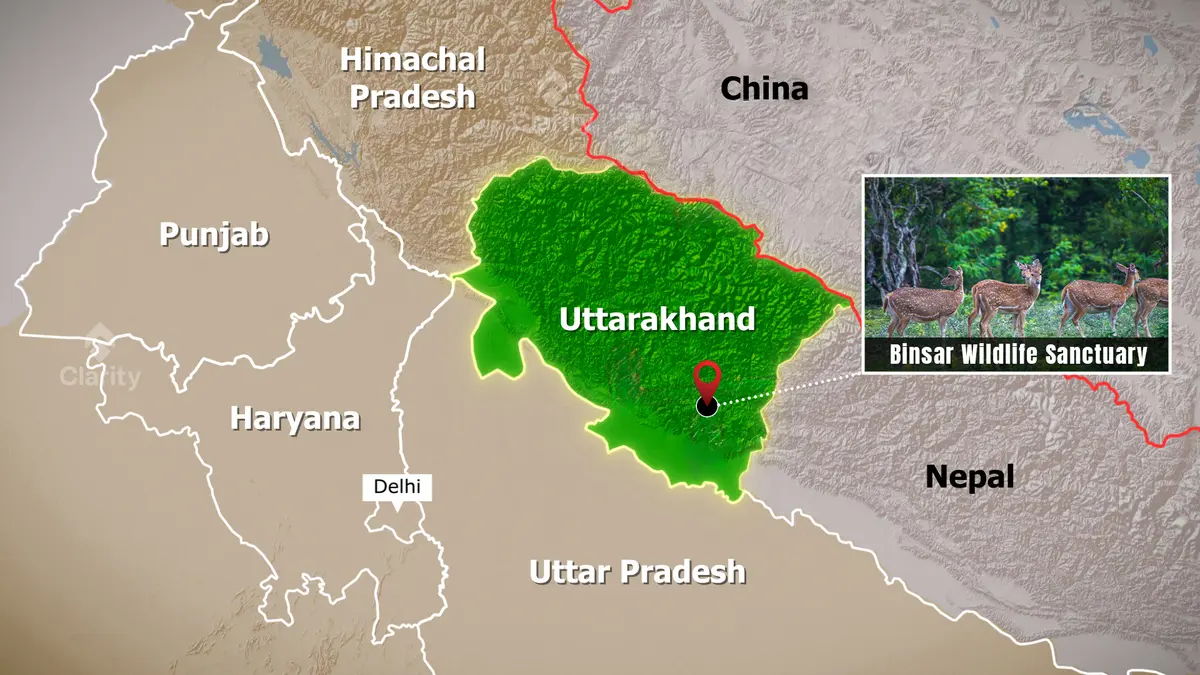
Why in news?
Forest staff reported a tiger near Zero Point in Binsar Wildlife Sanctuary. The sighting occurred at an elevation reported near 8,000 feet.
Location and habitat
Binsar Wildlife Sanctuary lies in Almora district within Uttarakhand’s Kumaon Himalaya. Binsar Hill reaches about 2,420 metres above sea level.
The protected landscape contains oak and rhododendron forests, with pine at lower elevations. It supports leopards, goral, deer and many bird species.
Zero Point is a prominent high point reached through the sanctuary. Settlements, roads and forest edges surround parts of the protected area.
How to interpret the sighting
Tigers can disperse over long distances and use unexpected elevations. One sighting does not prove a resident breeding population in Binsar.
It also cannot independently establish a climate-driven range shift. Camera traps, genetic samples and repeated observations are needed before such conclusions.
The report still matters because tiger movement can reveal habitat connections. It may also change risks for people, livestock and visitors.
Management priorities
Forest authorities should verify routes while limiting disturbance. Camera placement and scat analysis can identify the animal without crowding its path.
Villages need prompt, calm information and livestock safeguards. Compensation systems should respond quickly if verified losses occur.
Tourism controls are equally important. A rare sighting should not trigger vehicle pressure, baiting or attempts to locate the tiger.
Landscape questions
Movement may connect Binsar with larger forest patches beyond its boundary. Mapping corridors requires evidence across forest divisions and private lands.
Prey availability and human disturbance influence whether a tiger only passes through. Both should be measured before managers infer habitat suitability.
Leopard and tiger presence can also change livestock risk differently. Species identification matters for targeted prevention and fair compensation.
Monitoring results should guide visitor rules and village alerts. Exact live locations should remain restricted to prevent crowding or illegal pursuit.
Regional forest plans should treat dispersal as normal behaviour. Safe passage can reduce conflict when animals leave protected boundaries.
Public communication should explain uncertainty without hiding risk. Residents need practical precautions while researchers determine whether the animal remains nearby. Rumour control can prevent panic and retaliatory action.
Observation before explanation
The sighting is credible evidence of presence at one time. It is not yet evidence of permanent occupation or ecological change.
Conclusion
Binsar’s sighting deserves systematic monitoring rather than dramatic claims. Evidence-led management can protect both wildlife movement and nearby communities.