
Why in news?
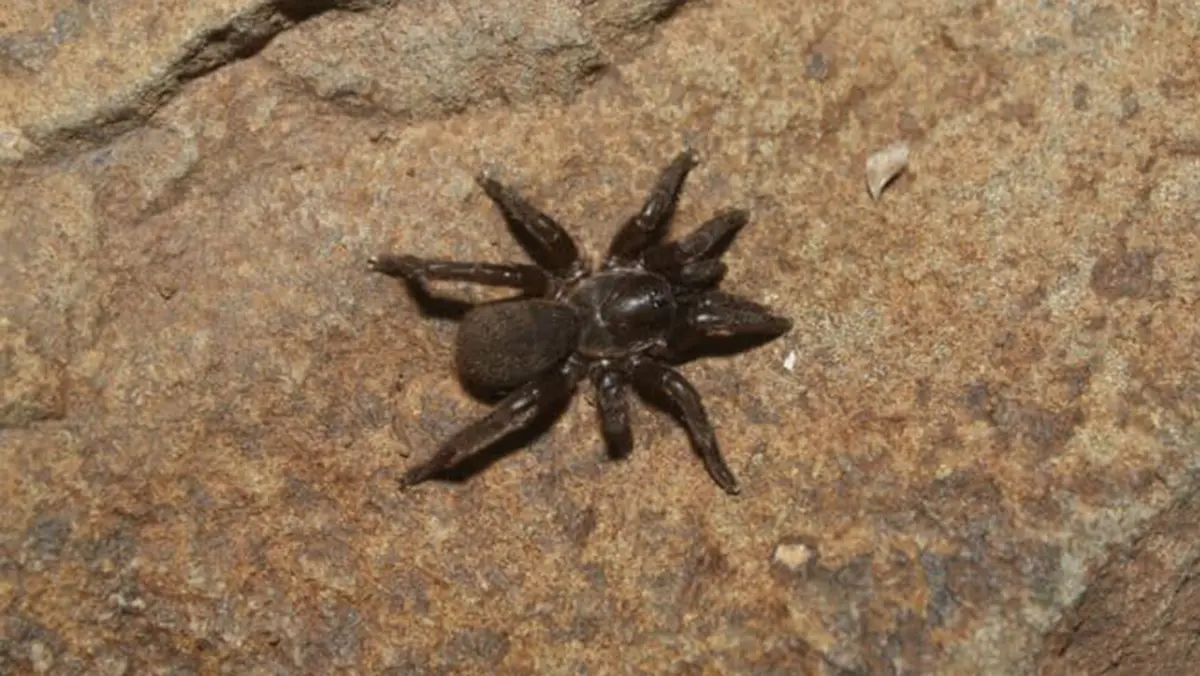
Researchers described Tigidia singhal, a new trapdoor spider from Maharashtra’s semi-arid Deccan grasslands. The discovery extends its genus beyond India’s better-studied forest habitats. A single adult female formed the species’ holotype. The finding highlights the biodiversity value of open natural ecosystems.
Background
Tigidia singhal is a newly described spider within the family Barychelidae.
It belongs to the infraorder Mygalomorphae, which also includes tarantulas and several trapdoor spiders.
Mygalomorph fangs generally point downward and move nearly parallel to each other.
Many species live for years inside carefully constructed underground burrows.
Where was it discovered?
Researchers found the specimen near Rehekuri Blackbuck Sanctuary in Maharashtra’s Ahilyanagar district.
The site lies within rocky, semi-arid grassland on the Deccan Plateau.
It represents an open natural ecosystem rather than a cleared or degraded forest.
Such landscapes support specialised plants, insects, spiders, reptiles, birds and large mammals.
How was the species described?
The scientific description relied on detailed morphology, measurements and illustrations of an adult female.
The designated female is the holotype, meaning the single name-bearing reference specimen.
It measured about 15 millimetres and had dark legs carrying greyish bristles.
Its lighter abdomen displayed a visible chevron pattern.
Female reproductive structures helped distinguish it from previously known relatives.
The male remains unknown, so later surveys may expand the species description.
What makes this record important?
Earlier Indian Tigidia records came mainly from evergreen or deciduous forest habitats.
This is the genus’s first recorded occurrence within a semi-arid open natural ecosystem.
The discovery raises India’s known Tigidia species count to eight.
It also broadens the genus’s recognised ecological range within peninsular India.
The finding does not mean the species evolved only after grasslands appeared.
It means science had not formally described this population earlier.
How do trapdoor spiders live?
- The spider digs a sheltered burrow inside suitable soil or beneath stones.
- Strong silk strengthens the wall and helps transmit nearby surface vibrations.
- A concealed entrance or hinged door effectively hides the waiting predator.
- The spider detects approaching prey through subtle vibrations around the burrow entrance.
- It rushes outward briefly before returning underground with its newly captured prey.
Burrow design varies across families and species, so not every trapdoor looks identical.
Why can mygalomorphs aid biogeography?
Many mygalomorph spiders disperse slowly and remain close to suitable local soils.
Geographically isolated populations can therefore preserve evidence of older landscape separation.
The genus Tigidia occurs in India, Madagascar and Mauritius.
This distribution supports research on ancient connections, dispersal and later evolutionary isolation.
However, one new species cannot alone reconstruct the entire geological history.
Why are grasslands misunderstood?
Open natural ecosystems are often incorrectly labelled empty, barren or available wasteland.
Plantations, mines, roads, intensive farming and urban growth can transform their native communities.
Small burrowing species may disappear before surveys record their presence.
Conservation planning therefore needs grassland-specific inventories, not only forest-cover measurements.
Taxonomic position
| Kingdom | Animalia |
|---|---|
| Phylum | Arthropoda |
| Class | Arachnida |
| Order | Araneae |
| Infraorder | Mygalomorphae |
| Family | Barychelidae |
| Genus | Tigidia |
Conclusion
Tigidia singhal demonstrates why overlooked grasslands require serious taxonomic research and habitat protection.