

Why in news?
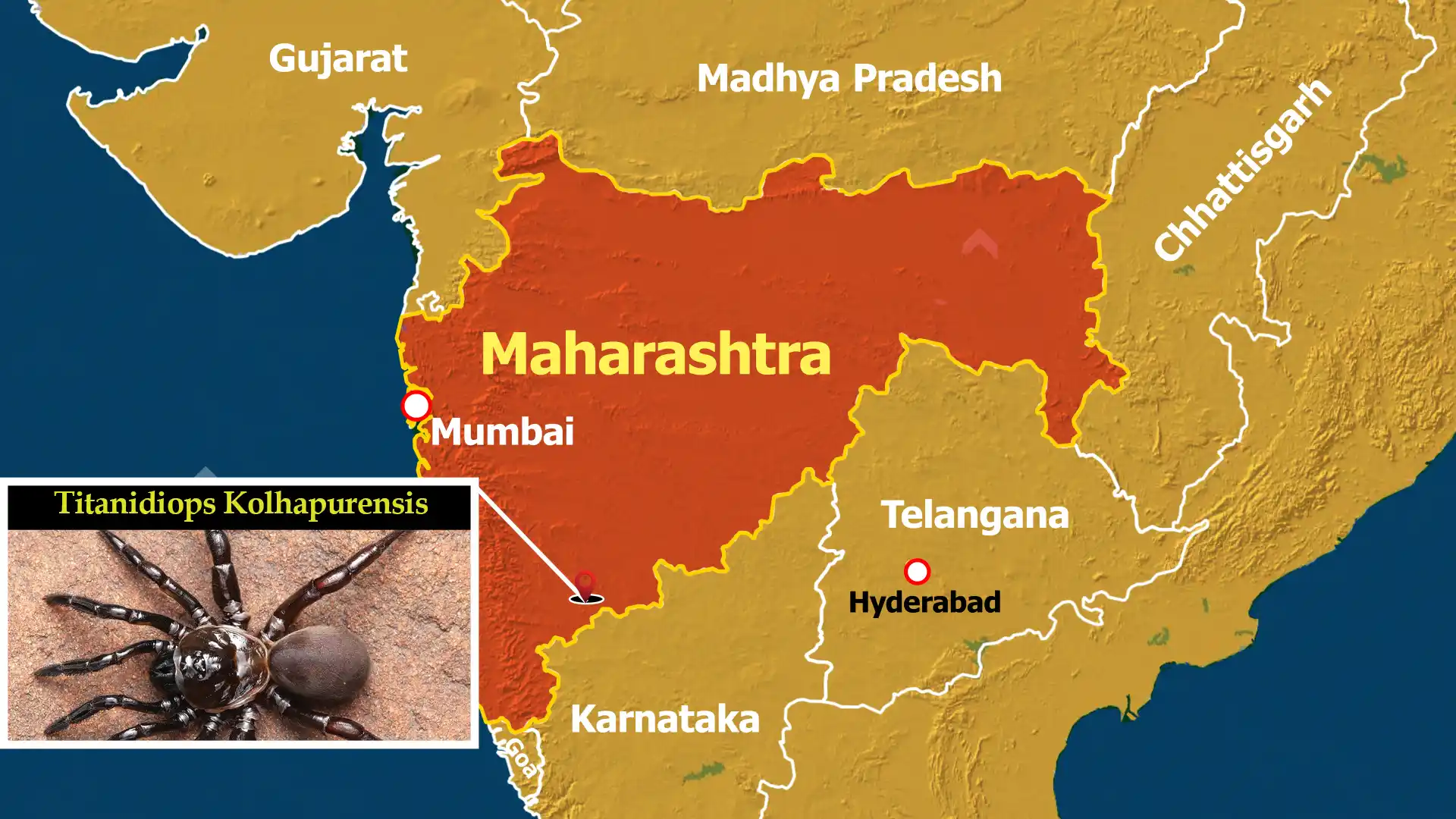
A joint team from the Thackeray Wildlife Foundation and Shivaji University, Kolhapur, discovered a new species of trapdoor spider in the grasslands of Maharashtra’s Kolhapur district. The species is named Titanidiops kolhapurensis after its place of discovery.
Background
Trapdoor spiders are burrowing arachnids found in tropical and subtropical regions. They construct silk‑lined burrows with hinged doors made of soil and vegetation, allowing them to ambush passing insects. These spiders are generally timid, rarely leaving their burrows except to catch prey. Their bites are not medically significant to humans.
About Titanidiops kolhapurensis
- Discovery: The species was found in grasslands and forest patches in Kolhapur. Researchers observed it in locations like the Shivaji University campus, Shenda Park and Puikhadi hill.
- Identification: The spider belongs to the genus Titanidiops and is nicknamed “darkari koli” in Marathi. Its classification is based on unique dental structures and the arrangement of its eight eyes.
- Habitat preference: The species thrives in natural forests and native grasslands but is absent in areas invaded by exotic tree plantations like Gliricidia sepium. It builds vertical or slanted burrows whose camouflaged doors blend with the soil.
- Conservation concern: Rapid habitat conversion for agriculture, construction and tree planting threatens the species. Researchers warn that without habitat protection it could face local extinction.
About trapdoor spiders
- Trapdoor spiders burrow up to 15 cm deep and line their tunnels with silk. A hinged “door” camouflaged with soil and plant material hides the entrance.
- They are ambush predators; when prey walks near the door, the spider bursts out, grabs the insect and retreats.
- These spiders seldom disperse far from their birthplace. As a result, habitat fragmentation can isolate populations and make them vulnerable to changes in land use.
Source: Times of India