

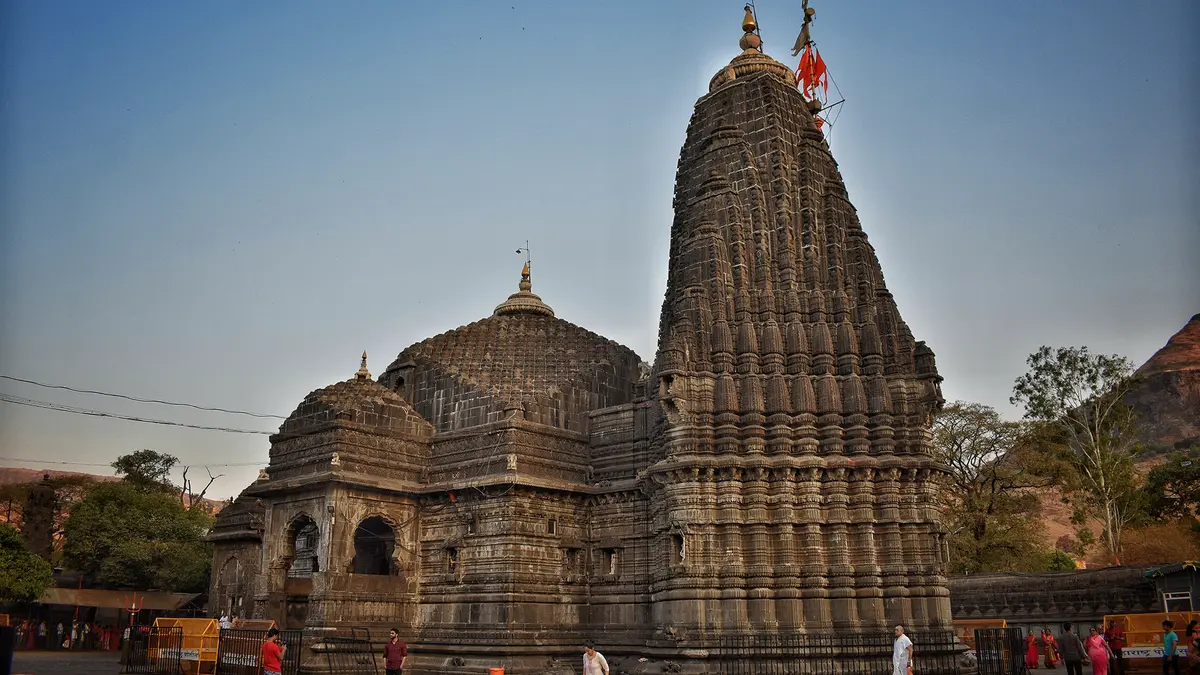
Why in news?
In late June 2026 workers cleaning the Amrit Kund at Maharashtra’s Trimbakeshwar temple found a stone Shivalinga at the bottom of the 65‑foot‑deep tank. The find, believed to be at least two centuries old, has renewed interest in the temple’s history and architecture.
Background
Trimbakeshwar is one of the twelve sacred Jyotirlinga shrines of Shiva. It is located 28 km from Nashik at the foot of Brahmagiri mountain, where the Godavari river originates. The present stone temple was constructed by Peshwa Balaji Bajirao between 1755 and 1786 on the site of an older temple destroyed in the late seventeenth century.
Features of the temple
- Architecture: The temple is built from black basalt in the Hemadpanthi style and has intricate stone carvings. Its sanctum houses a unique three‑faced Jyotirlinga representing Brahma, Vishnu and Shiva.
- Water tanks: The complex contains several sacred tanks including the Kusavarta kund and the Amrit Kund, believed to be sources of the Godavari river. Devotees collect water here for rituals.
- Religious importance: Trimbakeshwar hosts the Kumbh Mela every 12 years and draws millions of pilgrims. A jewelled crown adorns the Jyotirlinga, and a large Nandi (bull) statue stands at the entrance.
The newly discovered Shivalinga
During desilting of the Amrit Kund, workers uncovered a linga embedded in stone. Archaeologists estimate it to be at least 240 years old because it matches the period when Peshwa Balaji Bajirao rebuilt the temple. Some experts believe it may be even older, possibly belonging to the pre‑Mughal shrine that once stood here. The discovery highlights how religious sites often contain hidden artefacts that provide clues to past structures and rituals.
Conclusion
The Trimbakeshwar temple is a living example of India’s layered heritage, blending ancient myth with Peshwa‑era architecture. The recent discovery of an underwater Shivalinga adds another chapter to its story. Preservation and careful archaeological study will help us appreciate this sacred site and its place in Hindu tradition.