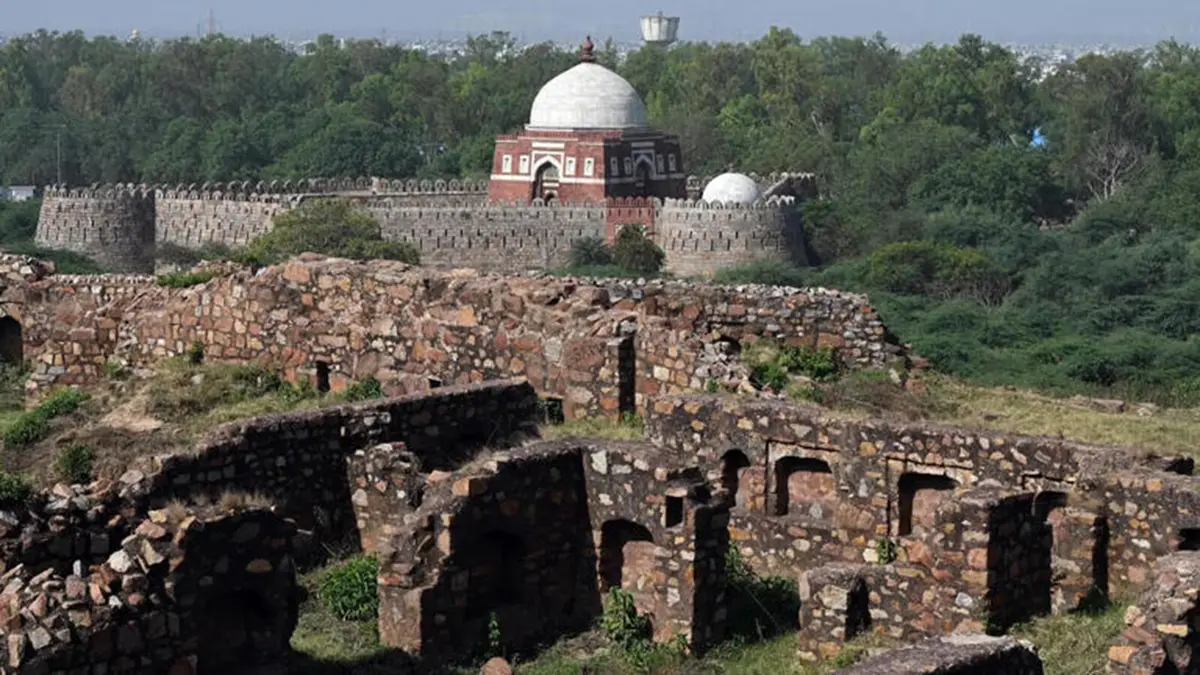
Why in news?
Courts in Delhi are monitoring a plan to survey and remove encroachments around Tughlaqabad Fort, a 14th‑century citadel. The Delhi High Court and the Supreme Court have expressed concern over delays and confusion about which agency should conduct the survey. Recent reports suggest that IIT Delhi, initially tasked with the survey, considered outsourcing the work to private firms, leading to judicial admonitions.
Background
Tughlaqabad Fort was founded in 1321 CE by Ghiyas‑ud‑din Tughlaq, the first ruler of the Tughlaq dynasty of the Delhi Sultanate. Built as the third city of Delhi, it served both as a fortress and a capital city. The fort’s massive stone walls, 10–15 metres high and extending over 6.5 kilometres, enclosed a citadel, palace complex and the main city. According to popular legend, the fort was abandoned within a few years due to a curse uttered by the Sufi saint Nizamuddin Auliya, who had quarrelled with the Sultan. The curse allegedly said, “May it remain uninhabited or be occupied by Gujjars,” and shortly after Ghiyas‑ud‑din died and the capital shifted.
Present issues
- Encroachments: Over time, slums and unauthorised structures have mushroomed around the fort, compromising its heritage value and structural safety.
- Survey confusion: The Archaeological Survey of India (ASI) requested IIT Delhi to conduct a modern survey using advanced tools. However, IIT Delhi considered subcontracting the task, which the Supreme Court had earlier prohibited, causing a stalemate.
- Judicial oversight: Both the Delhi High Court and Supreme Court are supervising the process, directing that the survey be completed expeditiously and without outsourcing to private entities.
- Cultural significance: The survey is important not just to clear encroachments but also to plan conservation of the fort, which is an outstanding example of Tughlaq architecture featuring sloping battered walls and a causeway leading to Ghiyas‑ud‑din’s tomb.
Conclusion
Resolving the survey dispute is essential to protect Tughlaqabad Fort from further degradation. A clear plan and coordination among government bodies will help preserve this medieval monument for future generations.