

Why in news?
Two microscopic foraminiferal species from Rajapuri Creek on Maharashtra’s Konkan coast received renewed attention. Scientists named them Psammophaga holzmannae and Psammophaga sinhai. Both live within marine sediment and ingest selected mineral grains. The work highlights organisms that are easily missed because they are smaller than half a millimetre.
The species were established through research published before the present news cycle. They should not be described as discoveries made during August 2026. The important current lesson concerns the research itself. Careful microscopy and genetic analysis uncovered distinct lineages in an understudied tropical creek. The finding also expands knowledge of the unusual sand-eating genus Psammophaga.
What are foraminifera?
Foraminifera are single-celled organisms found mainly in aquatic environments. Many construct an outer shell, called a test, from secreted material or collected grains. Their thread-like extensions capture food and help movement. Most familiar forms have several chambers. Monothalamous forms, including these species, have a simpler test with one main chamber.
Despite their size, foraminifera are important to marine science. Different species prefer particular depths, salinities and sediment conditions. Their shells can remain in seabed deposits for long periods. Researchers use fossil assemblages to reconstruct past seas and climates. Living communities can also indicate changes in oxygen, organic matter or pollution.
How the two species differ
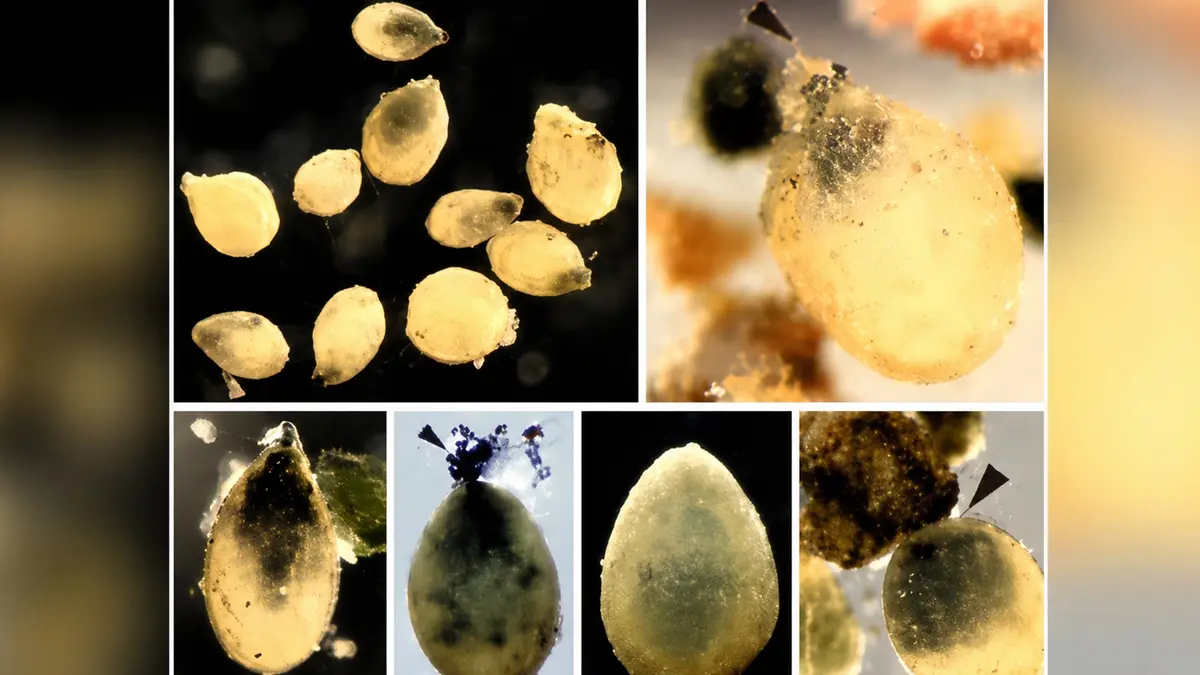
P. holzmannae is the smaller species. Observed cells measured about 103 to 246 micrometres. Its body is broadly oval or spherical, with translucent orange cytoplasm. Ingested grains gather mainly near the single aperture. The arrangement creates a useful visible feature when researchers examine a living specimen.
P. sinhai measured about 279 to 448 micrometres. It has a more elongated, elliptical or droplet-like form. Its cytoplasm appears yellow to olive. Mineral grains occur across more of the cell rather than mainly near the opening. These differences supported separation when combined with molecular evidence.
Both species build agglutinated tests from very fine clay particles. They also select heavier mineral grains from the surrounding sediment for ingestion. Reported grains included iron- and titanium-bearing minerals such as magnetite and ilmenite. Scientists still need to determine the full biological purpose. Selection may relate to feeding, mineral handling or another cellular process.
Why molecular evidence was needed
Very small and simple organisms may offer only a few stable visible characters. Similar shapes can also evolve in unrelated lineages. The researchers therefore examined part of the small-subunit ribosomal ribonucleic acid gene. This marker helps compare evolutionary relationships among foraminifera. Both species fell within a group known as Clade E, but formed distinct lineages.
Morphology and genetics answer different questions. Shape shows how the organism is built and lives. Sequence comparisons test whether apparently similar cells share close ancestry. Agreement between both forms of evidence strengthens a species description. It also makes later identification easier for researchers studying other coasts.
Rajapuri Creek and its physical setting
Rajapuri Creek lies in Raigad district on Maharashtra’s Arabian Sea coast. It is a narrow, deep inlet oriented broadly northwest to southeast. The creek opens near the historic Murud-Janjira area. Tides carry seawater into sheltered mud and sediment habitats. The tropical monsoon strongly changes runoff and local water conditions across the year.
The study area had warm water and moderately high salinity. Researchers recorded roughly 27 to 30 degrees Celsius and 27 to 32 parts per thousand. Organic-rich sediment provides many microhabitats and food sources. Creeks also receive material from land and sea. This mixture makes them productive, but sensitive to sewage, dredging and altered shoreline use.
Scientific and ecological significance
The study shows that Indian coastal diversity remains incompletely recorded. Large animals receive attention, while sediment microbes and meiofauna receive less. Yet these organisms process organic matter and interact with minerals and microbes. Their exact ecosystem contribution requires further measurement. A new species record should not be stretched into an untested claim about the entire coast.
Baseline taxonomy becomes valuable when a habitat changes. Scientists cannot detect biological loss if they do not know which species were present. Regular surveys could compare seasons, pollution levels and creek zones. Genetic reference sequences also allow environmental samples to be identified more reliably. The work therefore builds infrastructure for later ecological research.
Small size does not mean small scientific value
These organisms reveal hidden coastal diversity and refine evolutionary knowledge. Their genetic sequences also improve later identification. However, their wider ecological role still needs direct study. Researchers should measure that role rather than assume it from size or novelty.
Conclusion
Psammophaga holzmannae and P. sinhai demonstrate the value of patient observation in ordinary sediment. Their identification combined living features, test structure and genetic evidence. That combination gives the names scientific reliability. Renewed public interest should preserve the publication timeline. It should also recognise the institutions supporting long-term basic research.
Rajapuri Creek now has a stronger biological baseline than before. Future work can examine distribution, seasonal change and the role of selected minerals. Similar surveys may find related forms along the wider Konkan coast. Protecting creeks from avoidable pollution will keep those opportunities open. Discovery is most useful when it supports continuing study and informed management.