

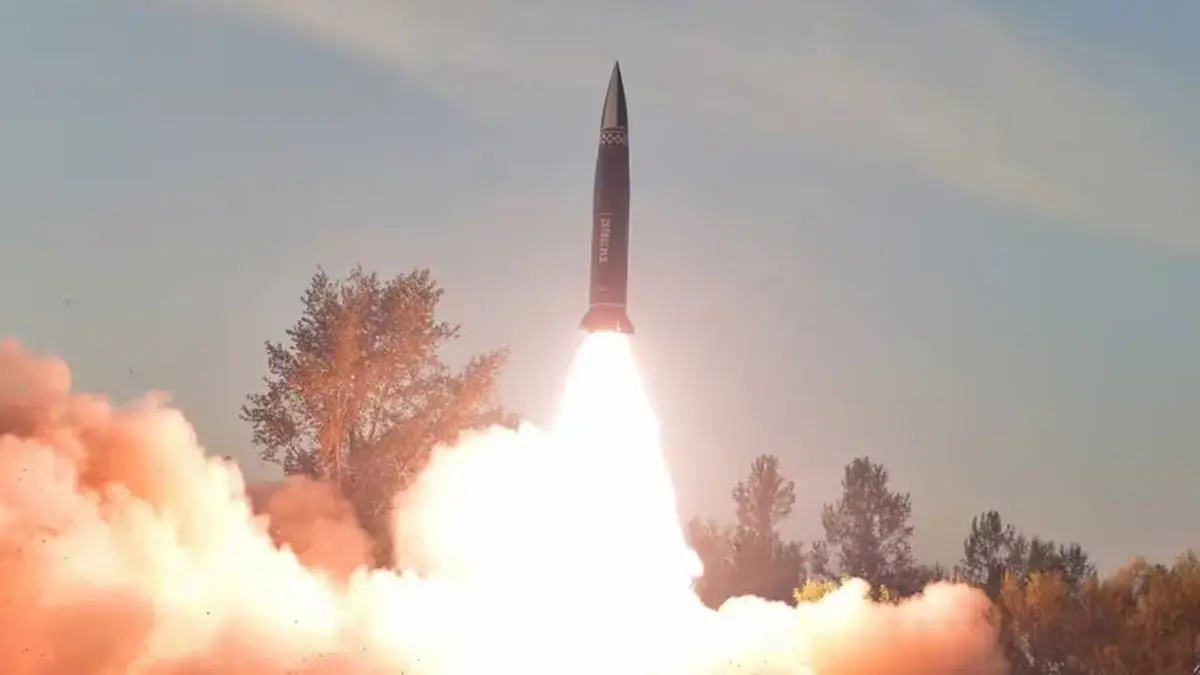
Why in news?
Ukraine’s Defence Intelligence reported a new North Korean missile in Russia’s inventory during August 2026. It identified the weapon as KN-30, also described as Hwasong-11C. The agency grouped it with KN-23 and KN-24 missiles already held by Russia. The reported transfer could widen Russia’s strike options and deepen concerns about prohibited arms transfers. The new inventory claim remains attributed to Ukrainian intelligence.
What the Ukrainian assessment says
Ukraine’s intelligence agency described Russia’s missile holdings as of July 2026. It estimated around 50 North Korean ballistic missiles across the KN-23 series, KN-24 and KN-30. The figure covers the combined group. It does not establish that Russia possesses 50 KN-30 missiles.
The Institute for the Study of War recorded the same Ukrainian claim. It said it had not observed evidence of Russian KN-30 use. This distinction separates an intelligence inventory from verified battlefield activity. Later wreckage, imagery or official disclosure may change the assessment.
Understanding the names
North Korea uses the Hwasong name for several missile families. Outside analysts use “KN” numbers to classify systems whose official details remain limited. These labels do not always map neatly across governments and research groups. A report should therefore state both names and preserve uncertainty.
Open-source analysis describes KN-30 as a heavier development within the Hwasong-11 family. It is associated with road-mobile, solid-fuel launch equipment. North Korean presentations have claimed a larger payload than earlier variants. Those specifications have not received full independent verification.
Why solid fuel and mobility matter
A solid-fuel missile stores propellant inside the weapon. It generally needs less visible preparation than a liquid-fuel system. Road mobility allows launchers to change positions. These features can shorten warning time and complicate surveillance. They do not make a missile undetectable or impossible to intercept.
Ballistic missiles rise rapidly before descending towards a target. Some newer short-range systems can adjust their flight path. Such movement complicates defence calculations. Actual performance depends on guidance, training and reliability. Claims from parades or tests need comparison with observed operations.
Geography of the transfer relationship
North Korea occupies the northern Korean Peninsula. It borders China, Russia and South Korea. Its short frontier with Russia creates a direct land connection. Rail links can move heavy military cargo without passing through a third country. Geography therefore supports sustained bilateral logistics.
Russia’s war against Ukraine creates demand across a much larger theatre in Eastern Europe. Missile supplies may travel thousands of kilometres before deployment. Long transport lines require storage, maintenance and trained crews. The distance does not prevent transfer, but it adds logistical evidence that investigators may trace.
Earlier North Korean missile use
Ukraine and independent investigations previously documented Russian use of KN-23 and KN-24 family missiles. A multilateral sanctions report examined recovered components and transfer patterns. Those findings provide context for the new claim. They do not by themselves prove that KN-30 has now arrived.
Weapons use can also give North Korea practical feedback. Engineers may learn about accuracy, reliability and defence penetration. Russia may gain another supply source for sustained attacks. Both effects deepen military cooperation. Precise conclusions still require verified evidence from each system.
United Nations sanctions context
United Nations Security Council resolutions prohibit specified arms transfers involving North Korea. Earlier ballistic-missile supplies therefore raised serious sanctions concerns. The monitoring system has weakened after Russia blocked renewal of the former expert panel. Existing resolutions did not disappear with that veto.
Several countries created a Multilateral Sanctions Monitoring Team to continue public assessment. Its reports do not replace Security Council enforcement powers. They can still document transfers, networks and recovered material. Effective accountability depends on customs evidence, financial tracing and cooperation among governments.
Implications for Ukraine and regional security
A heavier missile could threaten hardened or high-value targets if its claimed payload proves accurate. It could also force Ukraine to allocate scarce air-defence resources. Yet capability should not be inferred from a name alone. Reliability, accuracy and available numbers determine operational significance.
The relationship also affects security in East Asia. Military technology or economic support may flow back to North Korea. Neighbouring countries will watch testing and deployment more closely. Stronger ties can weaken diplomatic pressure on Pyongyang. They may also accelerate regional defence planning.
Confirmed attribution is essential
Ukraine’s Defence Intelligence is the source of the new KN-30 inventory claim. Publicly available independent evidence had not confirmed transfer or combat use. The combined estimate of around 50 covers several North Korean missile types.
Conclusion
The KN-30 report may signal a further expansion of Russia–North Korea military cooperation. Its importance justifies attention, but not certainty beyond the source. Analysts should seek imagery, debris, transport records and later operational evidence. Sanctions monitoring remains necessary despite weaker Security Council enforcement. Careful attribution protects both public understanding and the credibility of security analysis.