
Why in news?
A two-day Telugu Mahotsavam opened at Undavalli Caves on 25 July 2026. The Andhra Pradesh State Creativity and Culture Society organised the festival. It celebrated Telugu language, literature, performing arts and heritage. The venue renewed attention on the ancient rock-cut complex.
Background
The Undavalli Caves are rock-cut monuments at Undavalli village in Andhra Pradesh’s Guntur district.
Southwest of Vijayawada, artisans excavated these riverside rooms directly from a natural sandstone hillside.
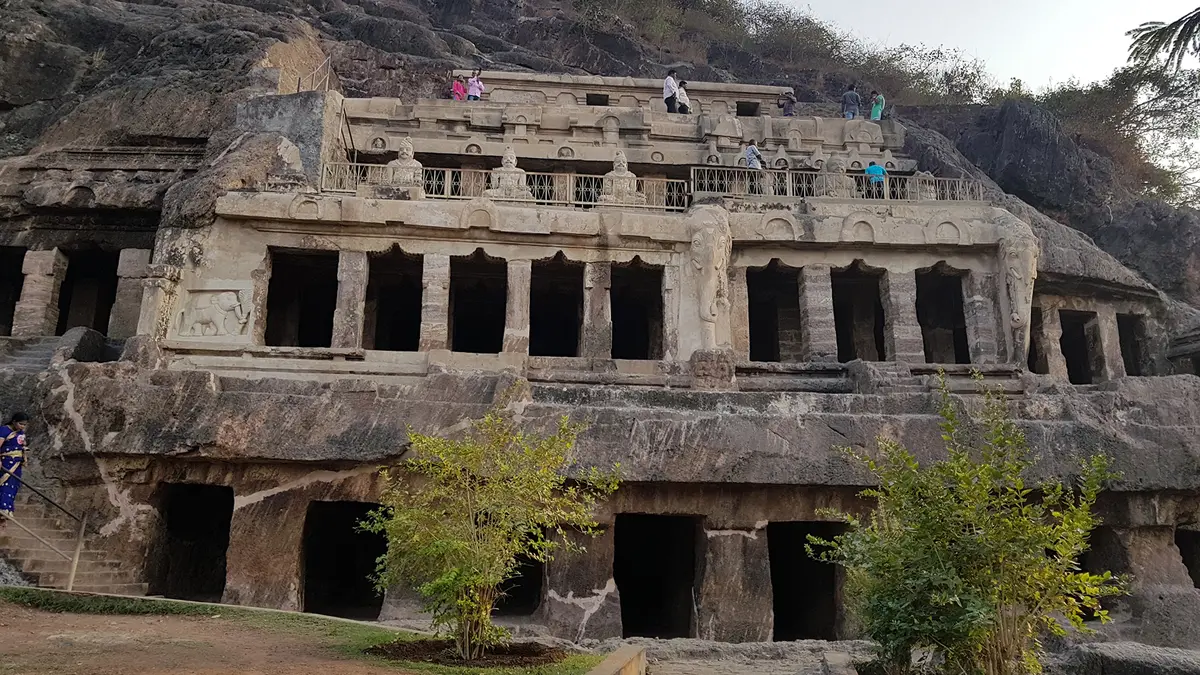
The main complex has a broad, multi-storeyed eastern façade.
What does rock-cut architecture mean?
Ordinary construction assembles separate materials, whereas rock-cut builders remove stone from a natural hill.
They gradually carve rooms and pillars inward, so mistakes can permanently damage the remaining rock.
This method therefore demands careful planning and skilled labour.
Historical development
| Period | Likely development |
|---|---|
| Fourth to sixth centuries CE | Artisans began and expanded the principal rock-cut spaces. |
| Vishnukundina period | Royal patronage supported major religious and artistic work. |
| Later centuries | Hindu worship and possible later additions continued at the site. |
| Modern period | The complex became a protected heritage and tourism site. |
The Vishnukundinas became important during the fifth and sixth centuries while ruling parts of the eastern Deccan.
They supported Brahmanical religion, while Undavalli’s surviving sculptures display a strongly Vaishnava character.
Was the complex originally Buddhist or Jain?
Some rooms resemble early monastic cells, encouraging theories about earlier Buddhist or Jain use.
Mixed religious features suggest a changing history, but scholars still debate its precise sequence.
The major surviving sculptural programme is clearly Hindu and mainly Vaishnava.
Main architectural features
The principal cave commonly has four described levels, although different terrace counts create occasional variation.
| Area | Important feature |
|---|---|
| Lower level | It contains plain and partly unfinished excavated spaces. |
| Middle level | Pillared halls and shrine areas dominate this section. |
| Main shrine level | A large reclining Vishnu forms the best-known sculpture. |
| Upper level | Smaller cells and open views overlook the river plain. |
| Façade | Rows of pillars create a monastery-like external appearance. |
The reclining Vishnu
The most famous image shows Anantashayana Vishnu, or Vishnu resting upon the serpent Ananta.
Artisans carved this roughly five-metre sculpture from living rock inside the sandstone hill.
It is not a later granite block, and represents cosmic rest between creation cycles.
Other religious features
- Vaishnava themes dominate several shrines, though images linked with Shiva also appear.
- Pillared halls supported gatherings, while simple cells may have housed residents or visitors.
- Later activity probably altered some original spaces.
Why is the location important?
The Krishna valley supported agriculture and travel, while nearby Amaravati became a major Buddhist centre.
Later settlements grew across the fertile plain, placing Undavalli within an active cultural landscape.
Heritage value and threats
- Soft sandstone allows fine carving but also weathers gradually.
- Water seepage can weaken surfaces and encourage biological growth.
- Touching and scratching can permanently damage old carvings.
- Unmanaged crowds can increase dust, vibration and surface wear.
- Nearby construction can disturb the monument’s historical setting.
Public festivals can build awareness when visitor movement remains carefully managed.
Conclusion
Undavalli joins engineering, religion and river-valley history within one carefully carved sandstone hill.