

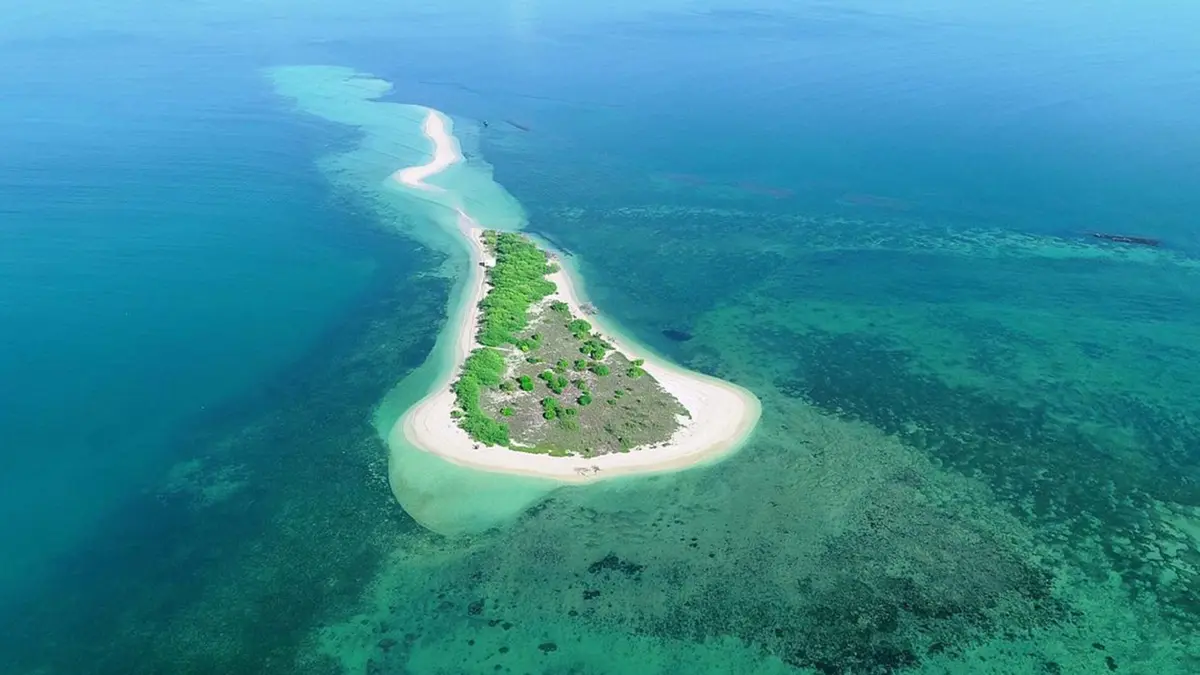
Why in news?
A technical assessment by the Tamil Nadu Coastal Restoration Mission and its partners found that restoring coral reefs around Vaan Island generated socio‑ecological benefits worth ₹61.67 crore, more than double the project’s inflation‑adjusted cost. The decade‑long project demonstrates that nature‑based coastal restoration can yield strong economic returns.
Background
Vaan Island is one of 21 uninhabited islands in the Gulf of Mannar between India and Sri Lanka. Declared part of a marine biodiversity park in 1986, the island is in the Tuticorin group of islands. Coral mining, sea‑level rise and reef degradation caused severe erosion, shrinking the island’s area by 92% between 1969 and 2015—from roughly 20 ha to just 1.53 ha. Scientists deployed 10,600 specially designed artificial reef modules around the island starting in 2015 to arrest further loss.
Key findings of the assessment
- Island expansion: Geomorphic monitoring shows that Vaan’s area has expanded to over 2.3 ha since the reef modules were installed.
- Ecological recovery: Each artificial reef module supports an average of 81 coral colonies. Fish density increased eight‑fold, from 106 to 875 individuals per hectare, and 26 native plant species were preserved.
- Economic valuation: The project yielded a benefit–cost ratio of 2.34. Coastal protection accounted for 46% of the benefits (₹28.57 crore), while sediment trapping, nutrient cycling and enhanced fisheries contributed the rest.
- Socio‑ecological benefits: Restored reefs protect coastlines from storm surge, create habitat for fish and support livelihoods such as fishing and eco‑tourism.
Gulf of Mannar – a brief profile
- The Gulf of Mannar is an inlet of the Indian Ocean between southeastern India and western Sri Lanka. It is bounded by Rameswaram Island, Adam’s Bridge (Rama’s Bridge) and Mannar Island.
- The gulf is 130–275 km wide and 160 km long. Rivers such as the Tambraparni (India) and the Aruvi (Sri Lanka) flow into it, and the port of Tuticorin lies on its Indian coast.
- The region is noted for pearl banks and chank fisheries, and its coral reefs support rich marine biodiversity.
Conclusion
The Vaan Island project shows that targeted interventions can reverse decades of degradation. Restoring coral reefs not only protects vulnerable islands but also delivers economic benefits through fisheries, tourism and coastal protection. The “Vaan model” could guide similar efforts for other eroding islands in the Gulf of Mannar.
Source: The New Indian Express