
Why in news?
A field report described Valmiki Tiger Reserve as Bihar’s main snake hotspot. More than forty-five snake species have been recorded there. Monsoon floods are increasing snake encounters near settlements. The report also contained a distribution claim requiring correction.
Background
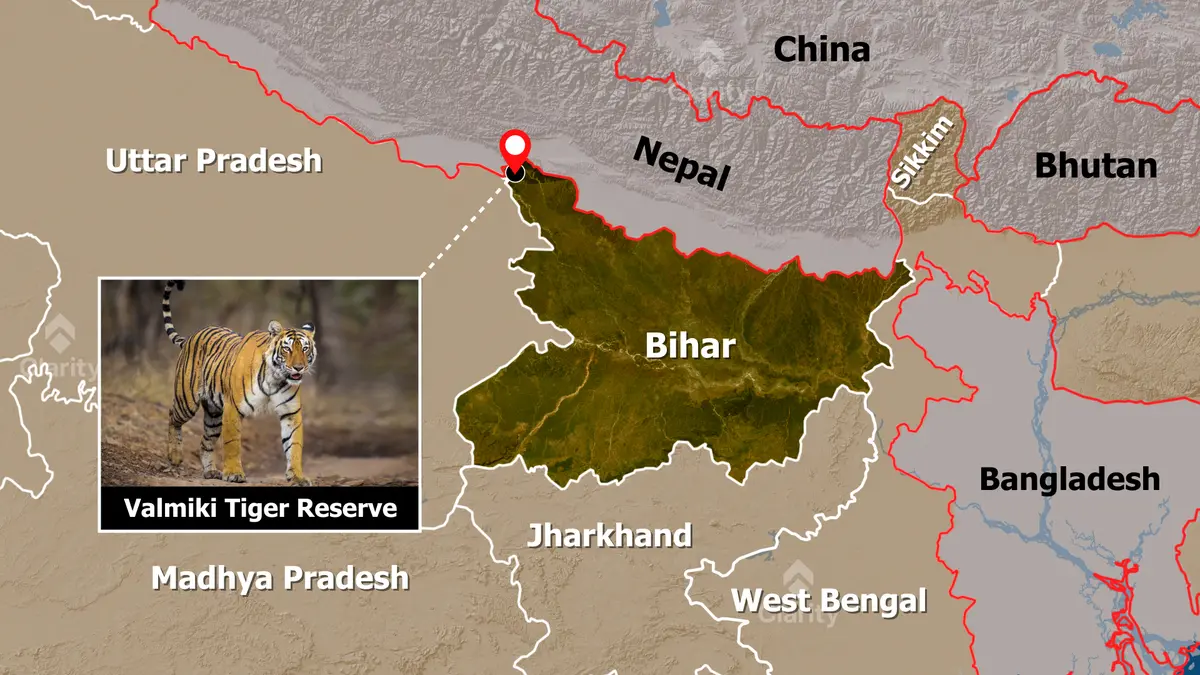
Valmiki Tiger Reserve lies in West Champaran district of northwestern Bihar, and it is Bihar’s only tiger reserve.
The reserve borders Nepal’s Chitwan forest landscape, and together, these forests create a large habitat across an international boundary.
The Gandak River flows along the reserve’s western side, and numerous smaller streams descend from the Himalayan foothills.
The protected landscape represents the easternmost limit of India’s Himalayan Terai forests. It belongs to the Gangetic Plains biogeographic zone.
Prelims facts: Valmiki is Bihar’s only tiger reserve, and it lies beside Nepal and forms part of the Terai landscape.
What are the Bhabar and Terai?
The Bhabar is a narrow foothill belt containing coarse pebbles and porous soil. Streams can disappear into this loose material.
The Terai lies immediately south of the Bhabar, and underground water reappears here because the soil becomes finer.
The Terai is therefore wetter and often marshy, and its natural landscape contains grasslands, forests, swamps and river channels.
This habitat variety supports mammals, birds, reptiles and amphibians, and it also changes greatly between dry and monsoon seasons.
How did the reserve develop?
- Valmiki Wildlife Sanctuary received protection in 1978.
- The landscape joined Project Tiger during 1989–90.
- Valmiki National Park was established in 1990.
- The tiger reserve received its formal notification in 2012.
The National Tiger Conservation Authority records 598.45 square kilometres as core, and the buffer covers 300.93 square kilometres.
The combined notified area is 899.38 square kilometres, and forests continue beyond this boundary through adjoining protected landscapes.
Why does Valmiki support many snakes?
- Rivers and wetlands provide water and amphibian prey.
- Grasslands support lizards, rodents and ground-dwelling snakes.
- Woodlands provide branches for tree-living species.
- Leaf litter offers shade and hiding places.
- Foothill elevation changes create varied microclimates.
- Connection with Nepal allows wildlife movement.
The report mentioned more than forty-five recorded species. A species count can rise as surveys, names and identification methods improve.
Which venomous snakes were reported?
The report listed cobras, kraits and vipers among medically important species, and these groups use venom to immobilise prey.
Named examples included the Indian cobra, monocled cobra and king cobra, and common, banded and Wall’s kraits were also mentioned.
Russell’s viper and saw-scaled viper completed the report’s main list, and distribution and abundance can differ greatly between local habitats.
Venomous means an animal injects toxin through a bite or sting. Poisonous usually describes harm after touching or eating something.
Safety caution: Labels like “mildly venomous” are not reliable field guides, and every unknown snake should receive distance and respect.
Pit vipers are venomous even when some bites cause limited symptoms. Bite severity depends upon species, venom quantity and treatment delay.
What is the long-snouted vine snake?
The long-snouted vine snake is scientifically called Ahaetulla longirostris, and scientists formally described it during 2024.
It has an elongated body and a remarkably long snout, and green colouring helps it hide among branches and leaves.
The original description used specimens from Bihar and Meghalaya. A later record also confirmed it in Uttar Pradesh’s Dudhwa Tiger Reserve.
Distribution correction: The species is not known only from Valmiki, and scientific records now include Bihar, Meghalaya and Uttar Pradesh.
The Uttar Pradesh record appeared during 2025. New field records can quickly expand the known range of a recently described species.
Why do monsoon encounters increase?
Heavy rain fills burrows and low ground, and snakes then move towards higher, drier shelters.
Frogs, lizards and rodents also become more active, and snakes may follow this prey near houses, farms and stored grain.
Floodwater can carry snakes away from usual habitat, and an encounter does not mean the animal is deliberately chasing people.
Most snakes avoid humans when given an escape route, and attempts to catch or kill them greatly increase bite risk.
Why are snakes useful?
Snakes consume rodents that damage crops and stored food, and rodent control can also reduce some disease risks.
They also eat frogs, lizards, fish and other animals, and larger birds and mammals may consume snakes in return.
Snakes therefore occupy both predator and prey roles, and removing them can disturb the local food web.
What should people do after finding a snake?
- Keep children and animals well away.
- Give the snake a clear escape route.
- Contact trained forest or rescue personnel.
- Never handle a snake using improvised tools.
- Do not crowd or provoke it for photographs.
- Seal household gaps after the animal leaves.
What is correct snakebite first aid?
- Move the person away from immediate danger.
- Keep the person calm and physically still.
- Remove rings, watches and tight footwear.
- Immobilise the bitten limb without a tight band.
- Arrange urgent transport to a suitable hospital.
- Note the time and changing symptoms.
Do not cut the wound or suck out venom, and do not apply ice, herbs or a tight tourniquet.
Do not delay treatment while searching for the snake. A photograph is useful only when taken safely from a distance.
Antivenom can treat serious envenoming when healthcare professionals consider it necessary. It must be given in a prepared medical setting.
What should reserve management prioritise?
- Seasonal awareness should reach every forest-edge village.
- Trained rescue teams need safe equipment and transport.
- Hospitals need reliable antivenom and clinical training.
- Species records should receive expert verification.
- Wetland and forest corridors should remain connected.
- Conflict data should guide targeted prevention measures.
Conclusion
Valmiki’s snake diversity reflects its rich Terai habitats, and accurate identification, safe behaviour and rapid treatment can reduce needless deaths.