

Why in news?
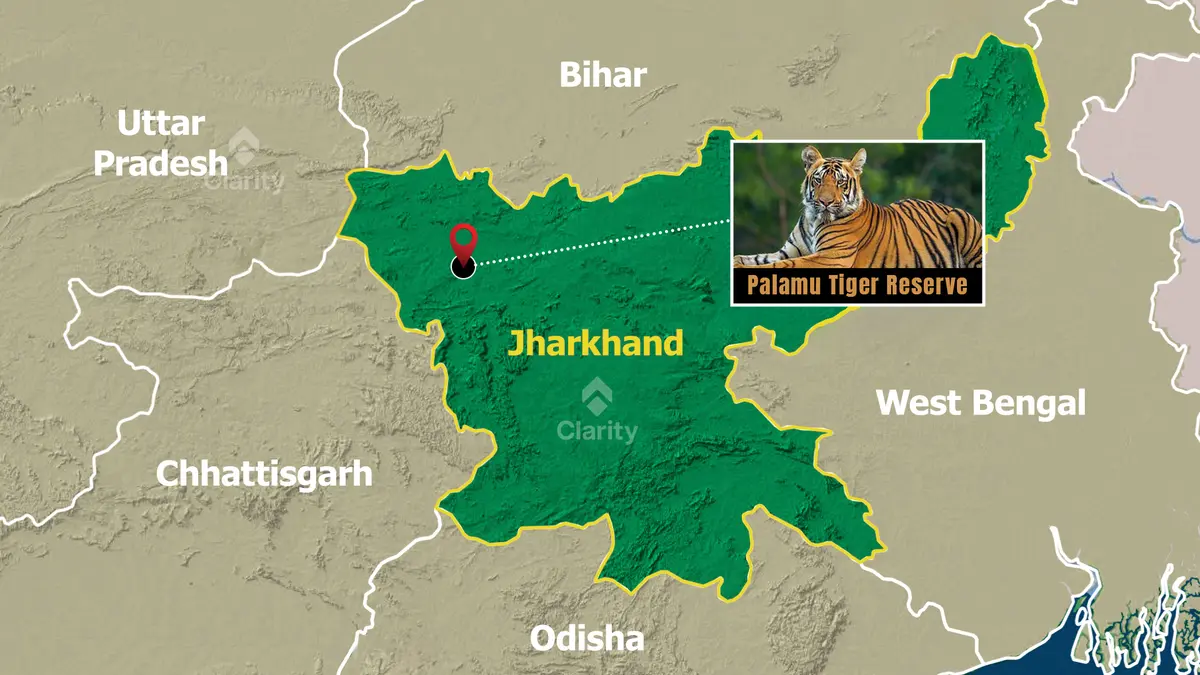
The south division of the Palamu Tiger Reserve in Jharkhand has launched the “Vanjeevi Didi” programme across 17 villages. Under this initiative, 18 educated women from each village are trained to act as ambassadors for forest and wildlife conservation, inspiring community members to protect the reserve.
Background
The Palamu Tiger Reserve, situated on the Chhotanagpur plateau of Jharkhand, is one of India’s first nine tiger reserves established under Project Tiger in 1973. It forms part of Betla National Park and encompasses undulating terrain with valleys, hills and plains. Three rivers—North Koel, Auranga and Burha—traverse its valleys, though the region is drought‑prone and Burha is the only perennial river. The reserve’s geology includes gneiss, granite and limestone, and the area is rich in minerals such as bauxite and coal.
Flora and fauna
- Vegetation: Moist and dry deciduous forests dominate, with sal and bamboo as key components.
- Wildlife: The reserve is home to tigers, Asiatic elephants, leopards, grey wolves, wild dogs, gaur, sloth bears and four‑horned antelopes. It is the site of one of the earliest tiger censuses conducted using pugmark counts (1932).
About the Vanjeevi Didi initiative
- The programme engages educated women in neighbouring villages to serve as “forest sisters” (Vanjeevi Didis). Each participant receives a monthly incentive and is tasked with motivating family members and neighbours not to harm forests and wildlife.
- Women will also share information on education, health, employment and government schemes, acting as a bridge between communities and reserve authorities.
- The initiative draws inspiration from self‑help groups (Sakhi Mandals) and para‑legal volunteers, harnessing women’s influence within households to reduce poaching and forest offences.
- The pilot phase runs for two months; its success will determine whether the programme is expanded and formally funded.
Significance
- Empowering local women fosters community ownership of conservation efforts and can reduce illegal activities by engaging those who are most connected to forest users.
- Integrating social welfare with wildlife protection – through education and job information – enhances the programme’s appeal and sustainability.
Conclusion
By enlisting women as conservation ambassadors, Palamu Tiger Reserve is pioneering a participatory approach to wildlife protection. If successful, Vanjeevi Didi could become a model for community‑based conservation in other reserves across India.
Source: The Times of India