

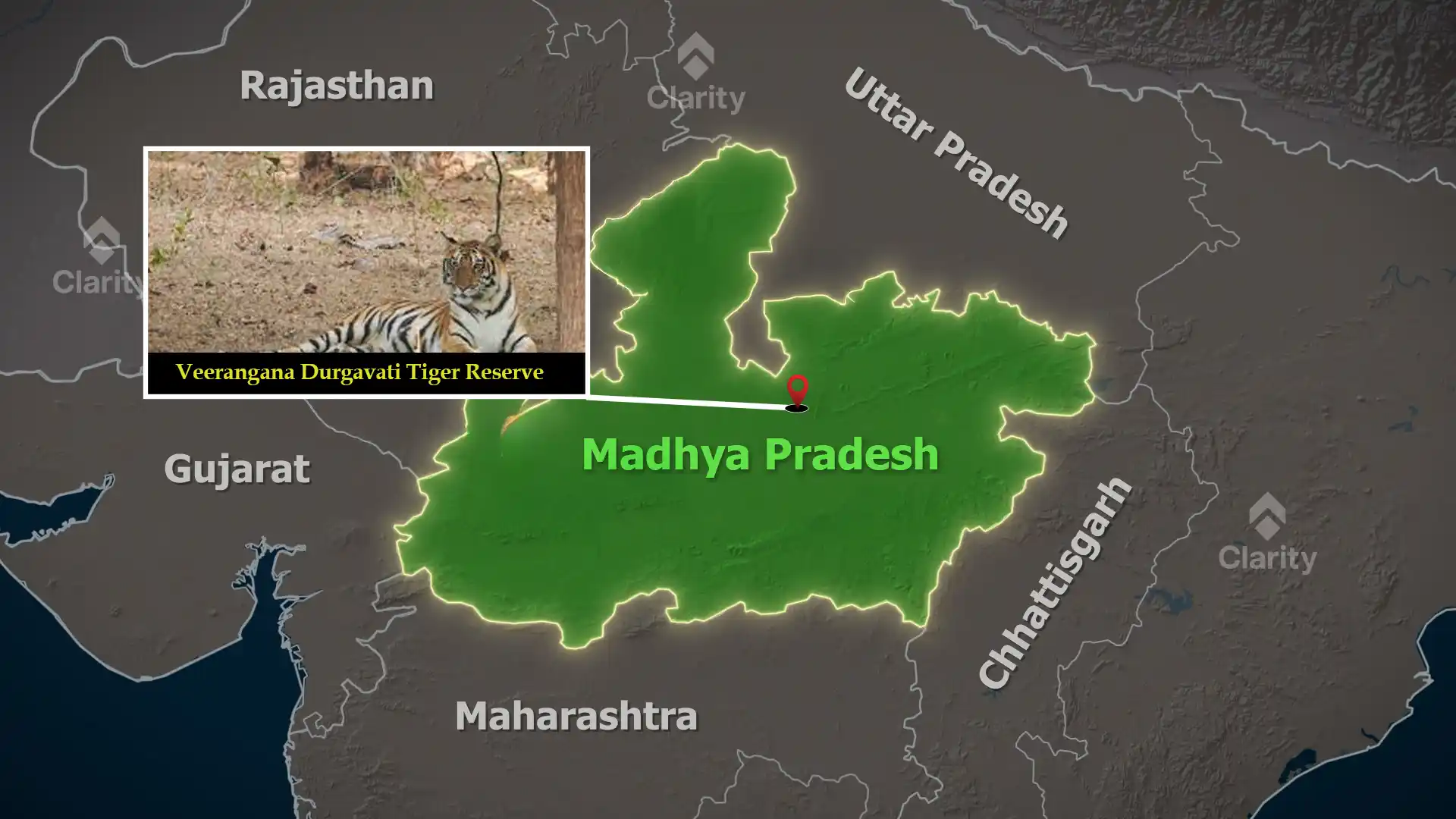
Why in news?
The National Board for Wildlife has approved the diversion of around 272 hectares of forest land from the Veerangana Durgavati Tiger Reserve in Madhya Pradesh for the construction of the Kopra medium irrigation project. The decision has sparked debate about balancing irrigation needs with conservation of a new tiger habitat.
Background
Veerangana Durgavati Tiger Reserve, named after the 16th‑century Gond queen Rani Durgavati, was notified in 2023 by upgrading the Durgavati Wildlife Sanctuary. Covering over 2,339 square kilometres, it lies between the Nauradehi and Panna tiger reserves, creating a corridor for dispersing tigers. The landscape comprises dry deciduous forests, grasslands and rivers, supporting Bengal tigers, leopards, sloth bears and many herbivore species.
The Kopra irrigation project
- Purpose: The project proposes to build earthen dams on the Byarma and Kopra rivers, creating reservoirs to irrigate about 9,900 hectares of farmland. It is expected to benefit farmers in Damoh and Jabalpur districts by ensuring water supply during the dry season.
- Forest diversion: To create the reservoirs and canals, approximately 272 hectares of reserve forest within the tiger reserve will be submerged or cleared. Thirteen villages may be displaced or affected by the backwaters.
- Compensatory measures: Authorities have earmarked around 310 hectares of revenue land for afforestation to offset the loss. Wildlife managers will also prepare a plan to mitigate impacts on tiger movements and other fauna.
Concerns and implications
- Tiger habitat: Conservationists worry that cutting forest and creating a reservoir could fragment the corridor connecting Nauradehi and Panna reserves, hindering tiger dispersal.
- Human displacement: The submergence of villages raises questions about fair compensation and rehabilitation of affected families.
- Water security: Supporters argue that the project will provide much‑needed irrigation, improve crop yields and reduce drought vulnerability in the region.
Conclusion
The Kopra project underscores the challenge of reconciling development with wildlife conservation. Effective implementation of compensatory afforestation and careful management of water releases will be crucial to minimise harm to the newly created tiger reserve while meeting farmers’ needs.
Source: The Indian Express