
Why in news?
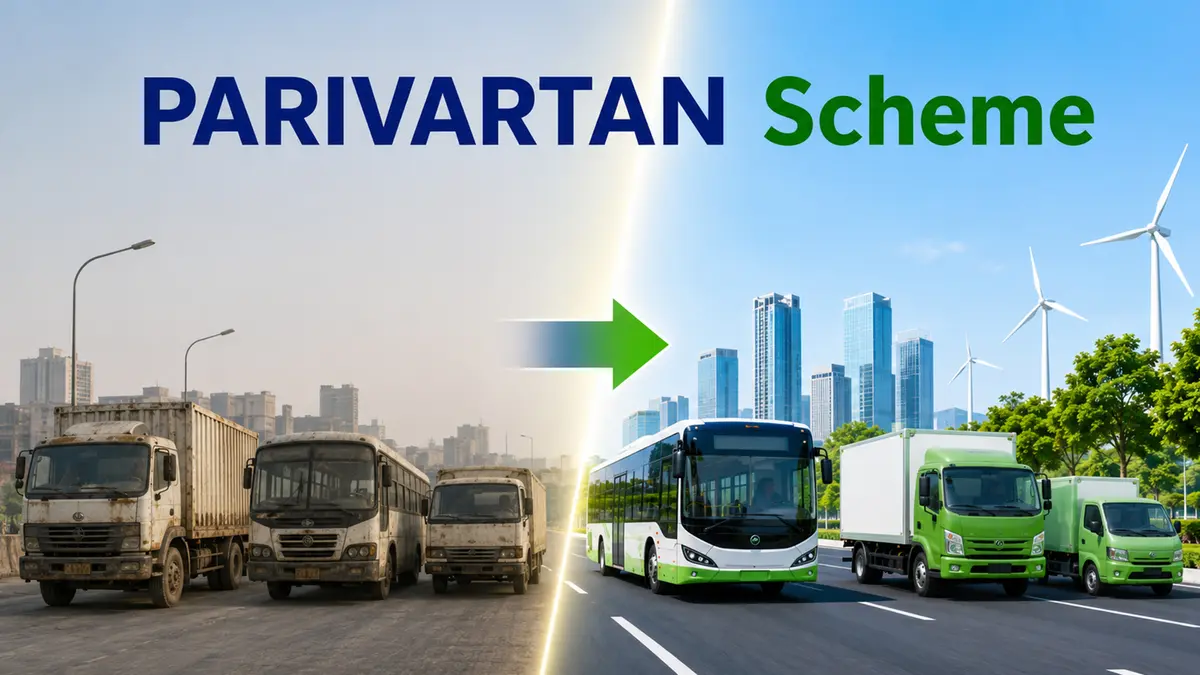
The Union government approved detailed guidelines for a vehicle renewal scheme. It targets old, highly polluting trucks and buses. The programme covers the National Capital Region. Eligible owners can replace vehicles with cleaner or electric models.
Background
Official name: Programme for Accelerated Renewal and Incentivization of Vehicle Assets for Reducing Transport Air Pollution and Network Emissions.
Its short name is PARIVARTAN; the programme uses financial incentives to encourage cleaner commercial vehicles.
It covers older trucks and buses operating in the National Capital Region.
This region is shortened to NCR; it is much larger than Delhi alone.
NCR includes the National Capital Territory of Delhi and notified districts in three neighbouring states.
These states are Haryana, Rajasthan and Uttar Pradesh.
Two different figures: The scheme’s total outlay is ₹9,585 crore. Central budget support forms ₹5,041 crore of that amount.
Why was the scheme needed?
Heavy commercial vehicles often travel long distances; older engines can release large amounts of harmful air pollutants.
These pollutants include particulate matter and nitrogen oxides; both can worsen respiratory and cardiovascular illness.
Delhi’s air problem also crosses administrative borders; trucks may enter, leave or pass through several NCR districts.
A region-wide programme can therefore work better than one limited to Delhi.
How did India’s vehicle standards develop?
- India introduced Bharat Stage standards to control vehicle emissions.
- Bharat Stage IV standards covered the whole country from April 2017.
- India then skipped Bharat Stage V and moved directly to Stage VI.
- Bharat Stage VI became mandatory nationwide on 1 April 2020.
- The Union Cabinet approved PARIVARTAN on 3 June 2026.
- The operational guidelines received approval during July 2026.
Bharat Stage VI is shortened to BS-VI; it places tighter limits on major exhaust pollutants.
A compliant diesel vehicle is cleaner than an older model; however, it does not become emission-free.
Which replacement vehicles are covered?
Owners of eligible old trucks or buses have two replacement choices.
- The first choice is a vehicle meeting Bharat Stage VI standards.
- The second choice is an electric vehicle meeting the scheme’s conditions.
The official release does not prescribe one replacement choice for every owner.
Eligibility, scrapping records, purchase details and financing must pass the scheme’s digital checks.
What incentives are offered?
- Motor vehicle tax concession: This reduces specified state-level vehicle tax.
- Registration fee waiver: This removes the eligible new vehicle’s registration charge.
- Interest subvention: The scheme provides a five per cent interest subsidy on eligible loans.
- Manufacturer discount: Participating manufacturers provide at least an eight per cent discount.
- Fuel vouchers: Eligible diesel and compressed natural gas vehicles receive monthly support.
- Electric support: Eligible electric replacements receive one-time financial assistance.
- Scrapping benefit: Owners can use or trade the recognised scrapping certificate.
Compressed natural gas is shortened to CNG.
An interest subvention is not a complete loan waiver; government support reduces part of the interest burden.
An original equipment manufacturer is the company producing the vehicle; its common short form is OEM.
Eleven manufacturers signed agreements to provide the discount; together, they cover over 95 per cent of the commercial market.
What have the participating governments done?
Delhi, Haryana, Rajasthan and Uttar Pradesh issued the necessary tax notifications.
They grant a ten-year motor vehicle tax concession for eligible new vehicles.
They also waive the registration fee; these steps create similar support across the participating region.
Who will implement and fund it?
The Ministry of Road Transport and Highways will implement the scheme.
Funding will flow through the National Capital Region Planning Board.
The Ministry of Housing and Urban Affairs approved the detailed operational guidelines.
These roles are different; one ministry approved guidelines, while another will implement the programme.
How will the digital system work?
An integrated platform will connect several government and private systems.
- VAHAN is the national vehicle registration database.
- V-Scrap supports the formal vehicle-scrapping process.
- DigiELV is a digital system for end-of-life vehicles.
- The Public Financial Management System tracks government payments.
- Participating lenders will process eligible vehicle loans.
- Fuel-voucher systems will deliver approved monthly support.
The common short form for the Public Financial Management System is PFMS.
The official release does not expand DigiELV; its full form should not be invented.
What is the Certificate of Deposit here?
A registered scrapping facility issues a Certificate of Deposit after accepting an eligible old vehicle.
The certificate proves that the vehicle entered the authorised scrapping process.
It can support benefits during a replacement purchase; the scheme also permits its trading.
Do not confuse the term: This Certificate of Deposit concerns vehicle scrapping; it is not a bank deposit.
Is the scheme compulsory scrappage?
The July release describes an incentive-based replacement programme; it does not announce automatic seizure of every old vehicle.
Other age, fitness and court-directed vehicle rules may still apply independently.
Therefore, scheme incentives and legal restrictions must not be treated as the same measure.
Why can the scheme be useful?
- It lowers the initial cost of replacing an old commercial vehicle.
- It combines tax, credit, manufacturer and fuel-related support.
- It encourages formal scrapping instead of informal vehicle disposal.
- It uses regional cooperation for a cross-border pollution problem.
- Its connected platform can reduce duplicate or unsupported claims.
Actual air-quality gains will depend on participation, enforcement, vehicle use and genuine retirement of old vehicles.
Conclusion
PARIVARTAN links cleaner transport with affordable replacement; its success will depend on careful verification and wide owner participation.