

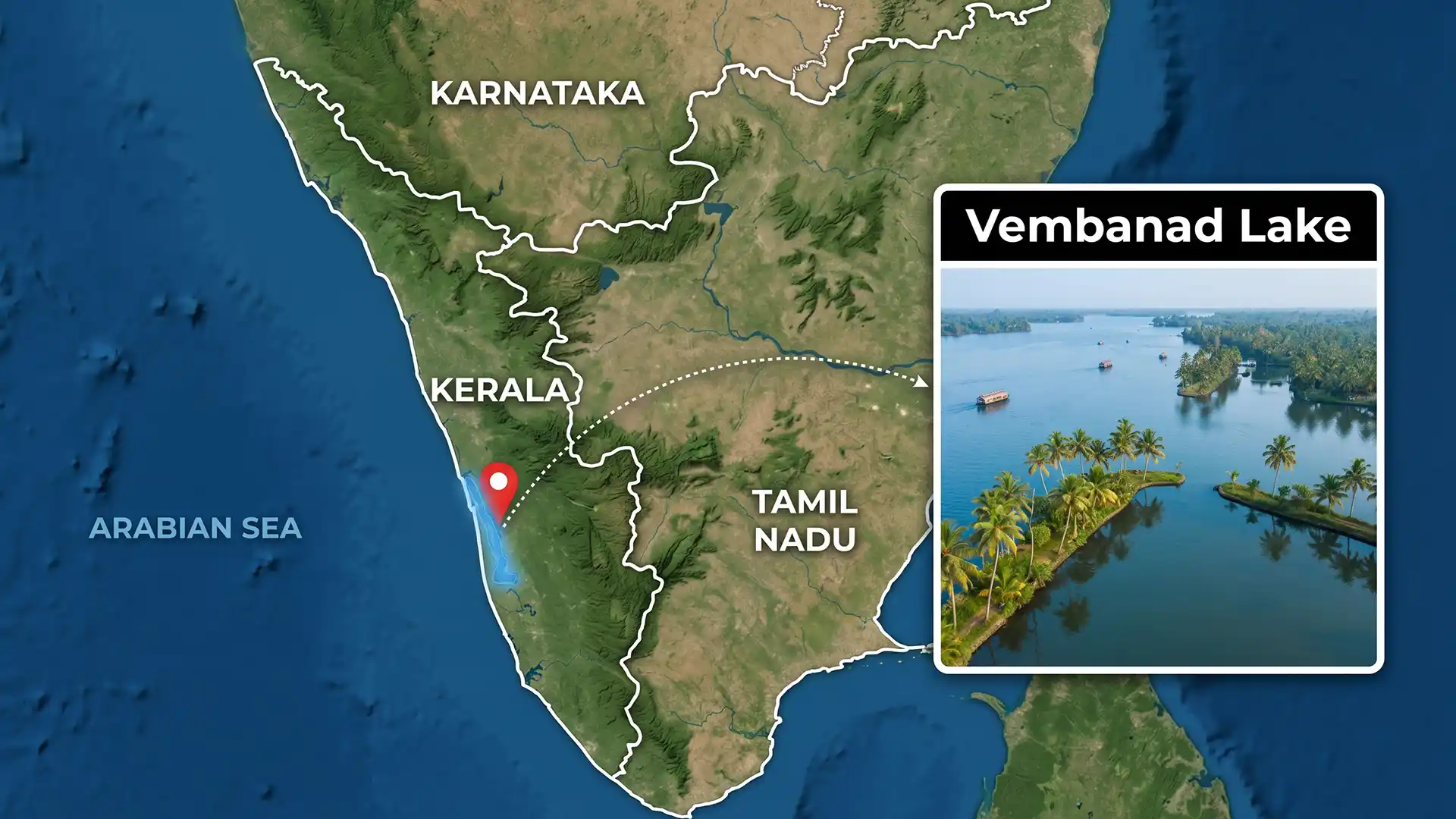
Why in news?
Kerala’s High Court recently directed authorities to regulate houseboats on Vembanad Lake after pollution complaints. Though the court order focused on tourism vessels, environmentalists say the crisis stems from decades of unplanned development, river control structures and poor waste management. The lake’s health is vital for fisheries, tourism and the livelihoods of thousands of families.
Background
Vembanad is India’s longest lake, stretching roughly 84 km along the Kerala coast. It formed when six rivers – the Pamba, Meenachil, Manimala, Achenkovil, Muvattupuzha and Periyar – deposited silt and created a sandbar parallel to the Arabian Sea. Traditionally the lake expanded during the monsoon, flooding rice fields and flushing out pollutants. In the dry season seawater would enter, providing a brackish habitat for prawns and fish.
In 1976 the Thanneermukkom barrage was constructed across the lake’s narrow mouth to prevent saltwater intrusion and allow year‑round agriculture. While the bund increased rice production, it also reduced tidal flushing. Sewage from towns, fertilizers from farms and plastic waste accumulated. From the 1990s, houseboats converted from rice barges became popular among tourists. Hundreds now operate, and many release untreated waste into the water because treatment plants and holding tanks are inadequate.
Key issues and features
- Ecological importance: Vembanad’s wetlands support mangroves, migratory birds and endemic fish. Surveys have recorded more than 170 bird species and large populations of spot‑billed pelicans, herons and egrets. Mangroves like Avicennia officinalis and Rhizophora apiculata protect the shoreline from storms.
- Human uses: The lake is a highway for ferries, fishing boats and houseboats. Its backwaters irrigate the Kuttanad “rice bowl” region. Tourism generates revenue through homestays and kettuvallam cruises, but poorly regulated growth strains the ecosystem.
- Pollution sources: Unrestricted dumping of sewage, agricultural runoff and plastic trash has increased water hyacinth and algal blooms. The Thanneermukkom bund’s closure during the dry season traps pollutants. Houseboats without proper waste treatment add to the problem.
- Governance challenges: Vembanad spans multiple districts and departments. Jurisdiction overlaps between irrigation, fisheries, tourism and local panchayats. Conservationists call for a single authority to coordinate regulation, enforce waste treatment and plan sustainable tourism.
Impact and significance
- Livelihoods at risk: Declining water quality threatens fish catches and prawn farming. Fisherfolk and boat operators depend on a healthy lake.
- Tourism reputation: Reports of foul odours and algae mats could deter visitors. Sustainable practices – such as fitting houseboats with certified treatment units and restricting numbers – can protect the industry.
- Climate resilience: Wetlands buffer floods and store carbon. Restoring mangroves and improving water flow can help communities adapt to rising sea levels and erratic rainfall.
Conclusion
Vembanad’s crisis is not caused solely by tourism; it is the result of decades of engineering interventions and neglect. Addressing it requires desilting channels, operating the Thanneermukkom barrage more flexibly, installing proper sewage treatment on boats and on land, and empowering a single body to manage the lake. Balancing agriculture, fisheries and tourism will sustain both people and nature along the backwaters.