

Why in news?
On 29 November 2025, former US President Donald Trump declared on social media that his administration would “close the airspace above and surrounding Venezuela in its entirety.” The statement raised questions because international aviation law gives each sovereign state exclusive control over its own airspace. Analysts have since explained what steps the United States can legally take and the broader implications of such threats.
Background
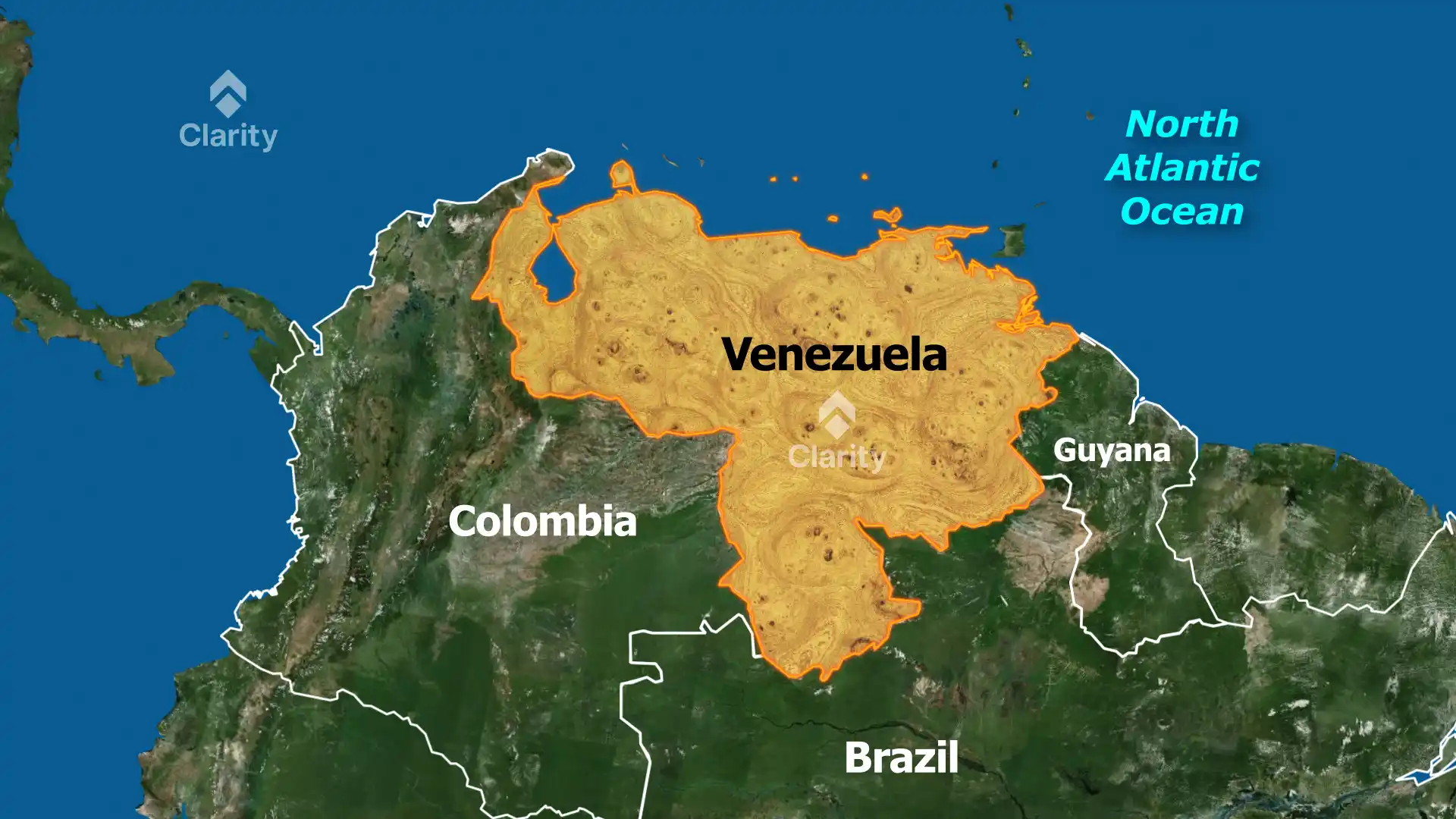
Venezuela, officially the Bolivarian Republic of Venezuela, is a South American country situated on the continent’s northern coast. It is bordered by Guyana to the east, Brazil to the south and Colombia to the west and southwest. Its northern coastline faces the Caribbean Sea and the Atlantic Ocean. The nation covers about 912,000 square kilometres, making it one of the larger countries in Latin America. The capital and largest city is Caracas.
Geographical features
- Topography: Venezuela’s landscape is diverse. The northwest contains the Andes Mountains and the Maracaibo lowlands; the central region consists of the vast Llanos (plains) fronting the Orinoco River; and the southeast is dominated by the Guiana Highlands, a high plateau deeply dissected by rivers and home to Angel Falls, the world’s tallest waterfall.
- Rivers and lakes: The Orinoco River, more than 2,000 km long, is the country’s principal waterway, with many tributaries including the Apure and Caroní. Notable lakes include Lake Maracaibo — South America’s largest — and the man‑made Lake Guri.
- Highest point: Pico Bolívar in the Andes rises to about 4,979 m.
- Natural resources: Venezuela possesses the world’s largest proven oil reserves, along with significant deposits of coal, iron ore, bauxite and gold.
The airspace issue explained
- Sovereignty over airspace: Under the Chicago Convention of 1944, states have complete and exclusive sovereignty over the airspace above their territory. Only a sovereign state can close its own airspace, unless the United Nations authorises a no‑fly zone during an armed conflict.
- Limits of US power: The United States cannot legally block other countries’ aircraft from flying over Venezuela without international approval. However, it can impose measures that indirectly isolate Venezuelan airspace, such as prohibiting US‑registered airlines and private jets from entering Venezuelan airspace or airports.
- Advisories and sanctions: The US Federal Aviation Administration can issue advisories or Notices to Air Missions (NOTAMs) warning pilots about security risks in Venezuelan airspace. The US can also expand economic sanctions, making foreign airlines reluctant to operate in Venezuela due to insurance and payment issues.
- Military presence: The article notes that the US has increased its naval and air presence in the Caribbean Sea, which could support enforcement actions or influence flight routes, but any direct closure would require broader international backing.
- Implications for other countries: While India and other nations maintain bilateral air agreements, sudden disruptions of Venezuelan airspace could affect commercial flight paths and raise insurance costs. However, such outcomes remain hypothetical given international legal constraints.
Sources: Indian Express