
Why in news?
Vietnam features regularly in international discourse because of its strategic location in the Indo‑Pacific and its rapidly growing economy. For aspirants preparing for competitive examinations, it is important to know the country’s geography, demography and historical context.
Background
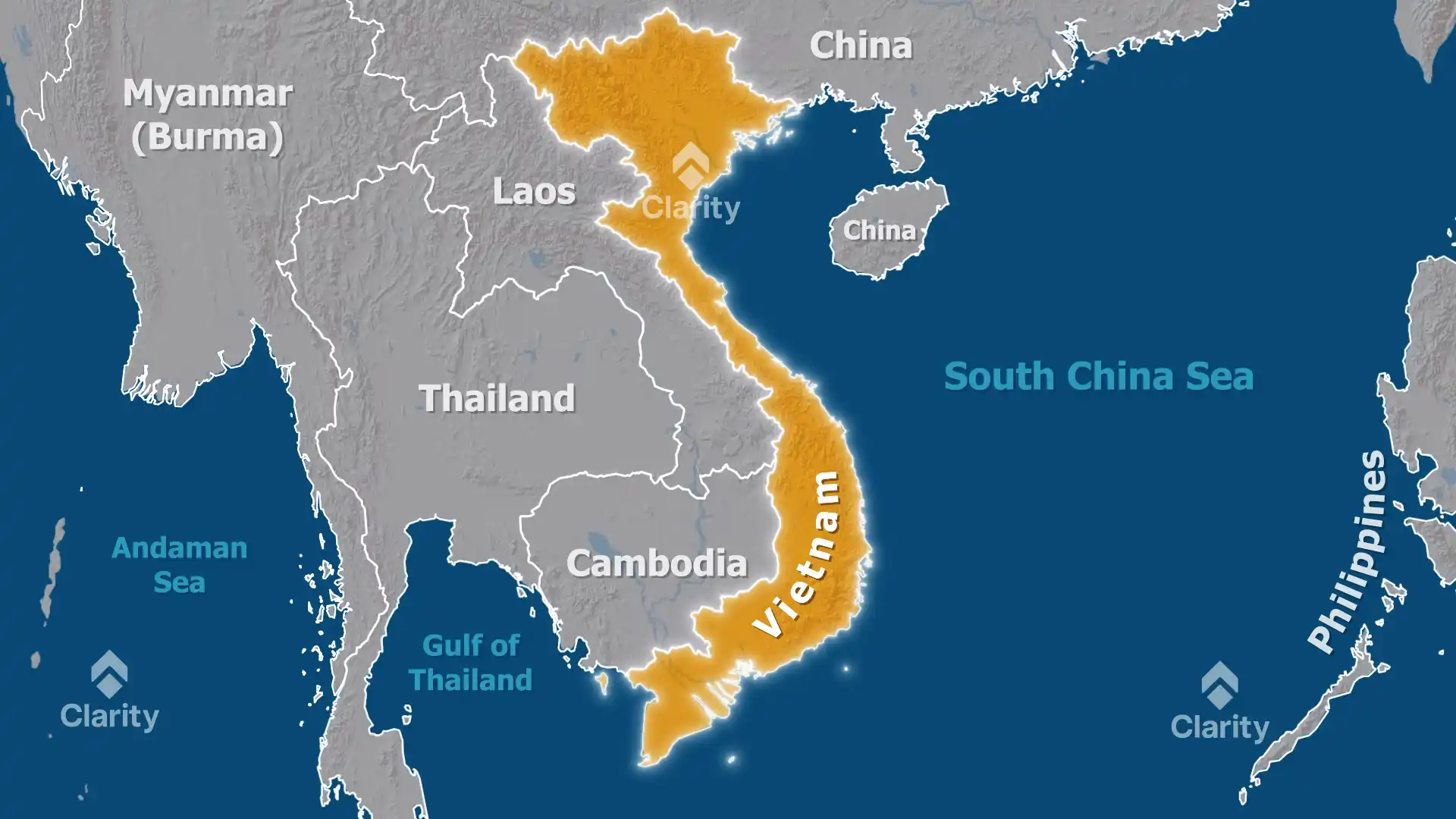
The Socialist Republic of Vietnam occupies the eastern edge of the Indochinese Peninsula in Southeast Asia. With an area of about 331,211 km² (roughly the size of Germany) and a population of around 106 million, it borders China to the north and Laos and Cambodia to the west. The country faces the South China Sea and Gulf of Thailand, giving it a long coastline of over 3,260 km. Vietnam is divided into 58 provinces and 5 centrally administered cities; the capital is Hanoi while Ho Chi Minh City (formerly Saigon) is the largest urban centre.
Physical geography
- Topography: The country has an S‑shaped outline with two fertile river deltas (the Red River in the north and the Mekong River in the south) separated by the Annamite mountain range and narrow coastal plains. The highest peak is Fansipan (3,143 m) in the northwestern highlands.
- Climate: Northern Vietnam experiences a humid subtropical climate with distinct hot and cool seasons, while the south is tropical with a long wet season. Monsoon rains and typhoons are common.
- Natural resources: Vietnam is rich in agricultural land and minerals such as coal, phosphates, manganese and rare earths. It has offshore oil and gas reserves and abundant hydropower potential.
Historical and economic context
- Vietnam has been influenced by Chinese, French and American interventions over centuries. After the Vietnam War, the country reunified in 1975 and launched economic reforms known as Đổi Mới in 1986, transitioning from central planning to a socialist‑oriented market economy.
- These reforms spurred rapid growth, turning Vietnam into one of Asia’s fastest‑growing economies with strong manufacturing and export sectors.
Source: PIB

