

Why in news?
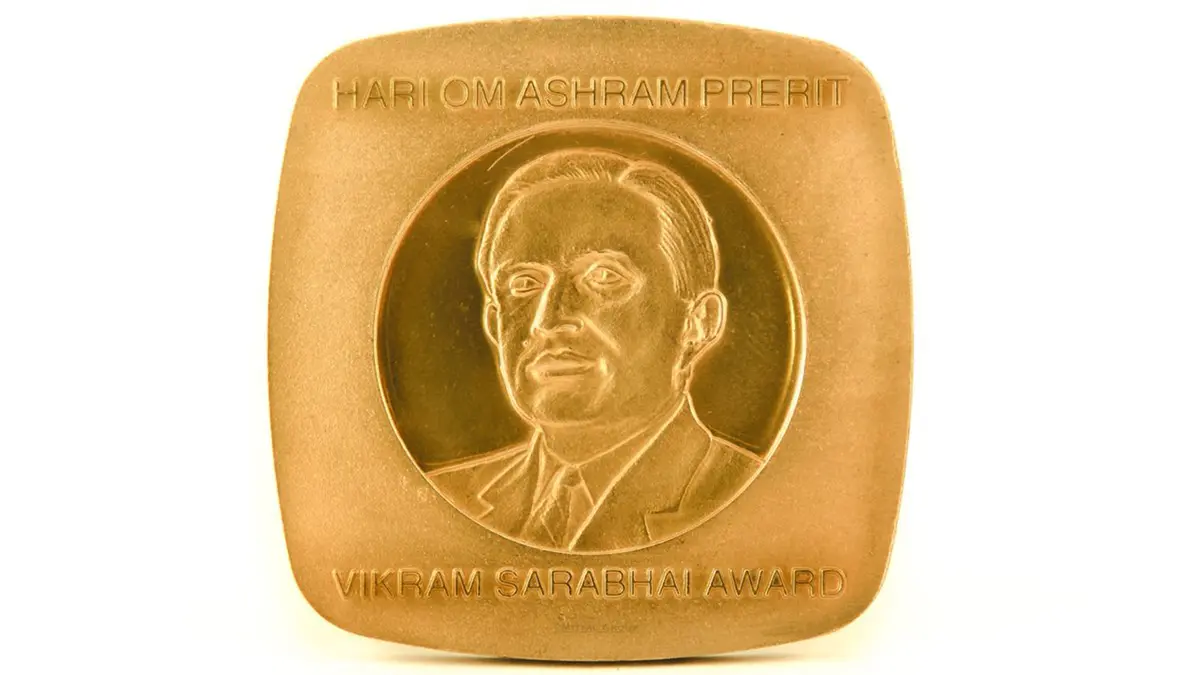
Astrophysicist Annapurni Subramaniam received the 2026 Vikram Sarabhai Medal. She became the fourth Indian recipient and first Indian woman. The award recognises work benefiting space research in developing countries. It was presented during an international scientific assembly in Florence.
Background
The Committee on Space Research is commonly known as COSPAR. It was created during 1958 by the former International Council of Scientific Unions. That council is now called the International Science Council.
COSPAR promotes international cooperation through scientific assemblies, specialist panels, publications and exchanges of space-research results. It is an international scientific organisation, not a United Nations body.
The Indian Space Research Organisation and COSPAR jointly offer the Vikram Sarabhai Medal. Presented since 1990, it honours contributions to developing-country space research and commemorates India's pioneering space scientist.
Eligibility and selection
Official rules allow candidates from any country, rather than restricting eligibility by nationality. The relevant work must mainly advance space research within developing nations.
Assessors ordinarily examine achievements during a specified recent period. For the 2026 cycle, the focus covered work relevant to the assembly's award window. This approach values sustained scientific contribution rather than nationality alone.
The 2026 recipient
Professor Subramaniam directs the Indian Institute of Astrophysics in Bengaluru. Her three-decade career spans star clusters, stellar populations, nearby galaxies and ultraviolet astronomy.
She calibrated the Ultraviolet Imaging Telescope aboard AstroSat, India's first dedicated multi-wavelength astronomy observatory. Accurate calibration turns detector signals into scientifically reliable measurements.
Her work has examined how stars form, evolve and populate galaxies. Star clusters act as useful laboratories because many member stars share an age and chemical history. Comparing their brightness and colour helps test models of stellar evolution.
She has also contributed to India's involvement in the Thirty Meter Telescope. She is associated with the proposed Indian Spectroscopic and Imaging Space Telescope. The proposed mission remains a scientific concept, not an operating observatory.
Indian recipients and factual distinctions
Udupi Ramachandra Rao received the medal in 1996. Gurbax Singh Lakhina followed in 2014, while Anil Bhardwaj received it during 2024. Subramaniam's selection therefore made her the fourth Indian recipient.
Reports described her as the third woman recipient overall, a count meaningful only against the official award list. Her more securely verified distinction is being the first Indian woman honoured.
The 46th COSPAR Scientific Assembly ran in Florence from 1 to 9 August 2026. Assemblies bring together researchers across planetary science, astronomy, Earth observation and space technology. An award at this forum carries international scientific recognition.
Why the recognition matters
Advanced astronomy depends upon expensive instruments, long collaborations and shared data. Scientists in developing countries often face unequal access to these resources. Capacity building can therefore matter alongside individual discovery.
Subramaniam's career connects domestic institutions with space observatories and global projects. Such links help train researchers and create long-term scientific capability. They also broaden participation in questions that no country can answer alone.
Conclusion
The medal recognises both scientific achievement and institution building. Its rules reward contributions to developing-country research, regardless of the recipient's nationality.