

Why in news?
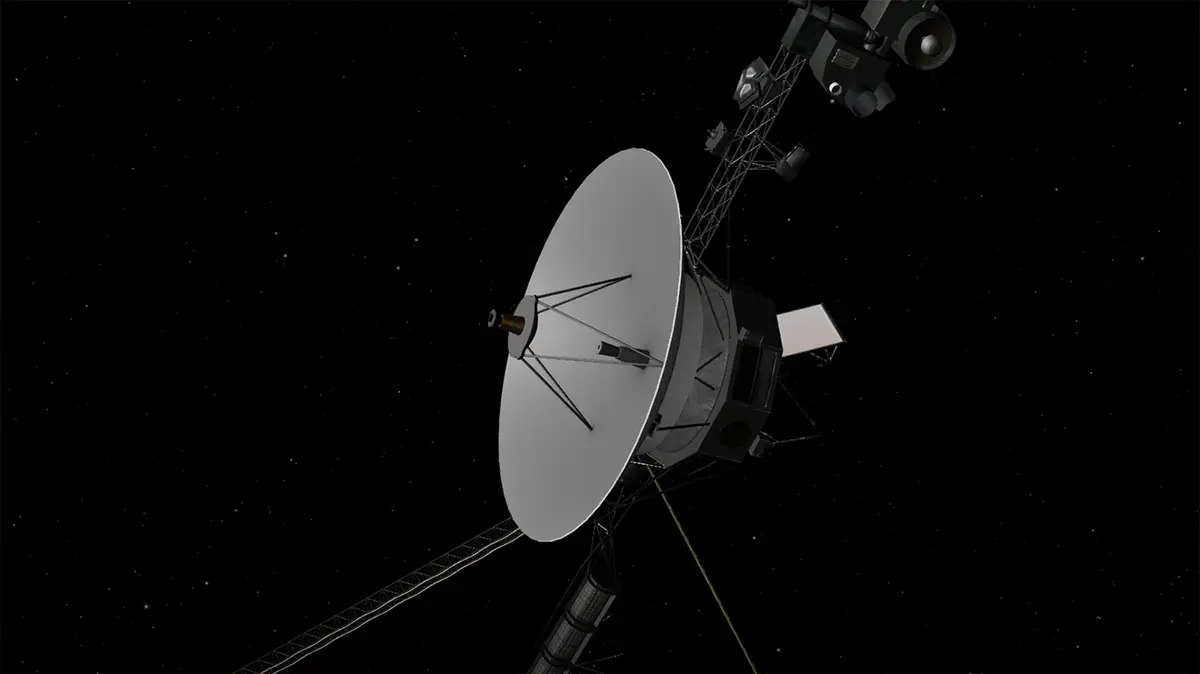
National Aeronautics and Space Administration (NASA) engineers freed power aboard Voyager 2. The change should preserve three instruments for another year.
The “Big Bang” operation
Engineers at the Jet Propulsion Laboratory nicknamed the procedure “Big Bang”. It involved several coordinated switching actions aboard the spacecraft.
They turned off selected powered devices and substituted lower-power alternatives. The team also had to keep the ageing probe warm enough.
Without the change, another Voyager 2 instrument faced shutdown before 2026 ended. NASA plans a similar operation on Voyager 1.
Why power is scarce
Voyager 2 uses three radioisotope thermoelectric generators. They convert heat from decaying plutonium-238 into electricity without moving parts.
The electrical output declines by roughly four watts each year. Mission teams have therefore shut non-essential systems and instruments gradually.
Every remaining watt must support computing, heaters, radio communication and science. A failed command would be difficult to reverse across such distance.
Interstellar space is not beyond the Solar System
Voyager crossed the heliopause, where the solar wind’s dominance ends. It remains far inside the Sun’s distant gravitational realm.
A unique planetary mission
Voyager 2 launched from Cape Canaveral on 20 August 1977. Gravity assists carried it past Jupiter, Saturn, Uranus and Neptune.
It remains the only spacecraft to visit Uranus and Neptune. Those flybys transformed knowledge of their moons, rings, atmospheres and magnetic fields.
The probe entered interstellar space on 5 November 2018. NASA announced the crossing after analysing plasma and magnetic-field evidence.
Its surviving instruments study cosmic rays, magnetic fields and plasma waves. These measurements sample a region unreachable by Earth-orbiting observatories.
Why longevity produces science
Voyager’s value now comes from duration and location, not modern computing power. Long records show how the Sun’s influence changes over time.
Communication uses NASA’s Deep Space Network. Commands take many hours to reach the probe, so operations must be planned conservatively.
Ageing missions also test redundancy and remote diagnosis. Their lessons inform spacecraft designed for decades beyond immediate repair.
Efficiency becomes exploration
The power saving is small in engineering terms. In scientific terms, it buys another year in a unique environment.
Conclusion
Voyager 2 survives through careful trade-offs, not a major hardware upgrade. Its extended life shows how engineering discipline protects rare science.