
Why in News?
For the first time, a male Western Hoolock Gibbon was documented crossing specially constructed canopy bridges over a railway line in the Hollongapar Gibbon Sanctuary in Assam’s Jorhat district. The sighting offers hope for reconnecting fragmented ape populations divided by linear infrastructure.
Background
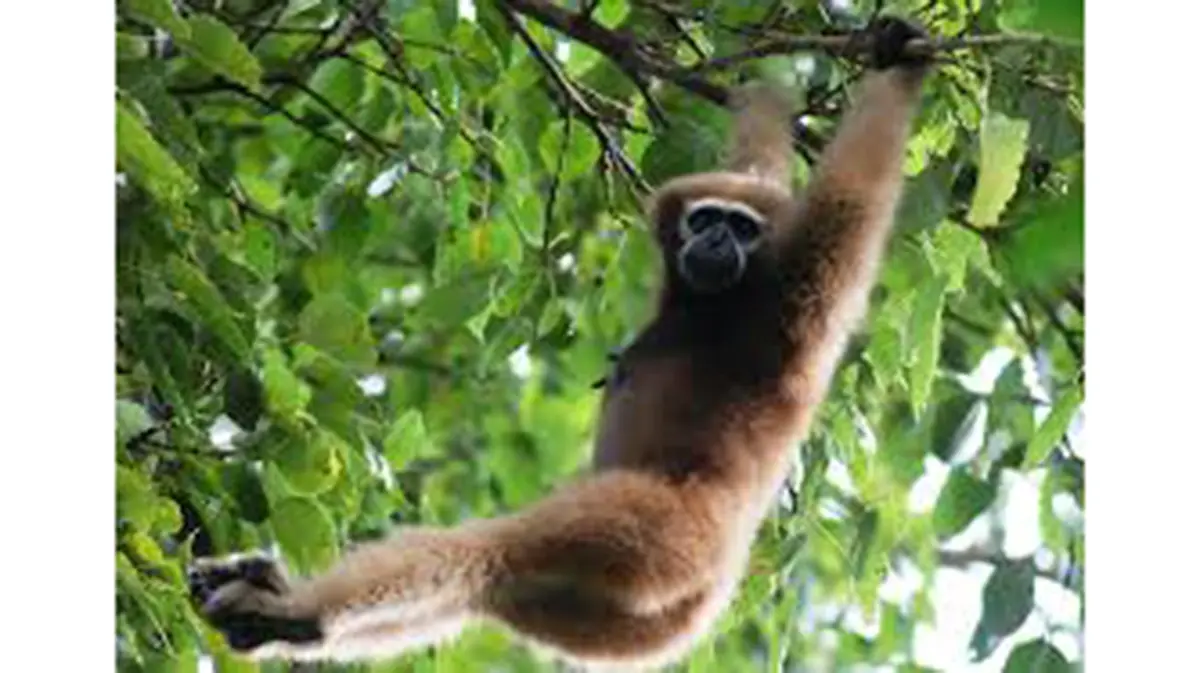
The Western Hoolock Gibbon (Hoolock hoolock) is the only ape species found in India. It is small, agile and brachiates through forest canopies using its long arms. Endemic to northeastern India, Bangladesh and Myanmar, the species prefers moist evergreen and semi‑evergreen forests south of the Brahmaputra River. Hoolock gibbons live in monogamous family groups, have a lifespan of around 25 years and communicate using loud songs.
The Hollongapar Gibbon Sanctuary, covering about 21 km², has been bisected by the Lumding–Dibrugarh railway line since the late 19th century. The track creates a gap in the canopy that gibbons cannot cross, isolating families on either side and reducing genetic exchange. Previous attempts to bridge the gap included planting trees to form a natural canopy and constructing a metal bridge, but these either took too long or failed to accommodate the gibbons’ specialised swinging movement.
The Canopy Bridge Initiative
- Design: Wildlife biologists and railway engineers installed rope‑and‑net bridges above the railway line in early 2025. The bridges are flexible and positioned at canopy height, allowing gibbons and other arboreal animals to swing and climb naturally.
- First crossing: On 16 May 2026 a male Western Hoolock Gibbon was filmed traversing the bridge. This is believed to be the first documented use of an artificial canopy bridge over a railway by a gibbon anywhere in the world.
- Importance: The crossing shows that appropriate design can mitigate the effects of linear infrastructure on tree‑dwelling species. By reconnecting isolated sub‑populations, such bridges can enhance genetic diversity and improve long‑term survival prospects.
- Other species: The sanctuary also supports other arboreal mammals such as slow lorises, several macaque species, capped langurs, Malayan giant squirrels and flying squirrels, all of which stand to benefit from canopy connectivity.
About the Western Hoolock Gibbon
- Physical characteristics: This gibbon is the smallest and fastest of the apes. Males are black or dark brown; females are brownish or buff. Both sexes have white eyebrows.
- Behaviour: Gibbons are diurnal and arboreal, travelling exclusively through the tree canopy. They form lifelong pair bonds and live in nuclear families, communicating with elaborate duets.
- Threats: Habitat loss from logging, tea plantations and urban expansion is the main threat. Illegal hunting and capture for the pet trade also endanger the species.
- Conservation status: The Western Hoolock Gibbon is listed as Endangered by the IUCN and is protected under Schedule I of the Wildlife (Protection) Act, 1972.
Significance
- The successful use of canopy bridges provides a model for mitigating habitat fragmentation caused by roads, railways and power lines across wildlife corridors.
- It underscores the importance of integrating ecological considerations into infrastructure planning, ensuring that development does not isolate wildlife populations.
- Publicising such success stories may garner support for funding and implementing similar conservation measures elsewhere.
Conclusion
The Hollongapar experiment demonstrates that targeted, science‑based interventions can make a tangible difference for endangered species. Ensuring regular maintenance of the bridges and restoring wider habitat connectivity will be essential for the long‑term survival of the Western Hoolock Gibbon.
Source: Times of India

