
Why in news?
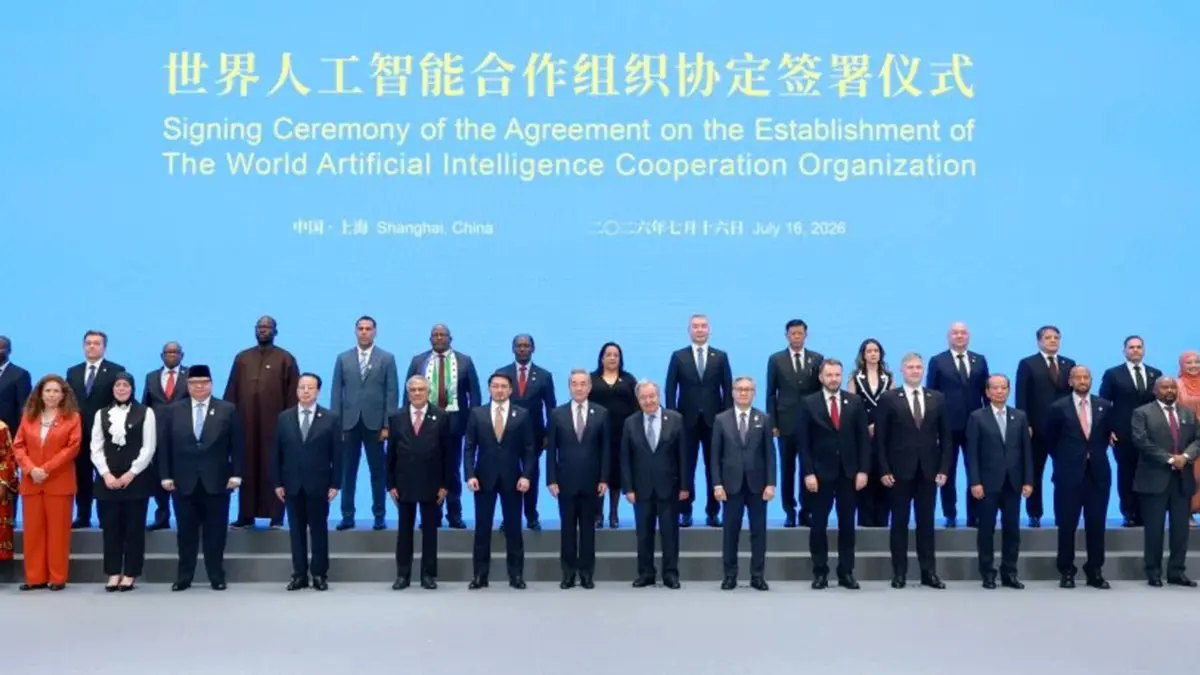
Twenty-nine countries signed an agreement in Shanghai on 16 July 2026. The agreement establishes a new global artificial intelligence cooperation body. Its headquarters will be located in Shanghai. India did not join the founding group.
Background
Artificial intelligence allows computer systems to perform tasks that usually require human intelligence.
Such tasks include prediction, language processing and image recognition; artificial intelligence is shortened to AI.
AI systems now cross national borders through software, data, research and cloud services.
However, countries differ greatly in computing power, skills, finance and regulatory capacity.
These differences created calls for wider international cooperation and fairer access.
What is the new organisation?
The World Artificial Intelligence Cooperation Organization is shortened to WAICO; it is an independent intergovernmental organisation.
Its founding agreement was signed in Shanghai on 16 July 2026; the city will host its headquarters.
The organisation seeks cooperation on AI governance, development, safety and access; it especially stresses developing countries’ needs.
Institutional clarity: WAICO is not a United Nations body; it was created through a separate intergovernmental agreement.
The United Nations Secretary-General attended the ceremony; this participation did not place WAICO inside the United Nations system.
How did the idea develop?
- China proposed a Global Artificial Intelligence Governance Initiative in 2023 to promote international consultation on development and governance.
- Chinese Premier Li Qiang proposed a global cooperation organisation on 26 July 2025.
- He made the proposal during the World Artificial Intelligence Conference in Shanghai.
- Countries then discussed an agreement and the organisation’s proposed functions.
- Twenty-nine governments signed the founding agreement on 16 July 2026.
The signing created WAICO’s foundation; domestic approval procedures may still be required in individual founding countries.
Which countries signed the agreement?
The founding group contained 29 countries from Africa, Asia, Europe and the Americas.
| Region | Founding signatories |
|---|---|
| Africa | Algeria, Cameroon, Congo, Ethiopia, Kenya, Lesotho, Mozambique, Senegal, South Africa and Zambia |
| Asia | Cambodia, China, Indonesia, Kazakhstan, Kyrgyzstan, Laos, Malaysia, Myanmar, Oman, Pakistan, Tajikistan and Uzbekistan |
| Europe and Eurasia | Belarus, Russia and Serbia |
| Americas | Brazil, Cuba, Nicaragua and Venezuela |
The official list uses the single name “Congo”; it does not specify which Congolese state.
Students should retain that official wording; India was not among the 29 founding signatories.
The name BRICS originally represented Brazil, Russia, India, China and South Africa.
Among these original five members, only India remained outside the founding group.
Prelims point: WAICO has 29 founding signatories; India was not one of them.
What principles guide WAICO?
- People-centred development: Technology should serve human welfare and social progress.
- Safety: Cooperation should reduce harmful or uncontrolled uses of AI.
- Fairness: Countries should receive more equal opportunities to use the technology.
- Consultation: Members should discuss rules and priorities together.
- Joint contribution: Members should provide knowledge, projects and institutional support.
- Shared benefits: Gains should not remain concentrated among a few economies.
Official statements also connect the body with the purposes and principles of the United Nations Charter.
This reference expresses a guiding commitment; it does not make WAICO a United Nations agency.
What work may the organisation undertake?
- It may encourage research exchanges and support infrastructure and skills in developing economies.
- It may discuss common approaches to safety, ethics and governance.
- It may connect governments, researchers, companies and international institutions.
- It may promote practical AI projects with development benefits.
- It may reduce the technological gap between richer and poorer countries.
These goals are broad; later rules will determine how programmes and decisions actually work.
Is WAICO the same as the Shanghai conference?
The similar names can confuse readers; the World Artificial Intelligence Conference is shortened to WAIC.
WAIC is a recurring conference that brings together governments, researchers and businesses.
WAICO is the new intergovernmental organisation created through an agreement.
| Feature | WAIC | WAICO |
|---|---|---|
| Full name | World Artificial Intelligence Conference | World Artificial Intelligence Cooperation Organization |
| Nature | Recurring conference and public forum | Intergovernmental organisation |
| Basic purpose | Discussion, exhibitions and networking | Long-term international cooperation |
Why did India remain outside?
The founding releases record India’s absence but do not give an official Indian reason.
Therefore, any explanation based on geopolitics or strategy would remain an inference.
India already participates in several global discussions on safe and inclusive AI.
Remaining outside this founding group does not mean abandoning international AI cooperation.
India can assess WAICO’s rules, governance and practical value before deciding its future approach.
Why does the development matter?
- AI governance is becoming an important field of international diplomacy.
- The new body gives China a central role in another global institution.
- Developing countries may gain training, infrastructure and research partnerships.
- Different governance bodies may also produce competing standards and expectations.
- India must protect its interests while supporting safe and inclusive technology.
Conclusion
WAICO adds a new global AI institution; its influence will depend upon rules, resources and practical results.