

Why in news?
Cross-border attacks again raised fears of wider fighting around Yemen. Saudi authorities said Houthi strikes wounded eleven civilians near the border. The 6 August incident followed renewed missile exchanges after several years of lower cross-border violence.
How Yemen became divided
The Houthi movement, also called Ansar Allah, seized Sana’a in 2014. It later displaced the internationally recognised government from the capital; a Saudi-led coalition intervened in March 2015. The war then drew in regional powers, local armed groups and competing political authorities.
Houthis control Sana’a and much of the populous northwest; the internationally recognised Presidential Leadership Council is based mainly in Aden.
Southern forces do not form a single political bloc. The Southern Transitional Council announced its dissolution in January 2026. Some members disputed that move. Its former networks and separatist ambitions still complicate the anti-Houthi camp.
Al-Qaeda in the Arabian Peninsula has also exploited weak governance; its presence adds a separate counter-terrorism dimension.
The truce and its limits
A United Nations-brokered truce began in April 2022; it expired formally in October, but major cross-border hostilities remained lower afterwards. The truce did not produce a comprehensive peace agreement. Front lines, divided institutions and economic pressure continued.
Saudi-Houthi contacts created further space for de-escalation; however, negotiations excluded or only partly involved several Yemeni actors.
Regional crises then complicated the process. Houthi attacks linked to the Gaza conflict brought international military responses around the Red Sea.
Renewed fire near Saudi territory now tests the restraint built since 2022. A limited exchange can still trigger a much broader cycle.
Claims during conflict
The reported civilian injuries came from Saudi military statements. Independent verification from the border area was limited. Houthi and opposing sources also frame operations differently. Attribution, target and damage should remain clearly sourced.
A humanitarian emergency beneath the politics
The 2026 humanitarian plan estimates that 22.3 million people need assistance or protection; that is most of Yemen’s population. About 18.3 million people face acute food insecurity. An estimated 2.2 million children under five face acute malnutrition.
More than five million people remain internally displaced. Repeated movement weakens household income, schooling and access to health care.
Only 59.3 per cent of health facilities were reported fully functional. Disease outbreaks therefore become harder to detect and contain.
Humanitarian agencies also face severe funding gaps and access restrictions. Aid cannot replace salaries, functioning markets and public institutions indefinitely.
Why geography matters
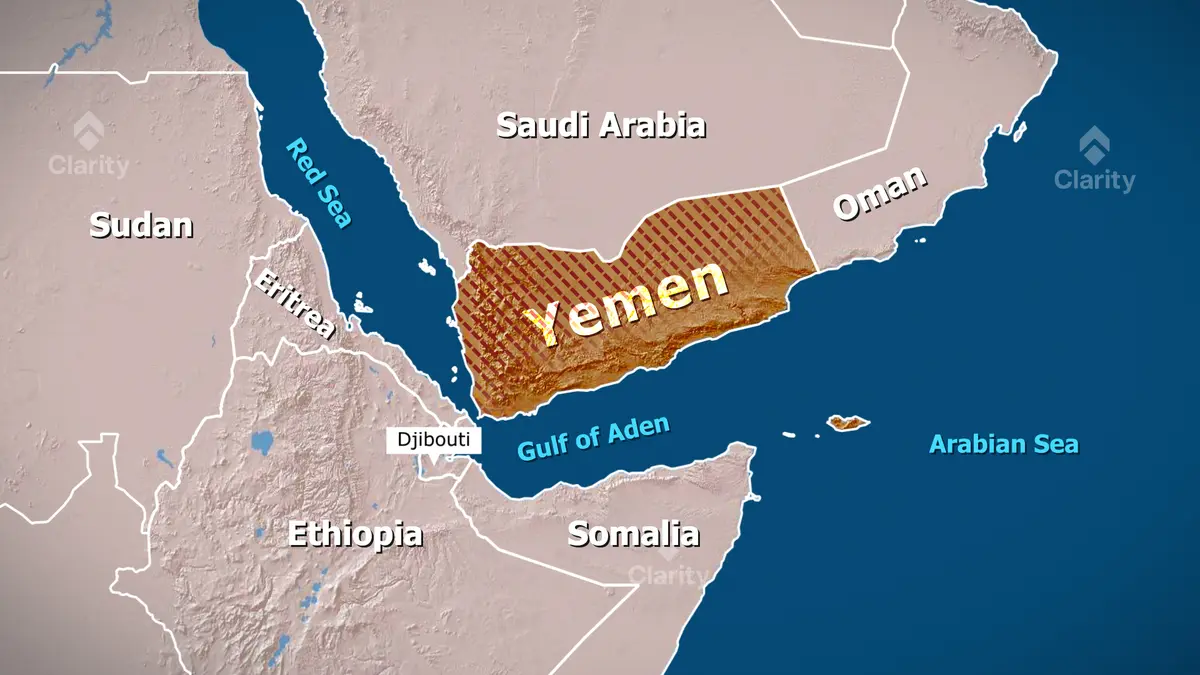
Yemen overlooks the Bab el-Mandeb strait between the Red Sea and Gulf of Aden. Shipping there connects toward the Suez Canal. Attacks near this route can increase insurance, rerouting and delivery costs. Their effects can therefore extend well beyond Yemen.
The country also shares a long land border with Saudi Arabia. Border security and local livelihoods are consequently linked.
Maritime pressure can attract external military action without resolving Yemen’s internal conflict; that separation is central to any durable settlement.
What a peace process must address
A ceasefire remains necessary, but it cannot settle every dispute. Yemen needs an inclusive political process among its diverse actors. Economic arrangements are equally urgent. Divided currencies, banking restrictions and unpaid salaries deepen hardship even without active combat.
Ports, roads and airports require predictable access. Detainee exchanges can build confidence, but they need broader institutional follow-through.
Women, civil society and marginalised regions need meaningful representation; a bargain among armed elites alone may reproduce instability.
Regional guarantees can support peace, but Yemeni ownership remains essential. External security deals cannot substitute for legitimate governance.
Conclusion
The latest border violence shows how quickly Yemen’s incomplete truce can erode. Restraint is needed before retaliation becomes self-sustaining. Any diplomatic response must protect civilians and restore economic life. Yemen’s humanitarian crisis cannot wait for a perfect political settlement.