

Why in news?
The famous Chadar Trek – a winter expedition where trekkers walk on the frozen Zanskar River in Ladakh – was postponed this year. Scheduled to begin on 10 January 2026, authorities delayed the start because the river’s surface had not frozen fully. Warmer temperatures and changing climate patterns were cited as reasons, and officials hoped to resume the trek around mid‑January.
Background on the Zanskar River
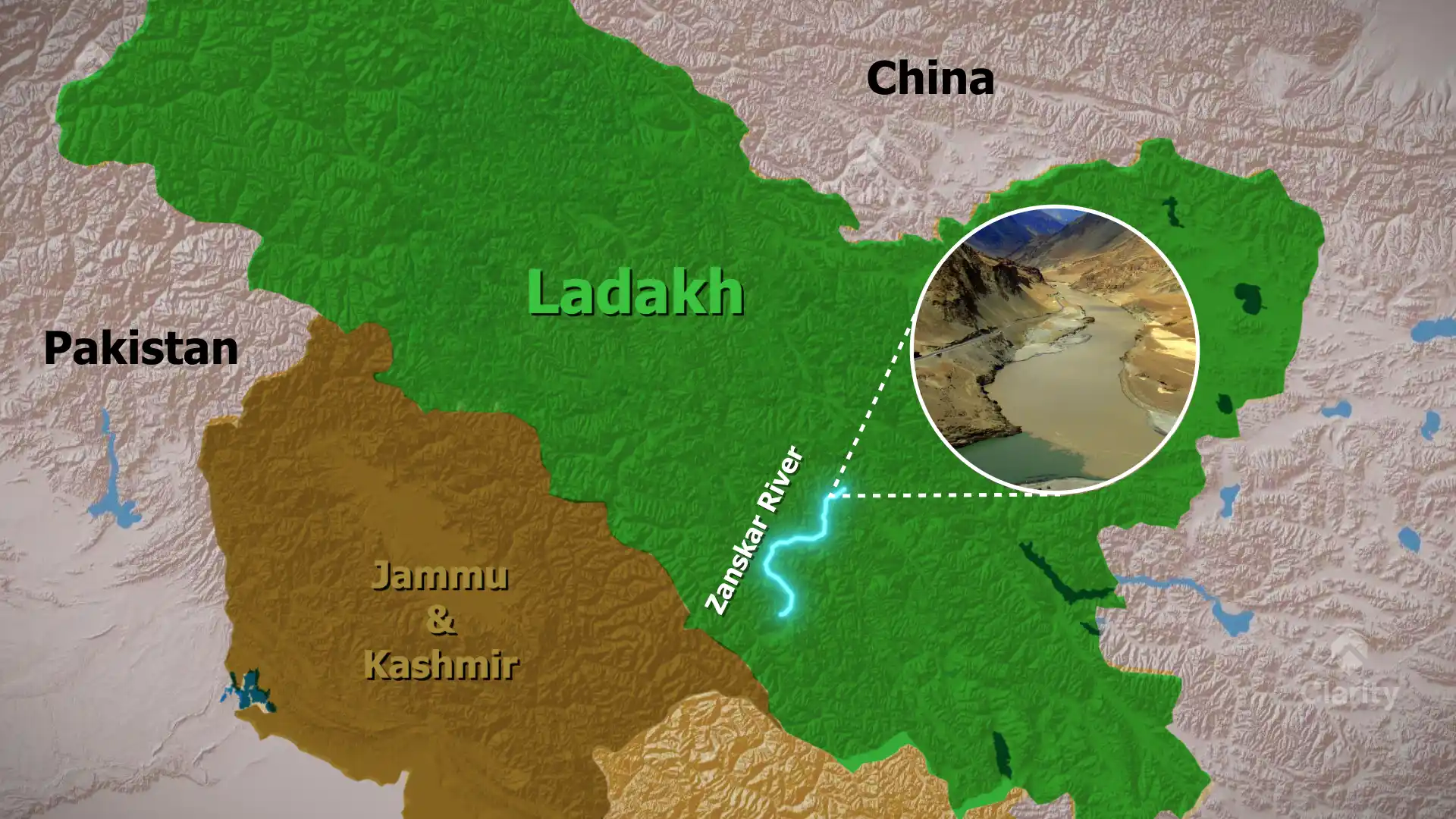
The Zanskar River is a major left‑bank tributary of the Indus River, flowing entirely within the union territory of Ladakh in northern India. It is formed by the confluence of two mountain streams:
- Stot (Doda) River: Originates near the Pensi‑La pass and is fed by glaciers on the southern mountain ranges.
- Lugnak (Lungnak) River: Drains catchments adjacent to Himachal Pradesh, receiving meltwater from glaciers near Shingo La.
These tributaries meet near the town of Padum to form the Zanskar River, which then carves a deep gorge through the Himalayas before joining the Indus at Nimmu downstream of Leh. The entire catchment has been shaped by glacial activity, resulting in a U‑shaped valley with numerous hanging tributaries.
Features and significance
- Deep gorge: In its middle course the river cuts a spectacular canyon known as the Zanskar Gorge. Sheer cliffs and turquoise waters attract adventure enthusiasts and geologists alike.
- Tributaries: Besides the Stot and Lungnak, important tributaries include the Tsarap Chu, Doda and Khurana rivers.
- Adventure tourism: In summer the Zanskar is popular for white‑water rafting between Chilling and Nimmu. In winter, when the river freezes into a thick sheet of ice, it becomes the route for the Chadar Trek, offering a unique experience of walking on a frozen river.
- Sparse habitation: Human settlements along the river are limited to small villages such as Padum and Abring. The rugged terrain and harsh climate make farming difficult, so locals depend on limited agriculture and tourism.
Reasons for the postponement
- Officials reported that the ice sheet on the Zanskar had not thickened enough to support trekkers safely. Warmer daytime temperatures and variability in winter precipitation slowed the formation of stable ice.
- The district administration announced that additional National Disaster Response Force (NDRF) personnel would be deployed, and a new inspection of the route would determine when the trek could begin.
- Experts noted that climate change and the construction of the Nimu–Padum–Darcha road have altered river conditions in recent years, leading to shorter windows for the Chadar Trek.
Significance
- The Zanskar River is both a lifeline for local communities and a major attraction for adventure tourists. Changes in its freeze–thaw cycles directly affect livelihoods in the region.
- The postponement highlights the wider impacts of global warming on Himalayan rivers and glaciers. Ensuring safety for trekkers while preserving fragile ecosystems will require adaptive management and responsible tourism.