

Why in news?
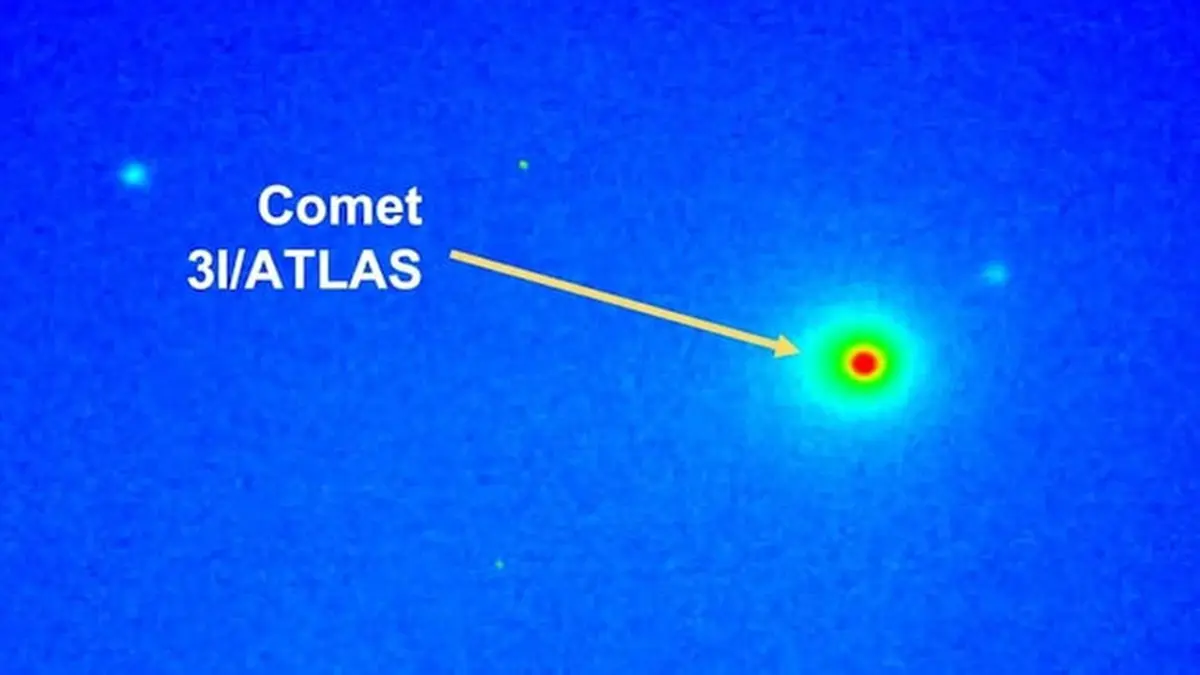
Observations with the James Webb Space Telescope and ALMA have revealed that the interstellar comet 3I/ATLAS contains water with extremely high deuterium levels – about thirty times the ratio found in comets born in our solar system. It also has very low amounts of carbon‑13. These clues suggest that the comet formed in a frigid region of the galaxy 10–12 billion years ago, making it one of the oldest objects ever studied. 3I/ATLAS is only the third interstellar object discovered and will leave the solar system after a brief visit.
Background
The Asteroid Terrestrial‑impact Last Alert System (ATLAS) telescope in Chile first spotted the comet on 1 July 2025. Its hyperbolic trajectory showed that it came from outside the solar system. Following the naming convention, astronomers designated it 3I/ATLAS – the third known interstellar object after 1I/‘Oumuamua (2017) and 2I/Borisov (2019). At discovery the comet was about 670 million kilometres from the Sun. It passed inside the orbit of Mars in October 2025 and is now heading back into interstellar space. With a speed of about 60 km per second, it will never return. The body is estimated to be up to 20 kilometres across and displays a coma and tail like ordinary comets, showing that it contains volatile ices.
What the new observations mean
- Ancient origin: The high deuterium and low carbon‑13 content indicate formation in an extremely cold environment shortly after the galaxy’s birth. Such conditions existed 10–12 billion years ago when heavy elements were scarce.
- Prebiotic clues: Because interstellar comets may carry primordial materials from other planetary systems, studying their chemistry could reveal how organic molecules form in space.
- Rare interstellar visitors: Only three interstellar objects have been observed. Each provides insight into planetary formation beyond our solar system and inspires missions like the European Space Agency’s planned Comet Interceptor.
- Trajectory and fate: 3I/ATLAS entered the solar system from the direction of the Sagittarius constellation. Once it leaves our Sun’s gravitational influence, it will travel through the galaxy for millions of years.
Conclusion
3I/ATLAS offers a rare glimpse into the early history of our galaxy. Its ancient, icy composition shows that building blocks of planets formed under a wide range of conditions. Continued observations of such visitors will expand our understanding of the wider universe.