

Why in news?
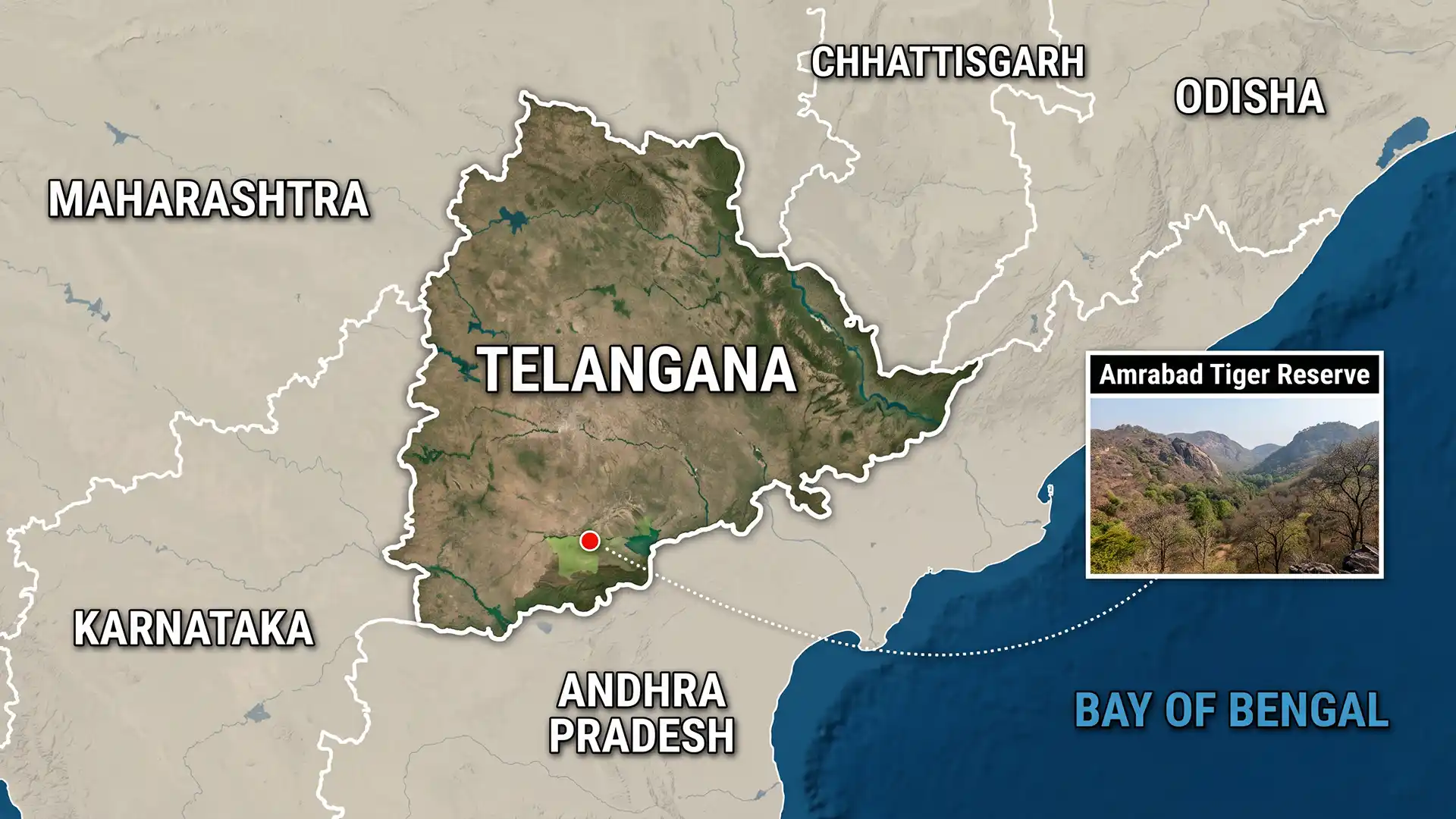
Conservationists have drawn attention to the Amrabad Tiger Reserve in Telangana as a critical habitat for tigers and tribal communities. Recent surveys and eco‑tourism projects emphasise its ecological importance and unique management challenges.
Background
Amrabad Tiger Reserve lies in the Nallamala Hills of Telangana’s Nagarkurnool and Nalgonda districts. It was notified as a wildlife sanctuary in 1983. After the division of Andhra Pradesh in 2014, it became a tiger reserve under Project Tiger. Covering about 2,611 square kilometres, it is one of the largest tiger reserves in India. The core area ranks second in size among Indian reserves, while the total area ranks sixth.
Key features
- The reserve encompasses rugged hills, deep valleys and gorges. Numerous perennial streams originate here and feed into the Krishna River, supporting large reservoirs such as Srisailam and Nagarjunasagar.
- It harbours the largest population of tigers in Telangana. The dense forests also shelter leopards, sloth bears, wild dogs, herbivores like sambar and chital, and a rich variety of birds and reptiles.
- The Chenchu tribe, a Particularly Vulnerable Tribal Group, lives within the reserve. Settlements range from isolated forest hamlets (pentas) to small villages on the periphery. Eco‑development programmes provide livelihood support and engage Chenchus as protection watchers.
- Visitors can access viewpoints such as Farahabad and Octopus View Point, waterfalls and the Akkamahadevi cave complex. Eco‑tourism activities are regulated to minimise disturbance.
- The reserve manages issues like forest fires, grassland maintenance, weed control and water conservation. It also runs a soft‑release programme for reintroducing mouse deer.
Conclusion
Amrabad Tiger Reserve exemplifies the delicate balance between wildlife conservation and tribal welfare. Protecting its expansive forest helps maintain river catchments and supports biodiversity in the Eastern Ghats. Continued community involvement and scientific management are essential for its future.
Source: TOI