

Why in news?
A recently noticed structure at Hyderabad’s Golconda Fort prompted claims about a hidden passage. The Archaeological Survey of India examined the opening and rejected the tunnel description. Its Hyderabad Circle identified a small rectangular chamber built with granite blocks. No continuing passage has been established. The finding matters because popular legends often surround the fortified city. Archaeological evidence must determine the structure’s age and purpose. Speculation should not become accepted history before a proper investigation.
Location and physical setting
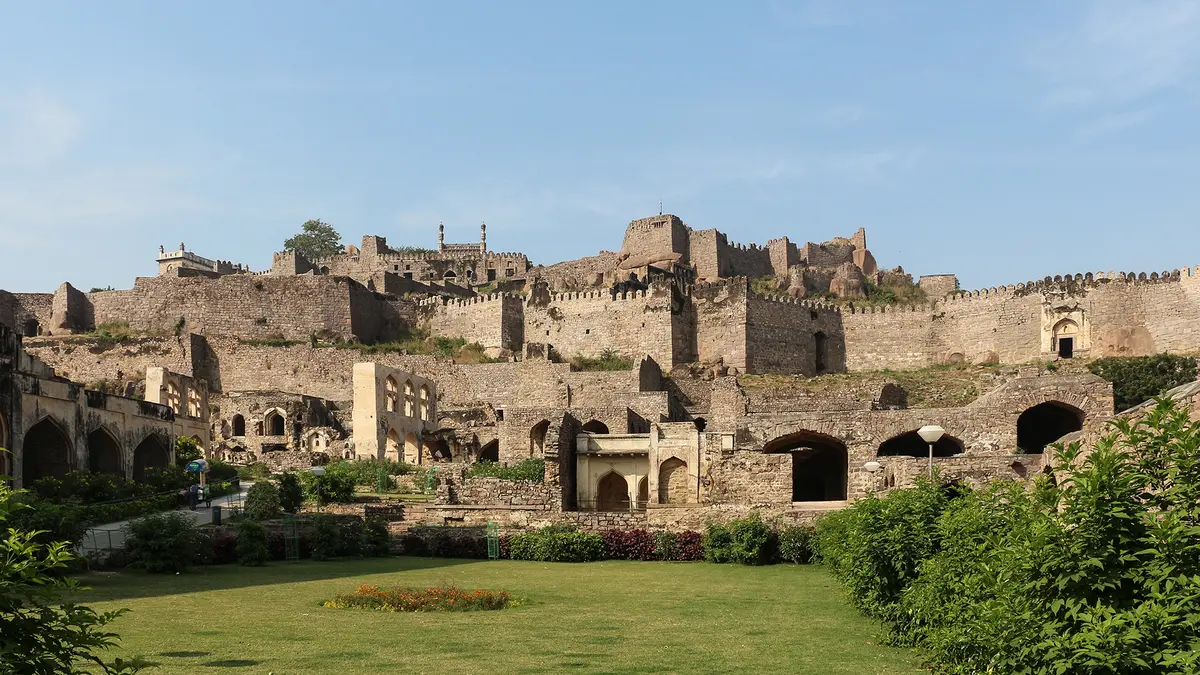
Golconda stands west of central Hyderabad in Telangana. The fort rises around a granite hill about 120 metres high. Massive walls and gateways extend across the surrounding rocky landscape. The elevated core offered defence and long views across the Deccan plateau. Granite outcrops also supplied durable material for fortifications, halls and water structures.
The site lies within the Musi River region, though it is not directly on the riverbank. Hyderabad later grew east of Golconda. Roads now surround much of the old defensive landscape. Urban growth increases visitor pressure and construction risk. Conservation must therefore consider both the monument and its setting.
Historical development of the fortified city
A Kakatiya fortification occupied the site during the medieval period. The Bahmani rulers later controlled it. Golconda became the capital of the Qutb Shahi dynasty during the sixteenth century. Those rulers expanded the stone fort, palaces, waterworks and outer city. They later founded Hyderabad while retaining Golconda’s political and military importance.
Mughal emperor Aurangzeb captured the fort in 1687 after a prolonged siege. The conquest ended the independent Qutb Shahi kingdom. Golconda had also become associated with diamond trade from mines across the wider region. Its name entered global commercial vocabulary. The fort therefore represents military, urban and economic history together.
Why tunnel stories remain popular
Large forts commonly attract stories about secret escape routes. Golconda’s complex levels, gates and underground spaces encourage such accounts. Some traditions describe passages towards Hyderabad landmarks. Repetition does not provide archaeological proof. A short chamber, drain or storage space can look like an unfinished tunnel when partly blocked.
The present structure should be documented before interpretation. Archaeologists can map its masonry, floor and relationship with nearby walls. Soil layers may reveal whether it was filled later. Mortar and construction style can support comparison with known phases. Excavation must proceed carefully because removing deposits also removes their original context.
What evidence could reveal
A chamber may have served storage, drainage, guard duty or another practical function. No purpose should be assigned without material evidence. Openings, ventilation, wear and associated objects can narrow possibilities. Historic plans and repair records may also help. Ground-penetrating radar can detect anomalies, but its signals still require expert interpretation.
Conservation begins with stability. Loose granite blocks or water seepage may threaten the opening. Investigators should protect visitors without permanently sealing useful evidence. Every intervention needs photographs, measured drawings and written records. Later researchers can then review the conclusion. Transparent documentation also reduces the space for sensational claims.
Legal and heritage status
Golconda Fort is a centrally protected monument under the Archaeological Survey of India. The Ancient Monuments and Archaeological Sites and Remains Act governs protection around such monuments. The fort also forms part of the Qutb Shahi Monuments proposal. India placed that group on the United Nations Educational, Scientific and Cultural Organization Tentative List in 2010.
A Tentative List entry is not a World Heritage inscription. It indicates possible future nomination. The group includes Golconda Fort, the Qutb Shahi Tombs and Charminar. Their shared history strengthens the case for coordinated management. Urban development, traffic and visitor facilities should not treat them as unrelated isolated buildings.
Why careful communication matters
Sensational labels can bring public attention, but they can also damage evidence. Visitors may enter unsafe spaces or disturb deposits. False certainty can become difficult to correct later. The Survey should release a concise technical note after study. Clear diagrams and photographs would help readers understand why experts rejected the tunnel claim.
Public curiosity can still support conservation. Local histories and oral traditions may guide research questions. They should be recorded without treating every story as fact. Archaeology works by testing claims against physical evidence. That method respects heritage more deeply than repeating an exciting but unsupported explanation.
No tunnel has been established
The Survey’s reported inspection found a small rectangular granite chamber. Its exact function remains undetermined. There is no verified continuing route to another Hyderabad monument. Until further evidence emerges, “secret tunnel” is a legend rather than an archaeological conclusion.
Conclusion
The Golconda discovery is valuable even without a hidden passage. A modest chamber can still reveal construction, defence or everyday life within the fort. Careful investigation should now establish its date and relationship with surrounding structures. Public reporting must separate evidence from folklore. That approach protects both visitor safety and the credibility of Hyderabad’s exceptional Deccan heritage.