Why in news?
Scientists and environmentalists have warned that light pollution is threatening the famously dark night skies of Chile’s Atacama Desert. Proposals for energy projects and the growth of nearby towns have raised concerns that unregulated lighting could diminish one of the world’s best windows to the universe.
Location and environment
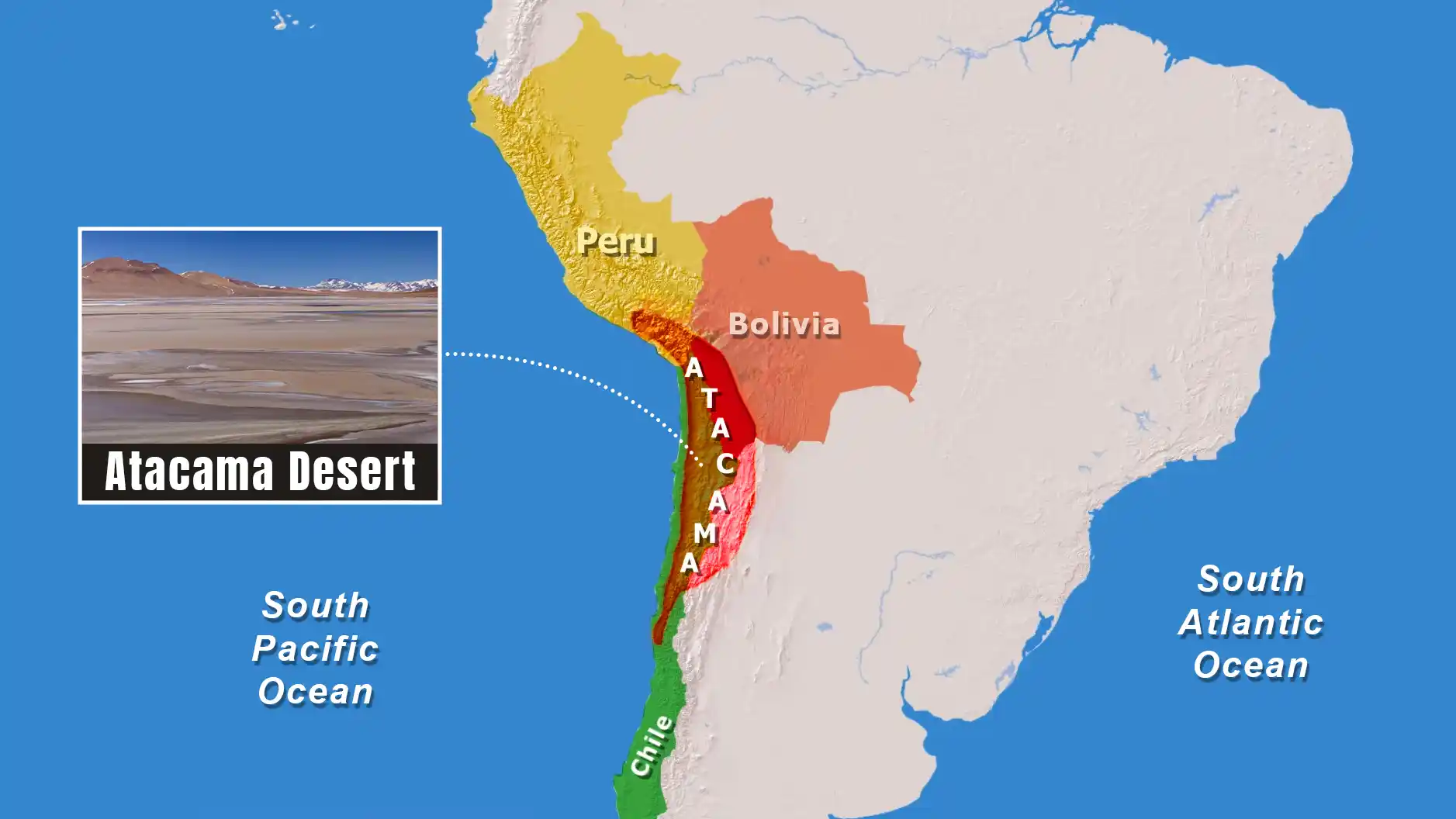
The Atacama Desert stretches along northern Chile, wedged between the Andes Mountains to the east and the Pacific Ocean to the west. Extending roughly 1,000 kilometres, it is often described as the driest place on Earth. Some areas receive less than 1 millimetre of rain per year; others have recorded no rainfall at all.
Despite its harsh conditions, the Atacama has relatively mild temperatures (around 18 °C on average) and clear skies. High altitude and isolation from cities mean there are more than 300 cloudless nights annually.
Astronomical significance
- Perfect dark skies: The combination of dry air, high elevation and absence of artificial light makes the Atacama an ideal site for observing the cosmos. Under its skies, the Milky Way and distant galaxies are visible to the naked eye.
- World‑class observatories: The desert hosts numerous observatories, including the European Southern Observatory’s Paranal Observatory and the future Extremely Large Telescope (ELT). These facilities attract astronomers worldwide and drive scientific discoveries.
- Tourism and education: Astrotourism has become an important economic activity. Visitors come to stargaze, and local communities offer guided tours and educational programmes.
Threats and responses
- Light pollution: Proposed renewable‑energy complexes and urban expansion near observatories could introduce stray light that obscures faint celestial objects. Scientists note that existing regulations are outdated and lack enforcement.
- Regulatory action: After protests from astronomers and Nobel laureates, a proposed power plant near the Paranal Observatory was cancelled in January 2026. Authorities are now reviewing and updating light‑pollution laws to protect designated astronomical zones.
- Conservation efforts: Organisations like the Cielos de Chile Foundation advocate strict lighting standards, shielded fixtures and community awareness to safeguard the desert’s night skies.
Additional facts
- Geology: The Atacama sits atop mineral‑rich rocks containing vast deposits of sodium nitrate. Historically, Chile exported this “Chile saltpetre” for fertilisers and explosives.
- Cultural heritage: The ancient Chinchorro culture of the Atacama performed some of the world’s earliest artificial mummification. Mummies over 7,000 years old have been unearthed here.
Conclusion
The Atacama Desert’s pristine night sky is a global treasure. Protecting it from light pollution will preserve scientific opportunities, cultural heritage and the awe‑inspiring experience of seeing an unspoilt cosmos.
Source: The Hindu