
Why in news?
Barren Island in the Andaman Sea continues to exhibit intermittent volcanic activity and remains the only confirmed active volcano in India and South Asia. Recent satellite reports from the Darwin Volcanic Ash Advisory Centre have recorded ash plumes and thermal anomalies from the volcano in early 2026, reminding researchers and travellers of this unique geological feature.
Background
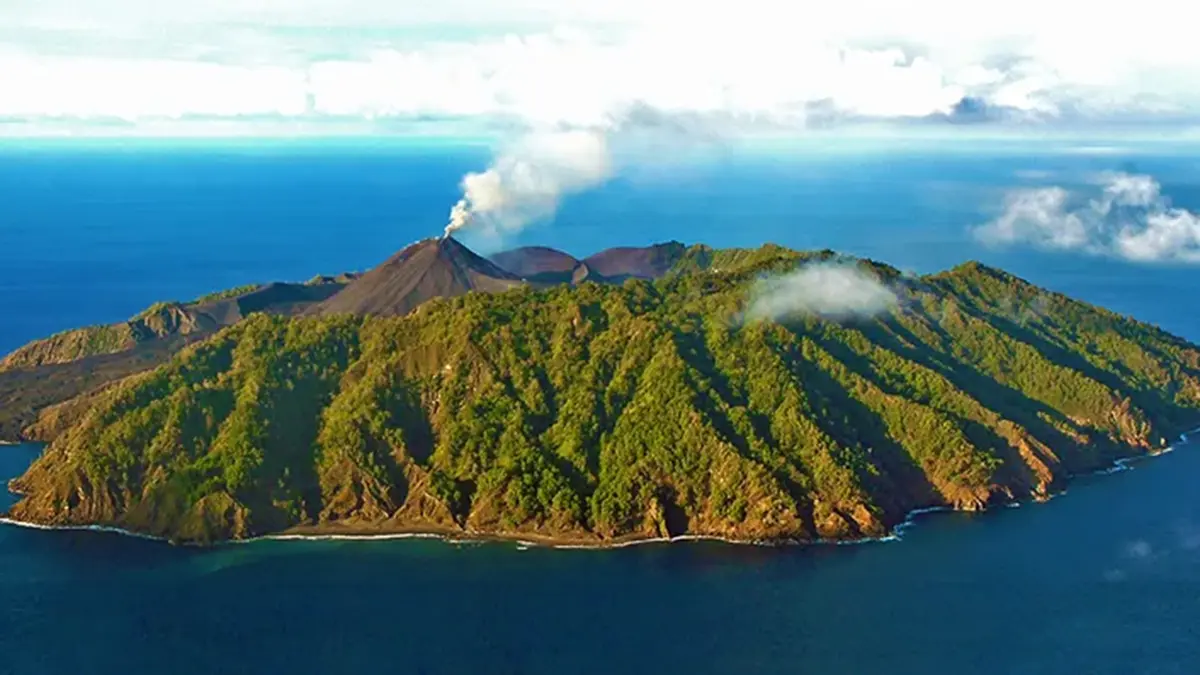
Barren Island is a small uninhabited island about 3 kilometres wide located roughly 138 kilometres northeast of Port Blair in the Andaman Sea. It is part of a north–south volcanic arc stretching from Sumatra to Myanmar. The island consists of a 1.6 kilometre‑wide caldera that opens to the west and contains a central pyroclastic cone. A major explosive eruption during the late Pleistocene carved out the caldera. Subsequent eruptions have built the cinder cone and sent lava flows spilling into the sea. The first recorded eruption occurred in 1787. The volcano was dormant for more than a century before awakening again in 1991 and has erupted sporadically since then.
Geological and ecological facts
- Active status: Barren Island is the only historically active volcano along the volcanic arc connecting Sumatra and Myanmar. Eruptions in 1991 and 1994–95 sent lava flows reaching the coast, and minor Strombolian activity has persisted into the 2020s.
- Height and structure: The island rises about 354 metres above sea level and 2 kilometres from the seafloor. Its 1.6 kilometre‑wide crater is partially filled by a scoria cone. Lava flows have built a plateau that slopes gently to the ocean.
- Formation: The volcano sits atop the boundary where the Indian Plate is subducting beneath the Burmese microplate. This subduction generates basaltic magma that feeds regular but moderately explosive eruptions.
- History of eruptions: After the 1787 eruption, sporadic activity was documented in 1789, 1795, 1803–04 and 1852. Following a 159‑year lull, the 1991 eruption lasted six months and damaged vegetation and animal life on the island. Further eruptions occurred in 1994–95, 2005–07, 2008–2010, 2013–14, 2017 and 2022. Two minor eruptions in September 2025 produced small ash plumes described as ‘minor’.
- Ecology: True to its name, much of Barren Island is devoid of vegetation, though hardy grasses and shrubs grow on the outer slopes. The island supports a small population of feral goats and is visited by seabirds. It falls within the Barren Island Wildlife Sanctuary, and access is restricted.
- Nearby volcanoes: Narcondam Island, about 140 km north‑north‑east, is a dormant volcanic cone within Indian territory. Other submarine volcanoes in the region remain below sea level but may emerge in the future.
Conclusion
Barren Island is a rare example of ongoing volcanism in the Indian subcontinent. Its periodic activity offers insights into subduction‑zone processes and poses minimal risk due to the island’s isolation. As the volcano continues to rumble, scientists will keep monitoring its ash emissions and lava flows to understand regional tectonics and protect nearby shipping routes and aircraft.