

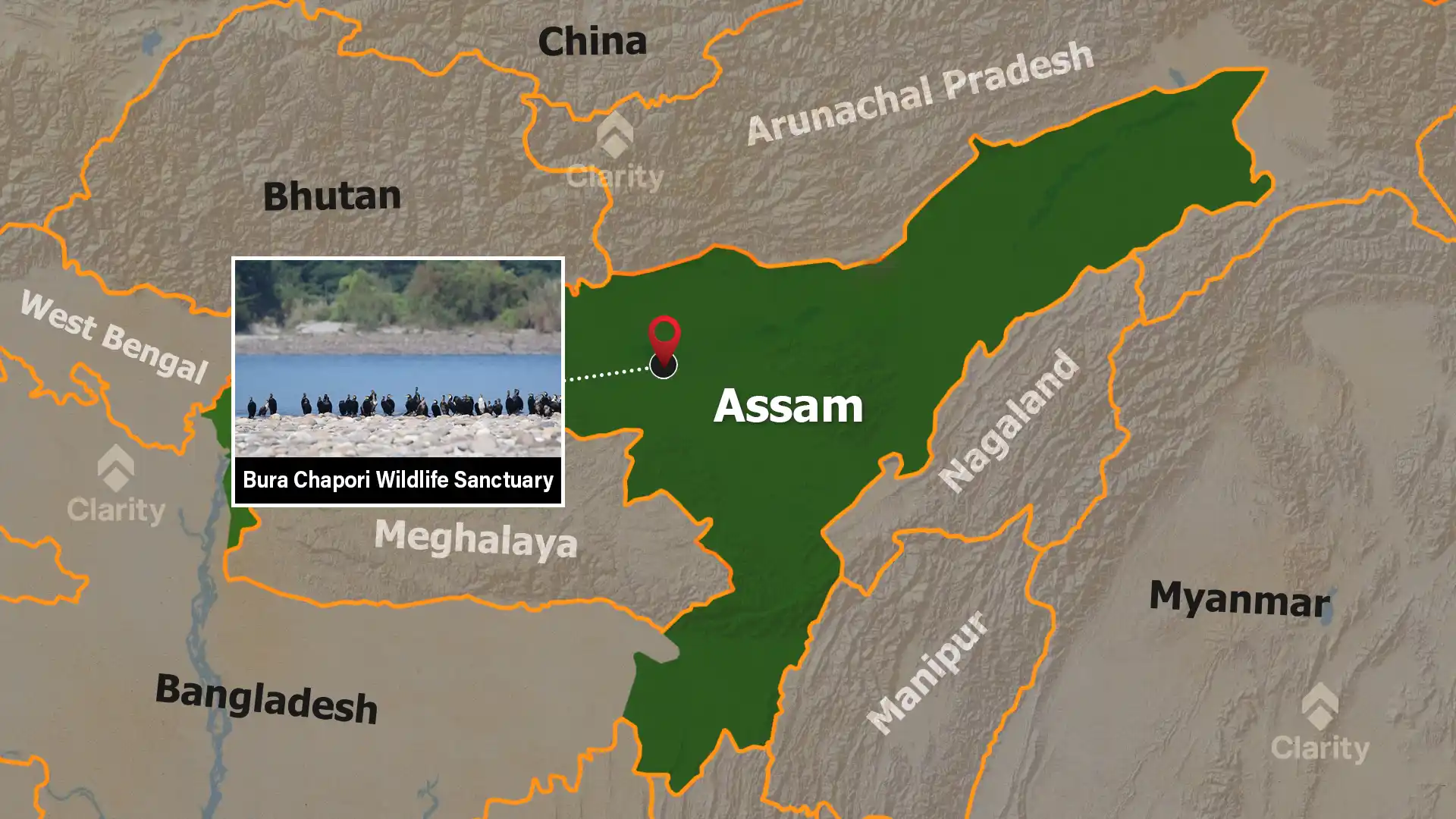
Why in news?
The Assam government announced in March 2026 that it would notify a new Burhachapori No. 5 Reserved Forest covering about 224 hectares adjacent to the existing Burha Chapori Wildlife Sanctuary. This compensatory afforestation is meant to offset forest land diverted for highways, energy pipelines, mining and other infrastructure projects. Authorities will settle land rights before formal notification.
Background
Burha Chapori (also spelt Burhachapori) Wildlife Sanctuary lies on the south bank of the Brahmaputra River in Assam’s Sonitpur district. It covers about 44.06 sq km and, together with neighbouring Laokhowa Wildlife Sanctuary, forms part of an ecological complex that acts as a buffer to the famous Kaziranga Tiger Reserve. The area was declared a reserved forest in 1974 and upgraded to a wildlife sanctuary in 1995.
Ecology and wildlife
- Habitats: The sanctuary comprises wet alluvial grasslands, riparian forests and semi‑evergreen woodland. Seasonal flooding by the Brahmaputra sustains lush grasses and wetlands.
- Fauna: It shelters the Greater one‑horned rhinoceros, tigers, leopards, wild buffalo, hog deer, wild pigs and elephants. The grasslands host endangered birds such as the Bengal florican, black‑necked stork, mallard, open‑billed stork, various teal species and whistling ducks.
- Medicinal herbs: The grasses and herbs of the floodplains are reputed to have medicinal properties and support local livelihoods.
About the new reserved forest
- Compensatory afforestation: Indian law requires that any diversion of forest land for non‑forest purposes be compensated by planting an equivalent area. The proposed Burhachapori No. 5 Reserved Forest will utilise an 830‑hectare riverbank transferred for such afforestation; about 224 hectares will be notified initially.
- Safeguarding connectivity: Adding the new forest near the sanctuary will enhance habitat connectivity for wildlife and provide an additional buffer against development pressures.
- Rights settlement: A forest settlement officer will investigate and compensate any customary land rights before the forest is formally notified.
Conclusion
The creation of a new reserved forest near Burha Chapori illustrates how compensatory afforestation can both comply with legal requirements and expand conservation areas. Long‑term success will depend on meaningful community engagement and strict protection of the new forest once notified.