

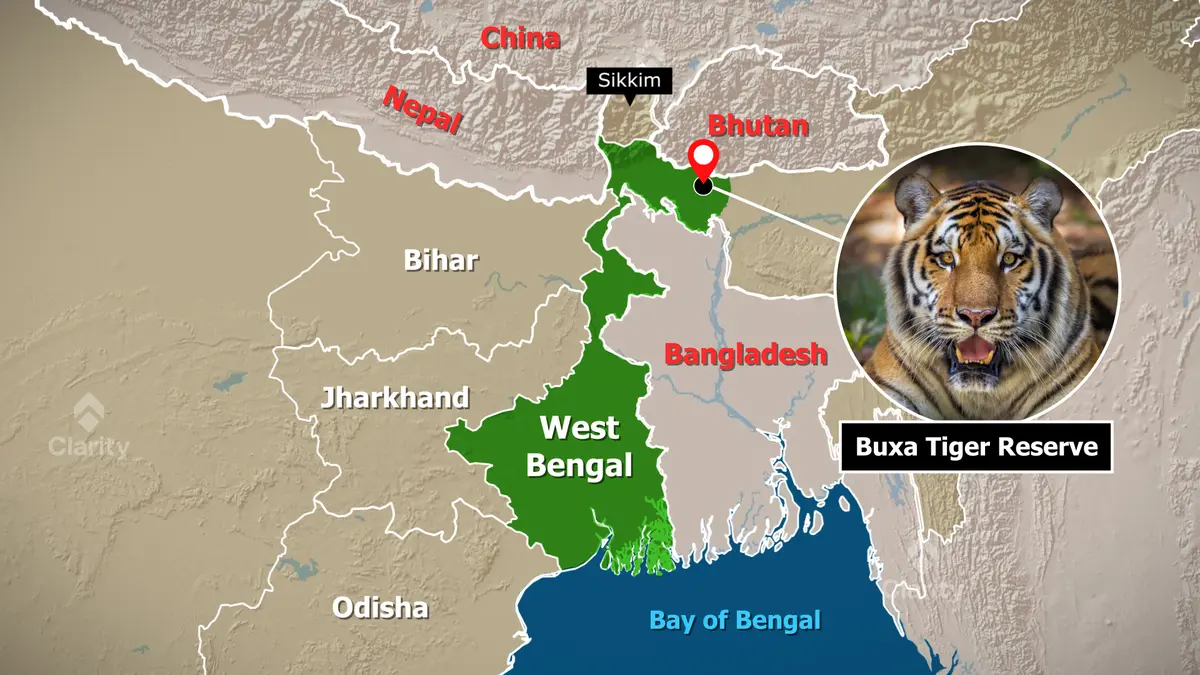
Why in news?
West Bengal was preparing to bring a tigress from Bihar’s Valmiki Tiger Reserve to Buxa in September 2026. On 13 September, The Times of India reported that a Sundarbans team had left to assist the capture operation. Buxa lies in northern West Bengal’s Alipurduar district, beside Bhutan and Assam. It forms part of a connected forest landscape, but rebuilding a breeding tiger population requires more than forest cover alone. The proposed transfer would move a wild female into a receiving habitat where managers seek to strengthen tiger recovery. Such a conservation translocation needs suitable prey, health checks, monitoring and arrangements for surrounding communities. The animal’s selection, transfer and release were still prospective in the dated reporting. Preparations should not be mistaken for a tigress already established and breeding in Buxa.
Locate the two reserves correctly
Buxa is in the eastern Himalayan foothill landscape of West Bengal. Bhutan lies along its northern side and Assam towards the east. National Tiger Conservation Authority material describes links with Bhutan’s forests, Assam’s Kochugaon forests and the wider Manas landscape. Towards the west, corridors connect it with the Jaldapara area.
Valmiki, the proposed source reserve, lies in north-western Bihar’s West Champaran district, adjoining Nepal. Its Himalayan foothill landscape includes the Gandak River and connections with Nepal’s Chitwan forests. It is not an adjoining section of Buxa. Moving an animal between these separate reserves therefore involves transport and adjustment risks, alongside the receiving habitat’s longer-term suitability.
A wildlife corridor is a usable connection between habitats, allowing animals to move across the wider landscape. It need not be a uniformly wide strip of untouched forest. Buxa’s links include areas influenced by tea estates and other land uses. A line joining two reserves on a map does not guarantee that every part remains safe to cross.
What Buxa’s habitat can support
The authority’s reserve profile describes moist tropical forests extending from plains into hills. Vegetation changes with altitude, soil and drainage. The landscape supports elephants, gaur, deer and several carnivores. Rivers and streams add further habitat variety. Tiger recovery is therefore one part of managing a diverse ecosystem, not the reserve’s only conservation purpose.
For a tiger, the presence and accessibility of prey matter as much as the appearance of dense vegetation. A receiving forest must support hunting, resting and movement over time. The conservation question is not simply whether there is enough room to release an animal. It is whether the animal can survive without creating unacceptable risks for itself or neighbouring people.
Choosing and moving an animal
The September report described coordination among Bengal teams, experts from the Wildlife Institute of India and national tiger authorities. The final tigress was to be chosen after assessment at Valmiki. That sequence matters: identifying possible animals is not the same as selecting one, and selection does not establish a successful transfer.
The International Union for Conservation of Nature defines conservation translocation around a measurable conservation benefit. Its guidance requires assessment of habitat, biological suitability, disease and other risks. Taking an animal from a source population also needs justification. Helping one reserve should not be assumed harmless to the population supplying the animal.
Health assessment protects both the transported animal and wildlife at the destination. Monitoring must be planned before release, including what observations would demonstrate progress or reveal problems. Managers also need resources to respond when outcomes differ from expectations. A transport operation can finish successfully while the longer conservation project remains uncertain.
Why neighbouring communities matter
A Press Trust of India report on 7 September described a survey around Buxa that found support alongside safety concerns. Those findings were attributed to the organisation conducting the survey, not presented as a vote by every resident. They nonetheless identify a practical issue: enthusiasm for wildlife recovery can coexist with concern about livestock, movement and personal safety.
Buxa’s official management profile already recognises the importance of surrounding villages, tea gardens and human–wildlife interactions. Community cooperation cannot be reduced to an awareness meeting after an animal arrives. People need clear contacts and workable responses to incidents. Livelihood needs and forest use also belong within the management discussion rather than outside it.
What would count as recovery?
A release is an action; a self-sustaining population is an outcome. Survival, suitable movements and eventual reproduction would provide different kinds of evidence. Managers would also need to understand changes in prey and conflict. One successful transfer cannot establish all of these results, just as an isolated sighting cannot by itself establish a breeding population.
Conclusion
The planned Valmiki-to-Buxa transfer is a step towards tiger recovery, with the decisive work extending beyond capture and transport. Habitat connections, prey, animal health and community arrangements must function together. The meaningful test will be how the tigress fares after release and whether the wider landscape can support recovery over successive years.