

Why in news?
Recent official reports highlighted rising use of India’s central grievance platform; they also reported faster disposal and new artificial-intelligence tools. Central ministries redressed 1,78,423 grievances during May 2026. Their average disposal time during 2026 was 13 days.
How the system works
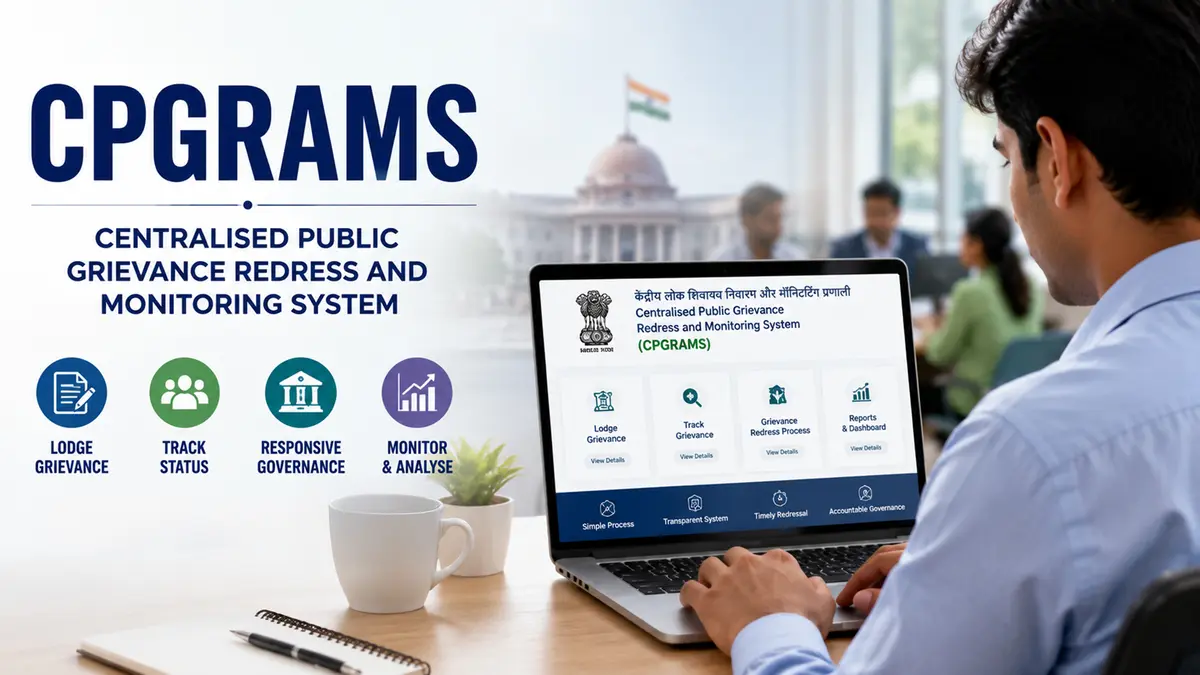
CPGRAMS provides one online gateway for complaints about public services. The Department of Administrative Reforms and Public Grievances manages the platform. Its online form routes complaints to participating ministries and departments.
Citizens can track a registration number and receive the department’s response; an appeal facility allows further review after unsatisfactory disposal.
The platform has evolved since 2007; it now connects central bodies, States, Union Territories and many Common Service Centres.
Common Service Centres give assisted access to people lacking devices or digital confidence. That link is essential for inclusion.
Recent reforms
Government guidelines prescribe a 21-day resolution timeline. Cases needing longer examination should carry an interim reply with reasons. Monthly performance reports compare departments on disposal, pendency and grievance quality; a review module supports meetings led by senior officials.
A feedback call centre asks citizens about completed cases; it can flag poor responses for further attention.
In May, the centre collected 78,830 responses across central and state cases. Such feedback can reveal the difference between closure and satisfaction.
Samadhan Didi, an artificial-intelligence voice assistant, launched on 30 May. Its intended role is easier guidance through the grievance process. The department also uses semantic analysis to group similar complaints. Pattern detection can reveal systemic failures hidden across thousands of individual cases.
Disposal is not the same as resolution
A dashboard may count a case as disposed after a reply; the citizen may still lack the promised service. Quality therefore depends on a reasoned and specific response. A department should address the complaint rather than send a standard template.
Appeals provide an important correction. Yet a high appeal rate may also indicate weak first-stage decisions.
Performance rankings can improve attention, but they can also create incentives for rapid closure. Independent audits should examine random case samples.
Useful measures include repeat complaints, reopened cases and satisfaction after appeal. Time alone cannot capture administrative fairness.
Technology opportunities and risks
Language tools can make the portal easier for diverse users. Voice access may help people who struggle with written forms. Automated clustering can identify recurring failures in pensions, telecom services or public distribution. Departments can then fix processes, not only individual files.
However, algorithms may misclassify local language or urgent hardship; every automated recommendation needs human responsibility and an escalation path.
Complaints can contain health, identity or financial information. Data minimisation and secure access are therefore necessary.
The platform should clearly explain data use and retention. Citizens should not fear retaliation for raising legitimate complaints.
Federal and inclusion challenges
Central and state reports show different workloads and institutional capacities. A uniform portal does not guarantee uniform remedies. In May, States and Union Territories received 85,900 cases and redressed 84,365. Their combined pendency remained above two lakh.
Last-mile access also varies. Common Service Centres help, but assisted filing must remain affordable and confidential.
A well-designed system should transfer misdirected complaints instead of rejecting them. Citizens cannot always know the correct administrative tier.
Conclusion
CPGRAMS has created a valuable national channel for administrative accountability. Faster disposal and wider access are genuine achievements; its next standard must be trustworthy resolution. Data, appeals and feedback should drive service reform rather than merely improve closure numbers.