
Why in news?
Wildfires in southern Crete forced large evacuations from settlements and tourist areas during late July 2026.
Reports placed the evacuation total near 8,000 as authorities repeatedly widened their orders.
Two firefighters died near Krya Vrysi, while another died during a separate Peloponnese fire.
Strong winds complicated firefighting, so early casualty and evacuation figures remained provisional.
Background
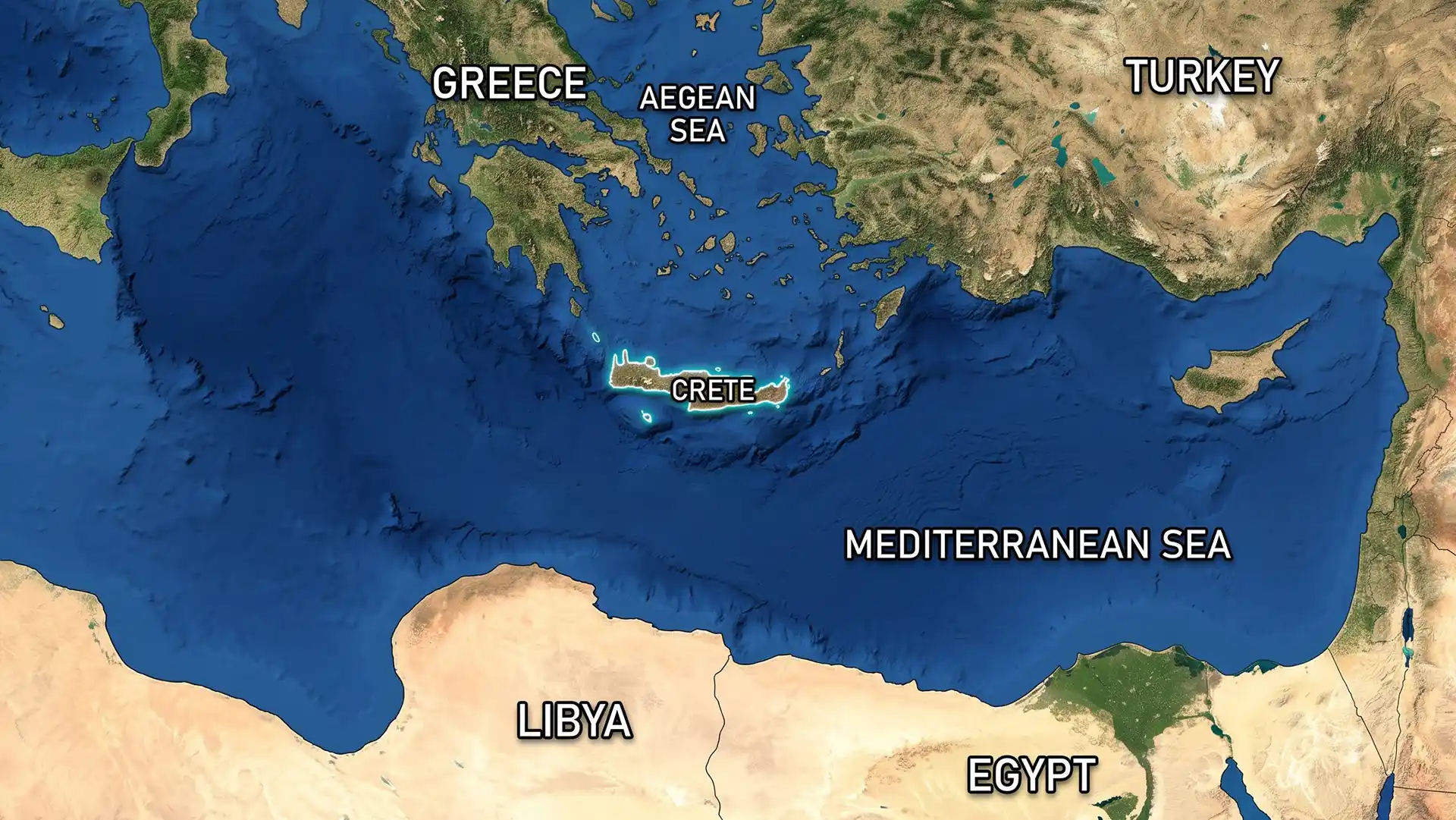
Crete is Greece's largest island and the Mediterranean Sea's fifth-largest island.
It lies around 160 kilometres south of mainland Greece, near the Aegean Sea's southern boundary.
The island covers about 8,336 square kilometres and extends approximately 260 kilometres from west to east.
Location and physical geography
- The Sea of Crete lies north, while the Libyan Sea lies south.
- The Myrtoan Sea borders western approaches, while the Carpathian Sea lies east.
- Heraklion is the administrative capital and the island's largest urban centre.
- Mountain ranges include the White Mountains, Mount Ida and the Dikti Mountains.
- Mount Ida, also called Psiloritis, forms the island's highest point.
- Crete contains deep gorges, fertile plains, coastal settlements and important Mediterranean ecosystems.
Historical importance
Crete supported the Minoan civilisation, which flourished during the Bronze Age.
Knossos, Phaistos, Malia and Zakros became important palatial centres within that civilisation.
The Minoan decline resulted from several interacting causes, not one proven earthquake.
Scholars examine volcanic disruption, regional instability and later Mycenaean influence together.
Rome annexed Crete during the first century before the Common Era.
Byzantine, Arab, Venetian and Ottoman administrations later controlled the strategically placed island.
Crete formally united with Greece on 1 December 1913 after prolonged political struggles.
German forces occupied the island after the Battle of Crete during the Second World War.
What happened during the July fires?
Fast-moving fires affected areas around Agia Galini and neighbouring communities in south-central Crete.
Authorities moved residents and visitors from hotels, villages and exposed coastal zones.
More than 200 firefighters participated as aircraft supported operations whenever wind conditions permitted.
Reports later confirmed two firefighter deaths near Krya Vrysi in Crete.
A third firefighter died during another blaze in the Peloponnese, outside Crete.
Why Mediterranean islands face severe fire risk
- Hot, dry summers reduce vegetation moisture and increase fuel flammability.
- Strong winds accelerate flames, carry embers and obstruct aircraft operations.
- Steep terrain can restrict access for vehicles and ground crews.
- Scattered settlements and seasonal tourism complicate rapid evacuation planning.
- Longer heatwaves can lengthen the regional fire season and strain responders.
Conclusion
Crete combines strategic geography and deep history, while its fires demonstrate rising Mediterranean climate risks.