

Why in news?
According to a Reuters report on 21 February 2026, Cuban security advisers and doctors have been leaving Venezuela as that country’s interim government faces strong pressure from the United States to unwind its alliance with Havana. The news has revived interest in Cuba’s political relationships and its geographic setting.
Background
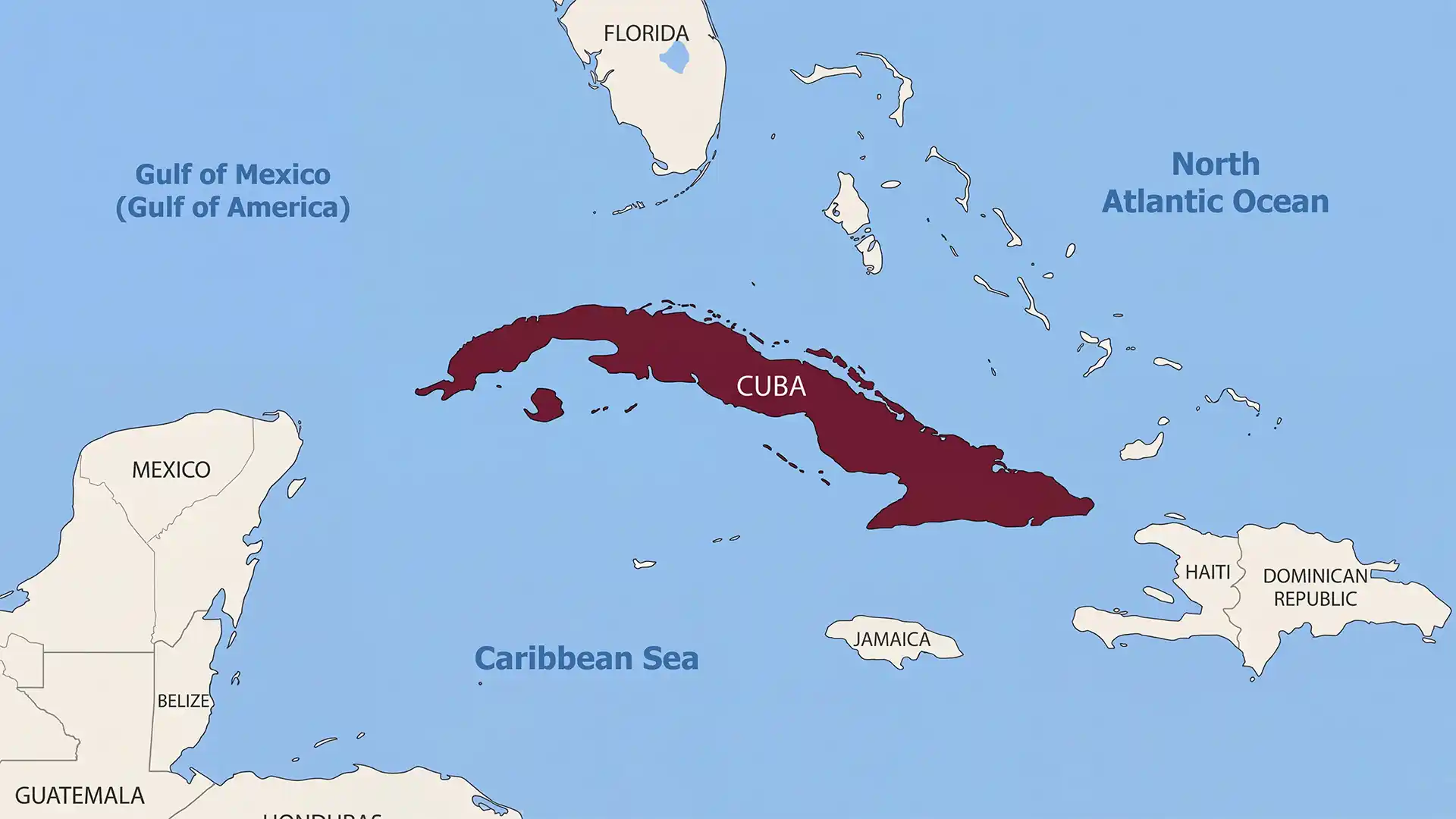
Cuba is the largest island country in the Caribbean and lies at the confluence of the Atlantic Ocean, the Caribbean Sea and the Gulf of Mexico. The main island of Cuba stretches roughly 1,250 km from east to west and is relatively narrow, averaging about 100 km in width. Several archipelagos made up of hundreds of small islands and cays ring its coastline. Isla de la Juventud (“Isle of Youth”) is the second largest Cuban island.
Geography and environment
- Location and neighbours: Cuba lies east of Mexico’s Yucatán Peninsula, south of the U.S. state of Florida and the Bahamas, west of Hispaniola (Haiti and the Dominican Republic) and north of Jamaica and the Cayman Islands. It is surrounded by the Atlantic Ocean, the Cayman Trench, the Gulf of Mexico, the Straits of Florida and the Caribbean Sea.
- Topography: The island is mostly flat to rolling, with mountain ranges along the coasts. The Sierra Maestra in the south rises sharply from the coast and includes Pico Turquino (1,999 m), the country’s highest peak. Other ranges include the Sierra Cristal and Escambray Mountains.
- Water bodies: Cuba has few large inland lakes; the largest natural lagoon is Laguna de Leche (67.2 sq km). The country’s longest river, the Cauto, flows 370 km across the southeast before reaching the Caribbean Sea.
- Climate and biodiversity: Cuba experiences a tropical climate moderated by trade winds. Its diverse ecosystems — from wetlands to mountains — support endemic species such as the Cuban crocodile and the bee hummingbird.
Political and economic context
- Population and capital: Cuba’s estimated population in 2026 is about 9.3 million people. Havana, located on the northern coast, serves as the capital, largest city and main port.
- Historical overview: Originally inhabited by Taino peoples, Cuba was colonised by Spain in the 16th century and became a major sugar producer. After a long struggle, it achieved independence from Spain in 1898. The Cuban Revolution of 1959 led to the establishment of a socialist state under Fidel Castro. The country has since experienced economic isolation due to U.S. sanctions but maintains strong cultural identity.
- Current developments: The reported withdrawal of Cuban personnel from Venezuela suggests that Havana may be recalibrating its foreign alliances amid U.S. pressure. Cuba continues to rely on tourism, sugar, tobacco and nickel exports, while also expanding renewable energy and biotechnology sectors.
Conclusion
Cuba’s strategic location and rich cultural heritage make it a key player in Caribbean geopolitics. Understanding its geography and history provides context for current events, including shifts in international alliances.
Sources: Devdiscourse